Specialised Cells and Stem Cells (OCR A-Level Biology A): Revision Notes
📚Revision Notes
Specialised Cells and Stem Cells
Specialised cells
Cells become specialised through a process called differentiation, where they develop specific structures and functions suited to particular roles. Red blood cells, for instance, differentiate to transport oxygen efficiently, while neutrophils become adapted for immune defence against pathogens.
Note
Differentiation is essential for multicellular organisms to function. While all cells in an organism contain the same genetic information, differentiation allows cells to express only the genes needed for their specific role, creating the diversity of cell types required for complex biological processes.
Animal specialised cells
Sperm cells
Sperm cells show several structural adaptations for fertilisation:
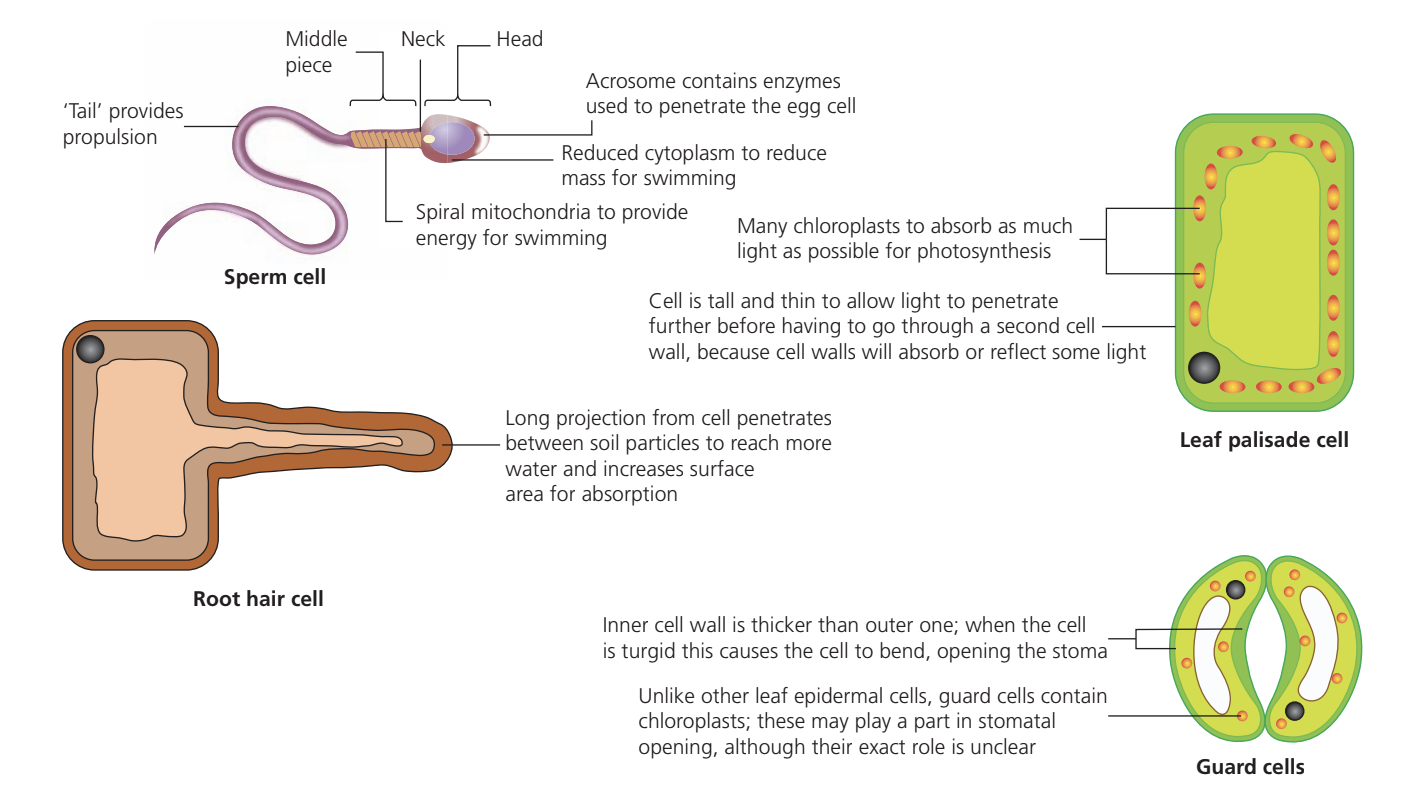
- Acrosome: Contains digestive enzymes that break down the outer layer of the egg cell, enabling penetration during fertilisation.
- Reduced cytoplasm: Minimises the cell's mass, making swimming more efficient.
- Spiral mitochondria: Arranged in the middle piece, these organelles generate ATP through aerobic respiration to power the tail's movement.
- Tail (flagellum): Provides propulsion through a whip-like motion, allowing the sperm to swim towards the egg.
The sperm cell's streamlined shape and energy-efficient design maximise its chances of reaching and fertilising an egg cell.
Plant specialised cells
Root hair cells
Root hair cells are found in the epidermis of plant roots and are specialised for water and mineral absorption:
- Long projection: Extends from the cell body deep between soil particles, increasing the surface area available for absorption.
- Increased surface area: The hair-like extension dramatically increases the surface area-to-volume ratio, enhancing the rate of water uptake by osmosis and mineral ion absorption by active transport.
- Thin cell wall: Reduces the distance for diffusion of water and dissolved minerals into the cell.
Note
Root hair cells are short-lived (typically - weeks) but are constantly replaced as the root grows through the soil. This continuous renewal ensures the plant maintains efficient absorption capacity as it grows.
Important
Water uptake occurs by osmosis (passive movement down a concentration gradient), while mineral ions are absorbed by active transport (requiring ATP energy to move against concentration gradients). This is why root cells contain many mitochondria.
Leaf palisade cells
Palisade cells are located in the upper mesophyll layer of leaves and are optimised for photosynthesis:
- Numerous chloroplasts: Positioned around the cell periphery to absorb maximum light energy for photosynthesis. Each cell may contain - chloroplasts.
- Tall, cylindrical shape: This elongated structure allows light to penetrate deeper into the leaf tissue before encountering a second cell wall, which would otherwise absorb or reflect light.
- Positioned near leaf surface: Located in the upper mesophyll layer, these cells receive the most intense light.
The arrangement and structure of palisade cells maximise light absorption whilst minimising light loss through reflection or absorption by cell walls.
Guard cells
Guard cells work in pairs to control gas exchange through stomata (pores in the leaf epidermis):
- Uneven cell wall thickness: The inner wall (facing the stoma) is thicker than the outer wall. When the cell becomes turgid (full of water), this unequal thickness causes the cell to bend, opening the stoma.
- Contain chloroplasts: Unlike other epidermal cells, guard cells possess chloroplasts. These may contribute to stomatal opening through photosynthesis, though their exact role remains unclear.
- Kidney-shaped structure: This curved shape enables the cells to change the size of the stomatal opening efficiently.
Important
Guard cells respond to environmental conditions (light, water availability, concentration) by controlling stomatal aperture, balancing gas exchange for photosynthesis with water loss through transpiration. This balance is critical for plant survival – too much water loss can lead to wilting, whilst insufficient gas exchange limits photosynthesis.
Stem cells
Stem cells are undifferentiated cells capable of dividing to produce more stem cells (self-renewal) or differentiating into specialised cell types. They are classified according to their potency – the range of cell types they can produce.
Classification of stem cells
| Type | Definition and characteristics |
|---|---|
| Totipotent | Can differentiate into any body cell type and extra-embryonic tissues (placenta and umbilical cord). Only the zygote and cells from the very early embryo (first few divisions) are totipotent. |
| Pluripotent | Can form any type of body cell but cannot produce extra-embryonic tissues. Embryonic stem cells (after the first couple of zygote divisions) are pluripotent. |
| Multipotent | Can differentiate into multiple cell types, but not all types. Adult stem cells, such as those in bone marrow, are multipotent and typically produce cells related to their tissue of origin. |
Important
The potency of stem cells decreases as the embryo develops, with totipotent cells only existing in the earliest stages of development. This progressive restriction in developmental potential reflects the increasing commitment of cells to specific lineages as the organism develops.
Stem cells in medicine
Induced differentiation
Scientists can now induce stem cells to differentiate into specific cell types by carefully controlling the culture conditions. Factors that influence differentiation include:
- Growth factors and signalling molecules added to the culture medium
- Physical environment (substrate stiffness, oxygen levels)
- Co-culture with other cell types
This ability to direct stem cell differentiation opens significant therapeutic possibilities.
Advantages of stem cell therapy
Important
Reduced rejection risk: If a patient's own stem cells can be harvested, differentiated, and transplanted back, the immune system recognises these cells as 'self', greatly reducing the risk of transplant rejection. This eliminates or reduces the need for immunosuppressive drugs.
Medical applications under research
Current research investigates stem cell treatments for numerous conditions:
Neurological conditions:
- Alzheimer's disease: Developing nerve cells to repair neurological damage. However, the widespread nature of brain damage in dementia presents challenges for targeted cell replacement.
- Parkinson's disease: Replacing dopamine-producing neurons that die in patients with this condition. Loss of these cells causes movement problems including tremor, rigidity, and bradykinesia (slowness of movement).
- Spinal cord injuries: Introducing stem cells at injury sites to promote nerve regeneration and repair.
Sensory disorders:
- Age-related macular degeneration: Growing retinal cells to treat this common cause of vision loss in people over years old.
Metabolic and organ conditions:
- Type 1 diabetes: Protecting or replacing pancreatic beta cells that produce insulin in newly diagnosed patients.
- Heart disease: Repairing cardiac tissue damaged by myocardial infarction (heart attack).
- Chronic obstructive pulmonary disease (COPD): Regenerating damaged lung tissue.
Blood disorders:
- Sickle cell disease and other haematological conditions: Using bone marrow stem cells to treat various blood diseases. Bone marrow transplants are already an established treatment for leukaemia and other blood cancers.
Note
The diversity of conditions being researched highlights the versatility of stem cell therapy. However, most of these treatments remain experimental, requiring extensive testing to ensure safety and efficacy before becoming widely available.
Research applications
Beyond therapy, stem cells are valuable for studying developmental biology – understanding how a single fertilised egg develops into a complete organism. Such research provides insights into:
- Normal cellular behaviour and differentiation pathways
- How developmental problems arise
- Mechanisms of gene expression and regulation
- Disease modelling in laboratory conditions
Case study: Parkinson's disease research
Parkinson's disease is a progressive neurodegenerative disorder affecting the central nervous system. It impairs movement and speech due to insufficient production of dopamine, a cell-signalling molecule.
Example
Research Study: Testing Stem Cell Treatment for Parkinson's Disease
Experimental approach: Researchers investigated whether human adult stem cells from the endometrium (uterine lining) could differentiate in vitro (outside a living organism) into dopamine-producing neurons.
Method:
- Mice received injections of a neurotoxin that specifically destroys dopamine-secreting cells, inducing Parkinson's-like symptoms
- Mice were divided into three groups:
- Group A: Neurotoxin + stem cell transplant
- Group B: Neurotoxin only (no treatment)
- Group C: Control (no neurotoxin, no treatment)
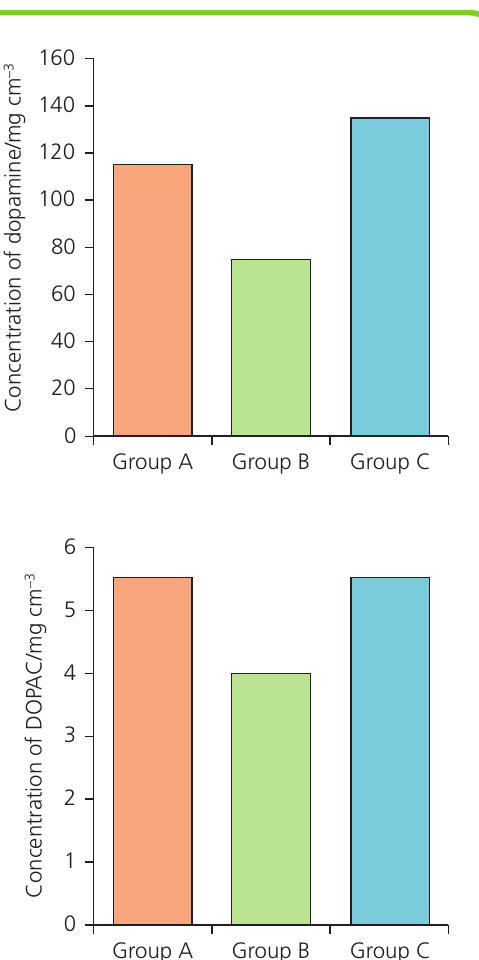
Measurements: After five weeks, researchers measured brain concentrations of:
- Dopamine: The signalling molecule itself
- DOPAC: A breakdown product of dopamine (measuring DOPAC provides evidence that dopamine was actually produced and metabolised)
Key findings:
- Group B (neurotoxin only) showed the lowest dopamine concentration (~), confirming the neurotoxin's effect
- Group A (stem cell treatment) showed intermediate dopamine levels (~), higher than Group B
- Group C (control) showed the highest dopamine concentration (~), representing normal levels
- DOPAC concentrations in Groups A and C were similar (~), both higher than Group B (~)
Interpretation: The results suggest that transplanted stem cells can differentiate into functional dopamine-producing neurons and partially restore dopamine levels in mice with induced Parkinson's disease. The similarity in DOPAC levels between treated mice (Group A) and controls (Group C) indicates active dopamine metabolism.
Further research needed:
- Long-term survival and function of differentiated cells (beyond five weeks)
- Assessment of symptom improvement in treated animals
- Safety testing to ensure stem cells do not form tumours
- Clinical trials in human volunteers
Ethical considerations
The use of embryonic stem cells raises significant ethical concerns:
Arguments supporting embryonic stem cell research:
- Embryos used are surplus from in vitro fertilisation (IVF) treatment and would otherwise be destroyed
- Potential to alleviate human suffering from serious diseases
- Research advances understanding of human development
- Strict regulations govern their use in most countries
Ethical objections:
- Embryos have the potential to develop into human beings
- Some people believe life begins at fertilisation, making embryo destruction morally equivalent to taking human life
- Religious and philosophical views on the sanctity of human life
- Concerns about commodification of human life
Important
The debate balances the potential medical benefits against deeply held moral and religious beliefs about when human life begins and the status of early embryos. This is not a simple scientific question but involves fundamental values about human life and personhood.
Alternative approaches: Research into adult stem cells and induced pluripotent stem cells (iPSCs) – adult cells reprogrammed to behave like embryonic stem cells – may address some ethical concerns whilst maintaining therapeutic potential.
Remember!
Summary
Key Points to Remember:
-
Specialised cells have specific structural adaptations that suit them to particular functions – sperm cells are streamlined for swimming, palisade cells are packed with chloroplasts for photosynthesis, and root hair cells have large surface areas for absorption.
-
Stem cells are classified by potency: totipotent cells can form any cell type including extra-embryonic tissues, pluripotent cells can form any body cell, and multipotent cells can form several related cell types.
-
Stem cells can be induced to differentiate into specific cell types under controlled conditions, offering potential treatments for conditions including Parkinson's disease, diabetes, heart disease, and spinal injuries.
-
Using a patient's own stem cells for treatment reduces the risk of immune rejection, potentially eliminating the need for immunosuppressive drugs.
-
The use of embryonic stem cells is controversial due to ethical concerns about the status of human embryos, though these cells offer greater differentiation potential than adult stem cells.