Carbohydrates (OCR A-Level Biology A): Revision Notes
📚Revision Notes
Carbohydrates
Introduction to carbohydrates
Carbohydrates are organic molecules that form a large proportion of compounds in living cells. They serve three main functions: as energy sources (e.g. glucose in respiration), as energy stores (e.g. glycogen in animals, starch in plants), and as structural components (e.g. cellulose in plant cell walls).
Key features of carbohydrates:
- All carbohydrates contain the elements carbon (C), hydrogen (H) and oxygen (O)
- The ratio of hydrogen to oxygen atoms is always (same as in water)
- Most carbohydrates follow the general formula
- The name 'carbohydrate' literally means "hydrated carbon"
Note
The general formula shows why carbohydrates are called "hydrated carbon" - they appear to be carbon atoms with water molecules attached. However, carbohydrates are not actually made of carbon and water; the formula simply reflects the ratio of elements present.
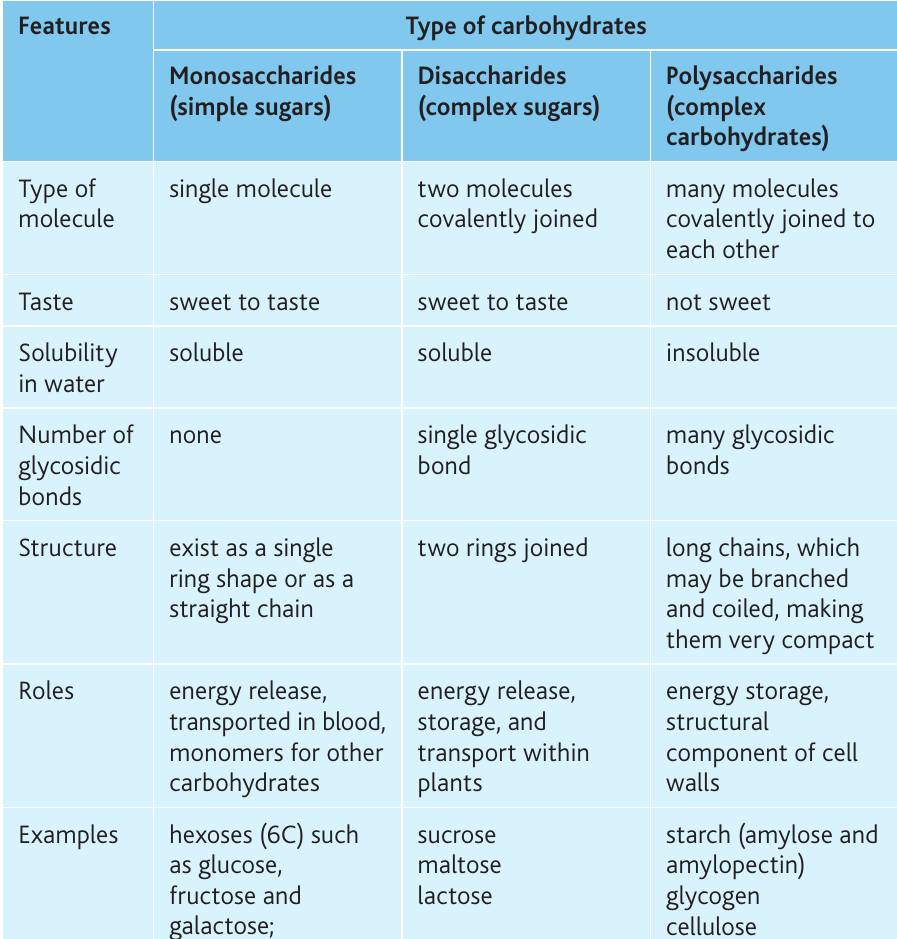
Monosaccharides
Monosaccharides are the simplest carbohydrates, consisting of single sugar molecules. They are often called simple sugars due to their small molecular size.
Properties of monosaccharides
- Small molecules that can easily pass through cell membranes
- Soluble in water, allowing transport in aqueous solutions
- Sweet-tasting
- Contain no glycosidic bonds (they are single units)
- Can exist as either ring structures or straight chains
- Serve as monomers (building blocks) for larger carbohydrates
Important
Monosaccharides are the only carbohydrates that can be directly absorbed into the bloodstream from the digestive system. All disaccharides and polysaccharides must first be broken down into monosaccharides before they can be absorbed and used by cells.
Glucose
Glucose is the most important monosaccharide in biology. It is a hexose sugar containing six carbon atoms.
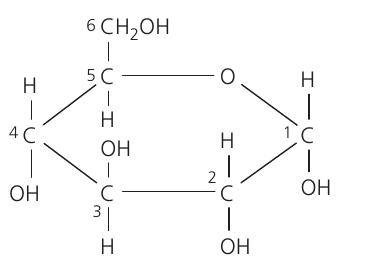
Functions of glucose:
- Main respiratory substrate - broken down during cell respiration to release energy
- Synthesised by plants during photosynthesis
- Transported in the blood of animals
- Building block for disaccharides and polysaccharides
Cell respiration is a process involving many enzyme-catalysed reactions within cells that release energy, which is used to make adenosine triphosphate (ATP).
Alpha and beta glucose (isomers)
Glucose exists in two structural forms: α-glucose and β-glucose. These are isomers - molecules with the same molecular formula but different structural arrangements.
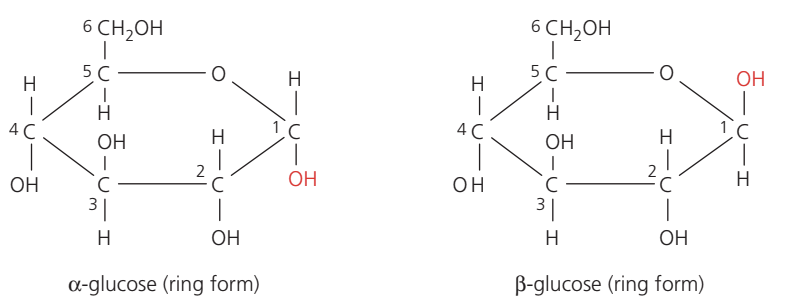
The difference between these two forms lies in the position of the hydroxyl group () and hydrogen () on carbon 1 ():
- In α-glucose: the group on is below the ring plane
- In β-glucose: the group on is above the ring plane
Important
"Alpha Down, Beta Up" Mnemonic
This seemingly small structural difference has major consequences:
- It affects how glucose molecules join together
- It determines the properties of the polymers formed from them
- Most organisms can only digest polymers of α-glucose (like starch) because they lack enzymes to break down polymers of β-glucose (like cellulose)
The inability to digest cellulose is why humans cannot obtain energy from eating grass or wood, even though these materials are made of glucose molecules!
Other monosaccharides
Pentose sugars contain five carbon atoms and play important roles in nucleic acids:
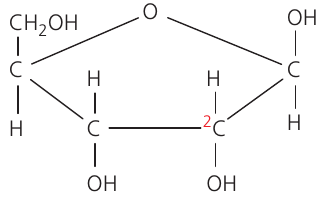
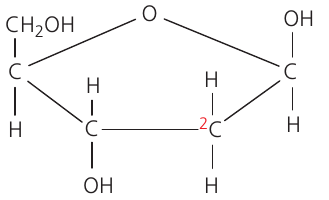
- Ribose (): component of RNA molecules and ATP
- Deoxyribose (): component of DNA molecules (note the loss of one oxygen atom at carbon 2)
Triose sugars contain three carbon atoms:
- Glyceraldehyde and other trioses are important intermediate molecules in respiration and photosynthesis
Note
The naming of monosaccharides follows a pattern based on the number of carbon atoms:
- Triose = 3 carbons
- Pentose = 5 carbons
- Hexose = 6 carbons
This makes it easy to determine the basic structure of a sugar just from its name.
Disaccharides
Disaccharides are carbohydrates formed when two monosaccharides join together. They are sometimes called complex sugars.
Formation of disaccharides
Disaccharides form through a condensation reaction:
- Two monosaccharides come together
- A molecule of water () is removed
- A covalent bond called a glycosidic bond forms between the two sugars
A glycosidic bond is a covalent bond that joins two carbohydrate molecules through a condensation reaction.
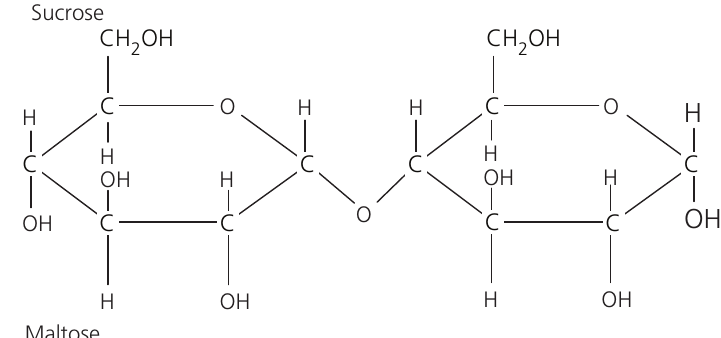
When two α-glucose molecules join:
- The bond forms between of one glucose and of the other
- This creates a 1,4-glycosidic bond
- The disaccharide maltose is formed
Example
Worked Example: Formation of Maltose
Starting materials:
- 2 molecules of α-glucose:
Process:
- Two glucose molecules approach each other
- The group from of one glucose and the group from of the other glucose react
- One water molecule () is removed (condensation)
- A 1,4-glycosidic bond forms between the two glucose molecules
Product:
- 1 molecule of maltose:
- 1 molecule of water:
Notice that the molecular formula of maltose () is not simply double that of glucose because one water molecule has been removed!
Breaking down disaccharides
Disaccharides can be broken down into their component monosaccharides through hydrolysis:
- A water molecule is added
- The glycosidic bond breaks
- Two separate monosaccharides are released

Note
Condensation and hydrolysis are opposite reactions:
- Condensation: joins molecules together, removes water
- Hydrolysis: breaks molecules apart, adds water
These reactions are fundamental to all biological polymers, not just carbohydrates!
Common disaccharides
| Disaccharide | Monosaccharides | Function | Location |
|---|---|---|---|
| Maltose | glucose + glucose | Energy storage and transport in plants | Produced when starch is broken down |
| Sucrose | glucose + fructose | Energy storage and transport in plants | Table sugar, transported in phloem |
| Lactose | glucose + galactose | Energy source for young mammals | Milk sugar |
Properties of disaccharides
- Small molecules but larger than monosaccharides
- Soluble in water
- Sweet-tasting
- Contain one glycosidic bond
- Easily hydrolysed to release monosaccharides
- Provide an energy source when broken down
Testing for reducing sugars (Benedict's test)
Reducing sugars (all monosaccharides and some disaccharides like maltose and lactose) can be detected using Benedict's test:
Principle: Reducing sugars donate electrons to copper(II) ions in Benedict's solution, reducing them to copper(I) oxide.
Procedure:
- Add equal volumes of Benedict's solution (bright blue) to the sugar solution
- Heat in a water bath at approximately for minutes
- Observe colour change
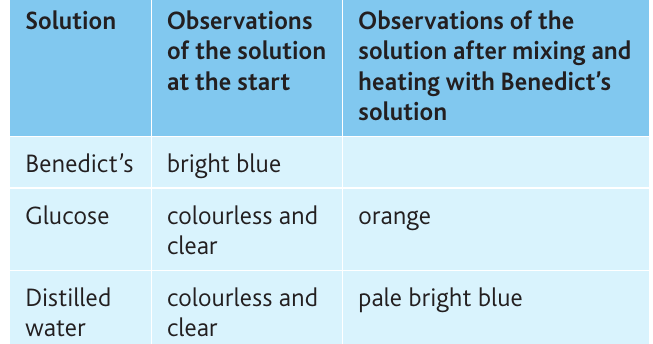
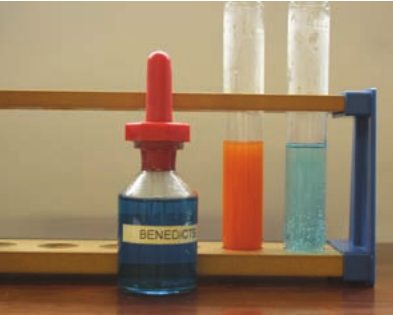
Results:
- Negative result (no reducing sugar): remains blue
- Positive result (reducing sugar present): colour changes through green → yellow → orange → brick red
- The final colour indicates the approximate concentration of reducing sugar
Note
"Benedict's Goes Orange-Red" Mnemonic
The colour change in Benedict's test is actually a semi-quantitative test - the final colour indicates how much reducing sugar is present:
- Green = trace amount
- Yellow = low concentration
- Orange = moderate concentration
- Brick red = high concentration
This makes Benedict's test useful not just for detecting reducing sugars, but also for estimating their concentration.
Control: Test distilled water with Benedict's solution - should remain pale blue, showing the reagent itself doesn't change colour without reducing sugar present.
Testing for non-reducing sugars
Non-reducing sugars (like sucrose) do not react with Benedict's solution initially because their glycosidic bonds prevent them from donating electrons. However, they can be detected by first hydrolysing them:
Procedure:
- Heat the sugar solution with dilute hydrochloric acid () for minutes
- This hydrolyses the glycosidic bond, breaking the disaccharide into monosaccharides
- Add sodium hydrogen carbonate to neutralise the acid
- Wait for fizzing to stop
- Now perform the Benedict's test as normal
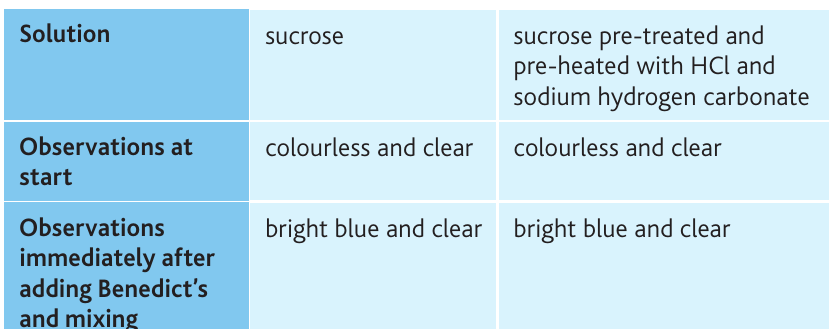
Results: If non-reducing sugar was present, the solution will now turn brick red with Benedict's solution, as the hydrolysis has released reducing sugars (monosaccharides).
Important
Common Mistake: Testing Non-Reducing Sugars
Students often forget that a negative Benedict's test doesn't mean "no sugar present" - it could mean there are non-reducing sugars present! You must perform the acid hydrolysis step and re-test to check for non-reducing sugars before concluding that no sugar is present.
Always remember: a negative initial Benedict's test only tells you there are no reducing sugars, not that there are no sugars at all.
Polysaccharides
Polysaccharides are large polymer molecules formed when many monosaccharide units join together through condensation reactions. Each monosaccharide is attached by a glycosidic bond.
Properties of polysaccharides
- Very large molecules containing hundreds to thousands of monosaccharide units
- Insoluble in water - this is advantageous for storage as they don't affect water potential or osmotic balance of cells
- Not sweet
- Contain many glycosidic bonds
- Form long chains which may be branched or unbranched, coiled or straight
- Often stabilised by many hydrogen bonds between chains
- Functions include energy storage (starch, glycogen) and structural support (cellulose)
Note
The insolubility of polysaccharides is one of their most important properties. If cells stored glucose as individual molecules rather than as polysaccharides:
- The water potential of the cell would decrease dramatically (due to the high concentration of solute molecules)
- Water would rush into the cell by osmosis
- The cell would swell and potentially burst
By storing thousands of glucose molecules as a single polysaccharide molecule, cells avoid these osmotic problems.
Starch
Starch is the main carbohydrate storage molecule in plants. It is a polymer of α-glucose molecules.
Structure: Starch actually consists of two different molecules:
- Amylose (10-30% of starch):
- Unbranched chain of α-glucose molecules
- Joined by 1,4-glycosidic bonds
- Coils into a helix (spring-like spiral shape)
- Forms due to the angle of glycosidic bonds and shape of α-glucose
- Amylopectin (70-90% of starch):
- Branched chain of α-glucose molecules
- Main chains joined by 1,4-glycosidic bonds
- Branch points formed by 1,6-glycosidic bonds (between and )
- Creates a branched, tree-like structure
Storage locations:
- Amyloplasts (plastids specialised for starch storage) in plant organs like potato tubers
- Chloroplasts in leaves
Summary
Properties making starch ideal for storage:
- Compact structure due to coiling and branching - doesn't take up much space
- Insoluble - doesn't affect water potential of cells or cause osmotic problems
- Stable - held together by many weak hydrogen bonds that collectively provide strength
- Easily mobilised - can be rapidly broken down by enzymes when glucose is needed
- Branched (amylopectin) - provides many "end points" from which glucose can be removed
Testing for starch (iodine test)
Starch can be detected using iodine solution (iodine in potassium iodide):
Procedure:
- Add two drops of iodine solution (straw yellow) to sample
- Observe colour change
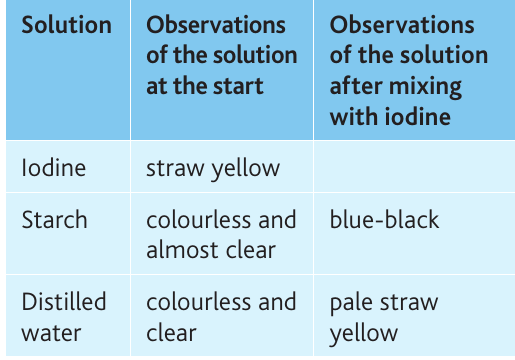
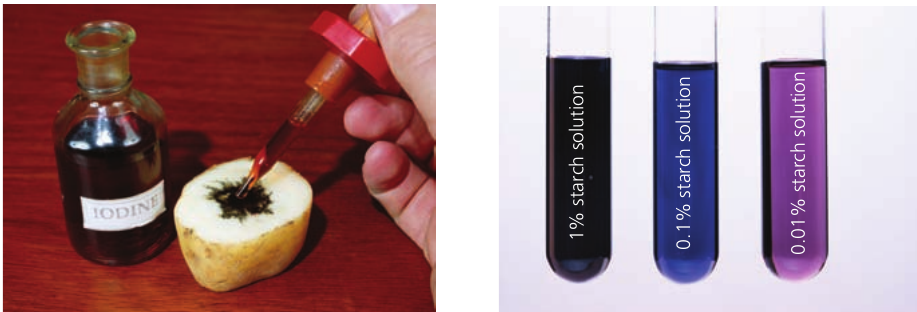
Results:
- Positive result (starch present): blue-black colour appears
- Negative result (no starch): remains straw yellow/brown
Note
"Iodine's Blue-Black for Starch Attack" Mnemonic
Explanation: Iodine molecules fit inside the helix of the amylose molecule, forming a starch-iodine complex that produces the characteristic blue-black colour.
Interesting property: When a starch-iodine mixture showing blue-black colour is heated, the colour disappears (returns to yellow), but reappears when cooled. This occurs because heating disrupts the helical structure, but cooling allows it to reform. This reversible colour change demonstrates that the test involves a physical interaction (iodine fitting into the helix) rather than a chemical reaction.
Glycogen
Glycogen is the main carbohydrate storage molecule in animals. Like starch, it is a polymer of α-glucose molecules.
Structure:
- Similar to amylopectin but with more frequent branching
- Shorter chains between branch points
- Even more compact than starch
- Contains both 1,4-glycosidic bonds (main chains) and 1,6-glycosidic bonds (branches)
Storage locations:
- Stored as granules in animal cells
- Main storage sites are liver cells and muscle cells
Summary
Properties making glycogen ideal for storage:
- Highly branched - provides many sites for rapid glucose release when energy is needed quickly
- Very compact - takes up minimal space in cells
- Insoluble - doesn't affect cellular water potential
- Rapidly mobilised - branches allow many enzymes to work simultaneously to release glucose
Important
Animals Store Glycogen, Plants Store Starch
The reason glycogen is more highly branched than starch relates to the different metabolic needs of animals and plants:
- Animals are mobile and require rapid energy release for movement - the extensive branching in glycogen allows for very fast glucose mobilisation
- Plants are stationary and have lower, more consistent energy demands - the less branched starch is adequate for their needs and uses slightly less cellular machinery to construct
This is an excellent example of how evolution has optimised molecules for specific biological roles!
Cellulose
Cellulose is the main structural carbohydrate in plants, forming a major component of plant cell walls. It is a polymer of β-glucose molecules.
Structure:
- Long, unbranched chains of β-glucose
- Due to the position of the group on in β-glucose, adjacent glucose molecules can only join if alternate molecules are inverted (rotated )
- This creates straight chains rather than coils
- Many groups project outwards from the chains
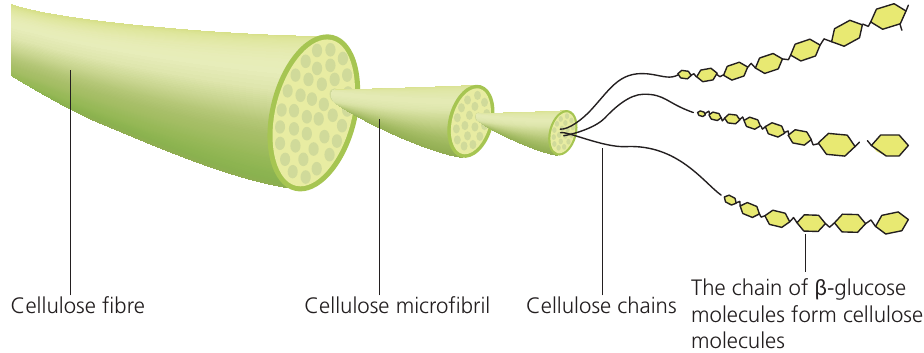
Hydrogen bonding and fiber formation:
- Many hydrogen bonds form between groups on adjacent cellulose chains
- Multiple chains held together form a microfibril
- Multiple microfibrils held together by more hydrogen bonds form a cellulose fiber
- These fibers are extremely strong and rigid
Note
The hierarchical structure of cellulose creates remarkable strength:
- Individual cellulose chain: moderate strength
- Microfibril (many chains): strong
- Cellulose fiber (many microfibrils): very strong
- Cell wall (mesh of fibers): incredibly strong
This is similar to how individual threads are weak, but when woven into rope, they become very strong. The strength comes from the collective effect of thousands of weak hydrogen bonds.
Summary
Properties making cellulose ideal for structure:
- Straight chains allow tight parallel packing
- Extensive hydrogen bonding between chains provides great strength
- Insoluble and chemically unreactive - provides stable structure
- Individual hydrogen bonds are weak, but collectively they create very strong fibers
- Arranged in a mesh-like network in cell walls, providing strength in all directions
Why can't most organisms digest cellulose?
- Most organisms lack the enzyme cellulase needed to break the β-1,4-glycosidic bonds in cellulose
- Only some bacteria, fungi, and protists produce cellulase
- Herbivores rely on gut bacteria containing cellulase to digest plant material
Important
Humans cannot digest cellulose, which is why it passes through our digestive system as dietary fiber. However, this "indigestible" material is actually very important for digestive health - it adds bulk to feces, stimulates intestinal muscles, and helps move food through the digestive system. This shows that not all components of our diet need to be digestible to be valuable!
Other polysaccharides
- Chitin: Found in exoskeletons of insects and cell walls of fungi
- Peptidoglycans: Found in bacterial cell walls
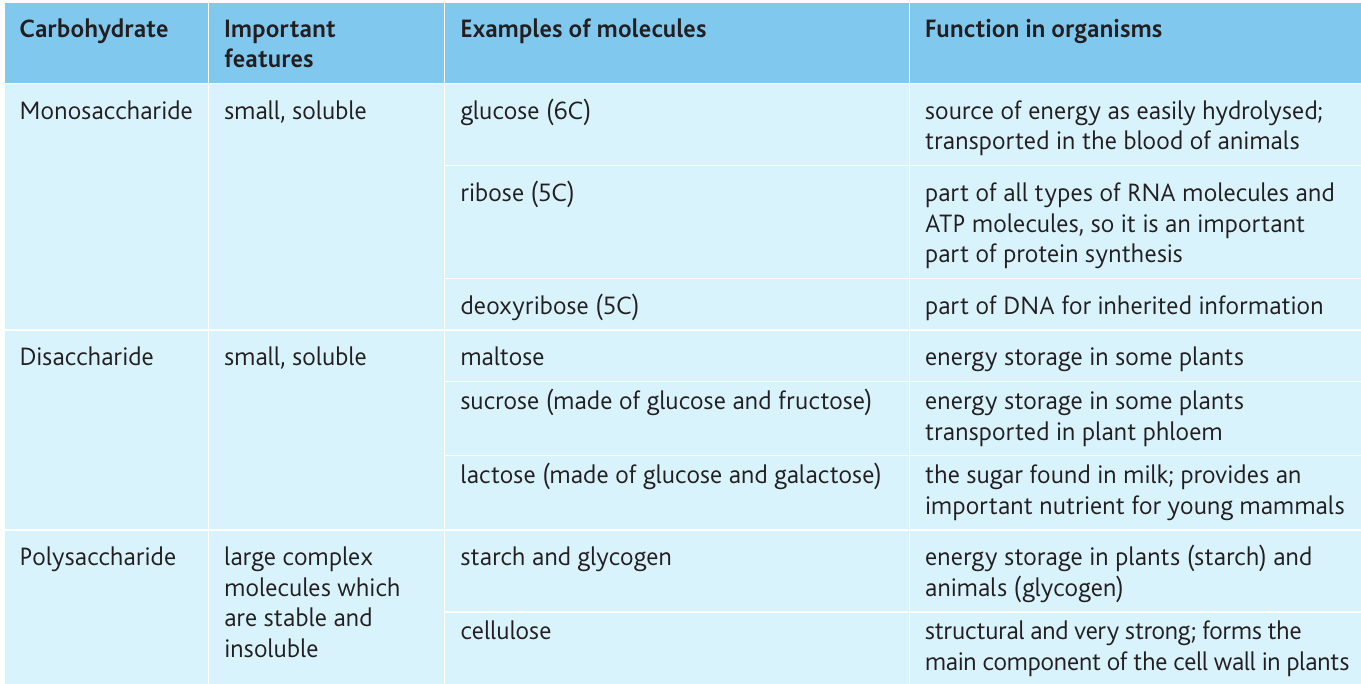
Relating structure to function
The structure of each carbohydrate determines its function in organisms:
Monosaccharides as energy sources
- Small size → easily diffuse through membranes
- Soluble → readily transported in blood and sap
- Simple structure → easily broken down to release energy quickly
- Ring structure → chemically stable but still reactive
Disaccharides for storage and transport
- Larger than monosaccharides but still relatively small
- Soluble → can be transported in solution
- More stable than monosaccharides → suitable for short-term storage
- Easily hydrolysed → can quickly release monosaccharides when needed
Polysaccharides for long-term storage
- Large, compact molecules → store many glucose units in small space
- Insoluble → don't affect water potential or cause osmotic problems
- Chemically stable → suitable for long-term storage
- Branched structures (in glycogen and amylopectin) → provide many sites for rapid glucose release
- Helical structures (in amylose) → further compaction
Cellulose for structural support
- Long, straight chains → can be packed tightly in parallel
- Extensive hydrogen bonding → provides tensile strength
- Insoluble and unreactive → provides stable, permanent structure
- Fiber arrangement → strength in multiple directions
Example
Worked Example: Why Store Glucose as Glycogen?
Consider a liver cell that needs to store enough glucose for energy:
Option 1: Store as individual glucose molecules
- 1000 glucose molecules = 1000 separate solute particles
- Massively decreases water potential
- Water rushes in by osmosis
- Cell must have very thick walls to resist bursting
- Takes up large volume in cell
Option 2: Store as glycogen
- 1000 glucose molecules condensed into 1 glycogen molecule = 1 solute particle
- Minimal effect on water potential
- No osmotic stress on cell
- Compact structure takes up minimal space
- Cell can maintain normal structure
This is why organisms always store glucose as polysaccharides rather than as free glucose - it's a matter of osmotic balance and efficient space usage!
Important
Key principle: Organisms store glucose as polysaccharides rather than as free glucose because:
- Storing thousands of glucose molecules would massively decrease water potential, causing water to enter cells by osmosis
- Cells would need much thicker walls to withstand the increased pressure
- Polysaccharides are compact, taking up far less space than equivalent glucose molecules with their associated water molecules
This demonstrates how molecular structure directly determines biological function - a central theme in biochemistry!
Remember!
Summary
Key Points to Remember:
-
Carbohydrates contain carbon, hydrogen and oxygen in the ratio C : H : O = , with general formula
-
Three main types of carbohydrates: monosaccharides (single sugars), disaccharides (two sugars joined), and polysaccharides (many sugars joined)
-
Alpha and beta glucose are isomers - the position of the group on determines whether glucose forms storage polysaccharides (α-glucose → starch/glycogen) or structural polysaccharides (β-glucose → cellulose)
-
Glycosidic bonds form through condensation (removal of water) and break through hydrolysis (addition of water) - these processes are central to carbohydrate metabolism
-
Structure determines function: small, soluble sugars provide quick energy; large, insoluble polysaccharides provide storage (starch, glycogen) or structure (cellulose)
-
Mnemonic aids:
- "Alpha Down, Beta Up" - position of OH group on C₁
- "Animals Store Glycogen, Plants Store Starch"
- "Benedict's Goes Orange-Red" - positive test for reducing sugars
- "Iodine's Blue-Black for Starch Attack" - positive test for starch