Immobilised Enzymes (OCR A-Level Biology A): Revision Notes
📚Revision Notes
Immobilised Enzymes
Introduction to enzyme immobilisation
Enzymes used in laboratory work and many industrial applications are typically in solution. While soluble enzymes are relatively inexpensive to produce, they present a practical challenge: after a single use, recovering them for reuse becomes costly. This economic limitation prompted scientists to develop methods for enzyme immobilisation.
Note
The high cost of recovering and reusing soluble enzymes after a single use drove the development of immobilisation technology, making enzyme-based industrial processes more economically viable.
Enzymes for industrial use are extracted from microorganisms cultured in laboratory conditions. When microorganisms secrete enzymes into their growth medium, extraction is straightforward. However, intracellular enzymes (those that remain inside cells) require the microorganisms to be broken open, making them more expensive to obtain.
What are immobilised enzymes?
Important
Definition: An immobilised enzyme is any enzyme that has been fixed to an inert substance, encapsulated in a bead, or contained within a partially permeable membrane so that it is no longer free in solution.
This technique allows enzymes to remain in one location while substrate molecules pass through, undergo catalysis, and products are collected separately from the enzyme.
Methods of immobilisation
Enzymes can be immobilised using several approaches:
Attachment to inert support materials:
- Glass beads
- Resin beads
- Collagen fibres
Enzymes attach to these surfaces through chemical bonds whilst keeping active sites accessible to substrate molecules.
Encapsulation methods:
- Trapping in polyacrylamide microcapsules
- Encapsulation in calcium alginate beads
- Containment within partially permeable membranes
Note
The Calcium Alginate Method
The calcium alginate method is particularly common. When a sodium alginate solution containing enzymes is dripped into calcium chloride solution, viscous beads form immediately, trapping enzymes within a gel matrix.
Industrial applications of immobilised enzymes
Immobilised enzymes play important roles across various industries:
| Enzyme | Microbial source | Industrial application |
|---|---|---|
| Glucose isomerase | Genetically modified Streptomyces | Converts glucose to fructose in high-fructose corn syrup manufacture |
| Penicillin acylase | Escherichia coli | Production of semisynthetic penicillins |
| Lactase | Yeasts and mould fungi (e.g. Aspergillus spp.) | Hydrolysis of lactose to glucose and galactose |
| Aminoacylase | Saccharomyces cerevisiae, Bacillus, Streptomyces, Aspergillus oryzae | Production of pure L-amino acids for animal feeds |
| Glucoamylase | Aspergillus spp. | Conversion of dextrins (short-chain carbohydrates) to glucose |
| Nitrile hydratase | Rhodococcus | Conversion of acrylonitrile to acrylamide for plastics manufacture |
Medical applications:
Immobilised enzymes are used in diagnostic test strips, including those for detecting glucose in urine and blood glucose monitors used by people with diabetes.
Food industry applications:
Immobilised lactase breaks down lactose in milk products for people with lactose intolerance, who cannot digest lactose and experience symptoms such as diarrhoea when they consume it.
Case study: high-fructose corn syrup production
Example
Industrial Application: High-Fructose Corn Syrup (HFCS) Production
The production of high-fructose corn syrup (HFCS) demonstrates the industrial application of both soluble and immobilised enzymes.
Process overview:
The multi-stage process converts corn (maize) starch into a syrup containing approximately fructose and glucose:
- Corn starch undergoes breakdown by soluble amylase, producing short sugar chains
- Glucoamylase (also in solution) breaks down these chains further to produce glucose
- The glucose solution passes through a column containing beads with immobilised glucose isomerase on their surface
- Glucose isomerase converts glucose to fructose
- HFCS collects at the column base, free from enzyme contamination
Economic significance:
- USA production exceeds million tonnes annually
- The immobilised glucose isomerase remains active for up to 100 days
- HFCS serves as a sweetener in numerous food products
Commercial advantages:
Fructose is sweeter than sucrose, meaning smaller quantities achieve the same sweetness level. Since corn starch is less expensive than sucrose as a raw material, HFCS provides a cost-effective alternative for food manufacturers.
Important
Glucose isomerase is an intracellular enzyme, making it expensive to extract. Immobilisation makes its industrial use economically viable despite the high extraction costs.
Advantages of immobilised enzymes
Immobilised enzymes offer several benefits compared to soluble enzymes:
Economic advantages:
- Enzymes can be reused multiple times before replacement
- No contamination of the final product with enzyme protein
- Lower long-term costs despite higher initial setup expenses
Process advantages:
- Enable continuous processes rather than batch production
- Products can be collected continuously without stopping production
- Simplified product purification (no enzyme separation needed)
Stability advantages:
- Greater tolerance of temperature extremes
- Wider functional pH range
- Longer operational lifetime
Practical advantages:
- Easy to pack into columns for continuous flow systems
- Simple filtration and separation from products
- Straightforward recovery and replacement
Note
Key Benefit: Reusability
While immobilised enzymes may have higher initial setup costs, their ability to be reused multiple times and facilitate continuous processing makes them highly cost-effective in the long term.
Practical procedures with immobilised enzymes
Example
Preparing Immobilised Enzymes Using Calcium Alginate
The following procedure demonstrates enzyme immobilisation using the calcium alginate method:
- Mix enzyme solution (e.g. sucrase) with sodium alginate solution in equal volumes
- Load the mixture into a syringe, ensuring no air bubbles are present
- Gently push the syringe plunger to release droplets into calcium chloride solution
- Beads form immediately as alginate droplets contact calcium ions
- Pack the resulting beads into a column for use
Using immobilised enzymes:
Once packed into a column, substrate solution flows over the beads. The substrate molecules diffuse through the gel matrix to reach enzyme active sites. After catalysis, products diffuse out and collect at the column base.
Testing the product:
For immobilised sucrase breaking down sucrose:
- Test for glucose using glucose test strips (positive result confirms enzyme activity)
- Test for protein using biuret solution (negative result confirms no enzyme leakage)
Important
Immobilised enzymes often work more slowly than soluble enzymes because substrates must diffuse through the gel matrix to reach active sites. However, their reusability and stability compensate for this reduced rate.
Temperature effects on immobilised versus soluble enzymes
When comparing immobilised and soluble forms of the same enzyme, temperature affects them differently.
Experimental observations with lactase:
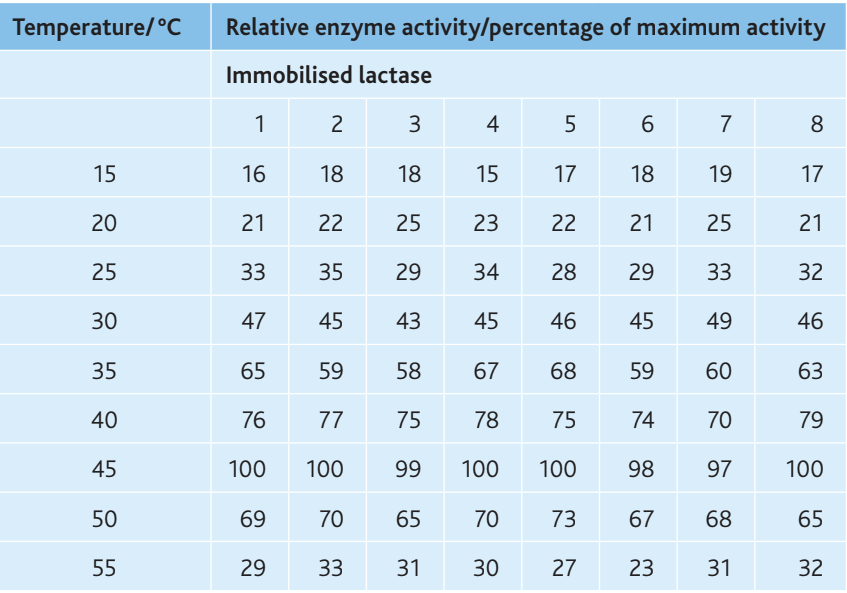
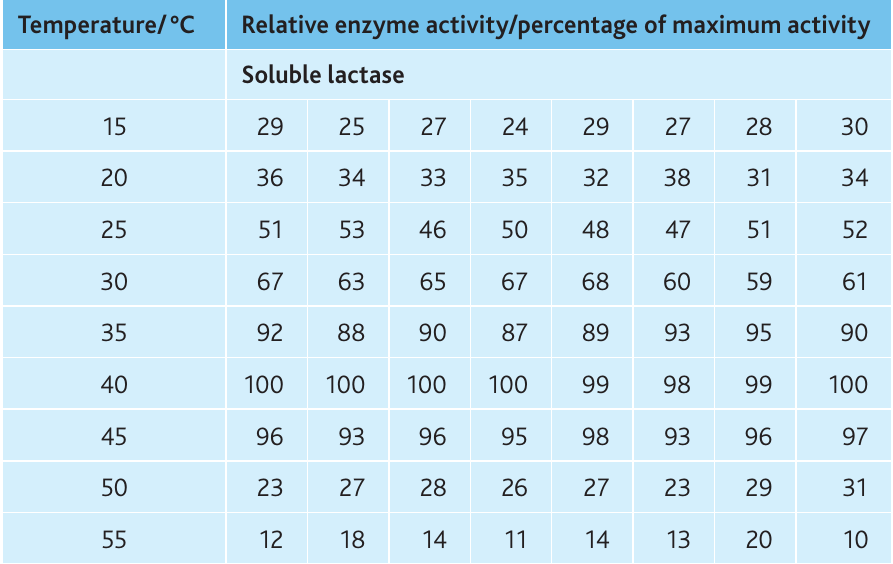
Research comparing immobilised lactase (in calcium alginate beads) with soluble lactase across temperatures from to reveals:
Key findings:
Soluble lactase:
- Shows optimal activity at 40°C
- Maintains high activity at (above of maximum)
- Activity drops sharply at and due to denaturation
- Shows the typical enzyme-temperature relationship
Immobilised lactase:
- Also shows optimal activity at 45°C
- Maintains higher activity at 50°C compared to soluble form
- Still shows substantial activity at (approximately of maximum)
- More resistant to denaturation at high temperatures
Note
Why Immobilised Enzymes Are More Stable
The gel matrix surrounding immobilised enzymes provides structural support, helping maintain the tertiary structure of the enzyme protein at higher temperatures. This protection allows immobilised enzymes to retain more activity when conditions would normally cause denaturation.
Practical significance:
The enhanced thermal stability of immobilised enzymes allows industrial processes to operate at higher temperatures, which can increase reaction rates without complete enzyme denaturation.
Remember!
Summary
Key Points to Remember:
- Immobilised enzymes are fixed to inert materials, trapped in beads, or contained in membranes rather than free in solution
- Common immobilisation methods include attachment to glass or resin beads, encapsulation in calcium alginate or polyacrylamide, and containment in partially permeable membranes
- Industrial applications include HFCS production (glucose isomerase), lactose-free milk (lactase), and antibiotic manufacture (penicillin acylase)
- Key advantages are reusability, no product contamination, continuous processing, and enhanced stability at extreme temperatures and pH values
- Immobilised enzymes tolerate higher temperatures than their soluble counterparts because the support matrix helps maintain protein structure and prevent denaturation