Acid–Base Titrations (OCR A-Level Chemistry A): Revision Notes
📚Revision Notes
Acid–Base Titrations
What is a titration?
A titration is a precise analytical technique that allows us to measure exactly how much of one solution reacts completely with another solution. This method is incredibly useful in chemistry for several practical applications:
- Determining the exact concentration of a solution when you know the amount of substance present
- Identifying unknown chemicals by analyzing their reactions
- Checking the purity of substances, particularly important in quality control
Note
Understanding purity is crucial in industries like pharmaceuticals, food production, and cosmetics. Even tiny amounts of impurities in medicines could cause serious harm to patients, so manufacturers must ensure their products meet strict purity standards.
Preparing standard solutions
Understanding standard solutions
A standard solution has a precisely known concentration. To create one accurately, we use specialized glassware called a volumetric flask. These flasks are manufactured to extremely precise tolerances, allowing very accurate volume measurements.
Common volumetric flask tolerances include:
- flask:
- flask:
Method for preparing a standard solution
The preparation process follows a careful sequence of steps to ensure accuracy:
Step 1: Begin by weighing your solid substance accurately using a balance. Record this mass precisely.
Step 2: Transfer the weighed solid to a beaker and dissolve it using less distilled water than the final volume you need. This partial dissolution makes the next step easier.
Step 3: Carefully transfer your dissolved solution into the volumetric flask. Rinse the beaker several times with small amounts of distilled water, adding these rinsings to the flask. This ensures no solution is wasted and all the dissolved solid reaches the flask.
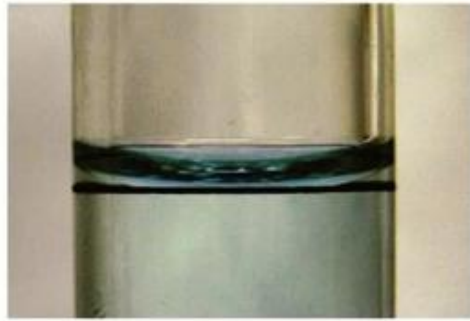
Step 4: Add distilled water dropwise to the flask until the bottom of the meniscus sits exactly on the graduation mark. This stage requires particular care – adding too much water will dilute your solution beyond the target concentration, and you'll need to start again. View the meniscus at eye level for best accuracy.
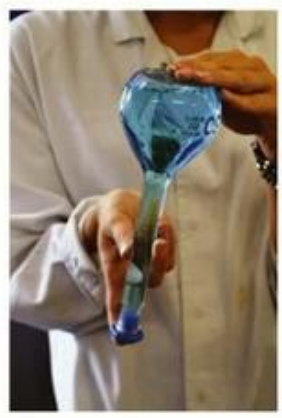
Step 5: Seal the flask with the stopper and invert it slowly several times to mix the solution thoroughly. You'll observe the denser original solution moving through and mixing with the added water as you turn the flask.
Important
Common Preparation Errors and Their Effects
Two frequent mistakes can affect your results:
- Overfilling the flask: If water is added above the graduation line, the solution becomes too dilute and must be prepared again from scratch.
- Not inverting the flask: Failing to mix the solution properly means the concentration won't be uniform throughout.
Carrying out acid-base titrations
Apparatus and equipment
An acid-base titration requires specific equipment with precise tolerances. You'll use a pipette to measure a fixed volume of one solution and a burette to add the other solution in a controlled manner.
Standard equipment tolerances are:
- pipette:
- pipette:
- burette:
Note
Reading the Burette Correctly
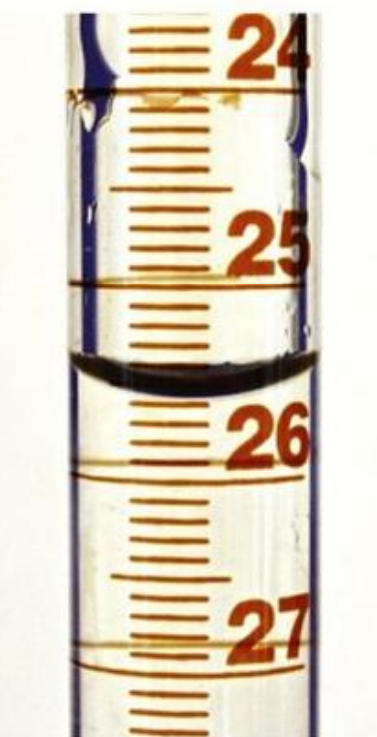
Understanding burette readings is essential. Always read the burette to the nearest half-division, with the meniscus bottom level with your eye. The bottom of the meniscus should align with a mark or sit between two marks. Record readings to the nearest , always using two decimal places. The final digit will always be either 0 or 5 (for example, or ).
The titration procedure
Step 1: Use a pipette to measure a precise volume of one solution and transfer it to a clean conical flask.
Step 2: Fill the burette with the other solution and record the initial burette reading to the nearest .
Step 3: Add a few drops of a suitable indicator to the solution in the conical flask. The indicator will change color at the end point.
Step 4: Carefully run the solution from the burette into the conical flask, swirling the flask constantly to ensure thorough mixing. As the indicator begins to change color, add the solution more slowly, eventually adding it drop by drop. The end point occurs when the indicator permanently changes color, showing that the solutions have reacted completely.
Step 5: Record the final burette reading. Calculate the titre by subtracting the initial reading from the final reading. The titre represents the volume of solution added from the burette.
Step 6: Perform a quick trial titration first to find the approximate titre value. This gives you a rough idea of where the end point occurs.
Step 7: Repeat the titration accurately, adding solution dropwise as you approach the end point. Continue performing titrations until you obtain two accurate titres that agree within – these are called concordant results.
Recording your results
Record all your measurements in a clear table format:
| Trial | 1 | 2 | 3 |
|---|---|---|---|
| final burette reading / | |||
| initial burette reading / | |||
| titre / | |||
| mean titre / |
Important
Understanding Common Errors
Three important experimental errors to recognize:
-
Air bubble in the pipette: An air bubble reduces the actual volume of solution delivered, making your titre value inaccurate.
-
Reading the burette incorrectly: Taking readings from the top of the meniscus rather than the bottom will give systematically incorrect results.
-
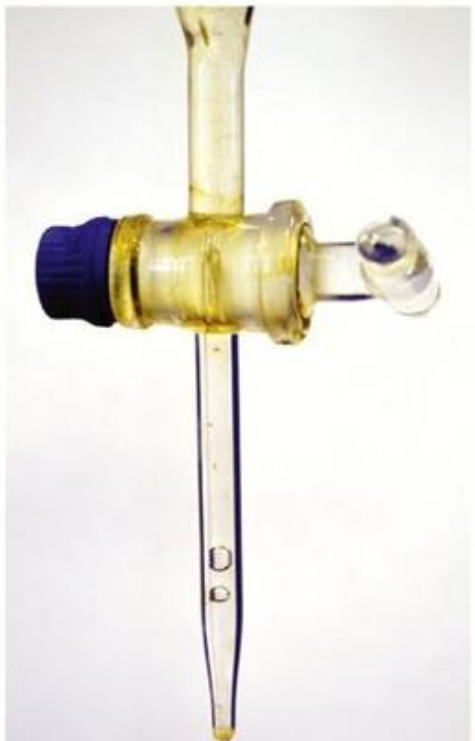
Air bubbles in the burette neck: If a bubble escapes during the titration, it appears that you've added more solution than you actually have, leading to an erroneously large titre value.
Analyzing titration results
Calculating the mean titre
When working out your average titre value, only use your closest accurate titres (concordant results). These should agree within .
Note
If you include all titres in your calculation, including those that don't agree closely, you lose the accuracy that makes titration such a precise technique. By repeating until two titres agree within , you can confidently reject any inaccurate measurements.
Titration calculations method
From your titration results, you'll know:
- Both the concentration and reacting volume of one solution
- Only the reacting volume of the other solution
The calculation follows a systematic three-step approach:
Step 1: Calculate the amount (in moles) of the solute in the solution where you know both the concentration and volume.
Step 2: Use the balanced equation to determine the amount (in moles) of the solute in the other solution.
Step 3: Calculate the unknown information about the second solution.
Example
Worked Example: Finding an Unknown Concentration
Given information:
- Pipette contains: of KOH(aq)
- Mean titre from burette: of H₂SO₄(aq)
- Unknown: concentration of H₂SO₄(aq)
Step 1: Calculate the amount of KOH that reacted.
Using the relationship :
Step 2: Determine the amount of H₂SO₄ using the balanced equation and stoichiometry.
From the equation: 2 mol KOH reacts with 1 mol H₂SO₄
Therefore: mol KOH reacts with mol H₂SO₄
Step 3: Calculate the unknown concentration.
Rearranging:
The concentration of H₂SO₄(aq) is 0.0486 mol dm⁻³.
The calculation relies entirely on the ratios shown in the balanced equation (the stoichiometric ratios).
Identifying unknown substances using titrations
You can use titrations to identify unknown substances by determining their molar mass. Here's how to identify an unknown carbonate, :
Experimental procedure
- Prepare a solution of the unknown carbonate in a volumetric flask
- Measure of this solution using a pipette into a conical flask
- Titrate with hydrochloric acid using a burette
- Analyze your results to identify the carbonate
Mass measurements
| Measurement | Mass / g |
|---|---|
| mass of weighing bottle | 11.41 |
| mass of weighing bottle + | 12.60 |
| mass of | 1.19 |
Titration results
| Trial | 1 | 2 | 3 |
|---|---|---|---|
| final burette reading / | 24.10 | 22.35 | 44.95 |
| initial burette reading / | 1.00 | 0.00 | 22.35 |
| titre / | 23.10 | 22.35 | 22.60 |
| mean titre / | 22.40 |
Note
Notice that only trials 2 and 3 are concordant (within ), so only these are used for the mean.
Example
Worked Example: Identifying an Unknown Carbonate
Step 1: Calculate the amount of HCl that reacted.
Using the mean titre and the concentration:
Step 2: Determine the amount of that reacted.
From the balanced equation:
The equation shows: 1 mol reacts with 2 mol HCl
Therefore: mol HCl requires mol
Step 3: Work out the unknown information in several stages.
Stage 1: Scale up to find the amount in the solution prepared.
Since we used in the titration:
- in = mol
- in = mol
Stage 2: Find the molar mass of .
Using , rearrange to get :
Stage 3: Identify element X in the formula .
The formula shows:
Therefore:
Rearranging:
Checking the periodic table, this value matches sodium ().
The unknown carbonate is sodium carbonate, Na₂CO₃.
Summary
Key Points to Remember:
- A titration accurately measures the volume of one solution that reacts exactly with another solution
- Standard solutions must be prepared carefully using volumetric flasks – accuracy is essential
- Always read the burette at the bottom of the meniscus, at eye level, to the nearest
- Repeat titrations until two results are concordant (within ) – only use these for your mean
- Titration calculations follow three steps: find moles of known substance, use the equation to find moles of unknown substance, calculate the required unknown value
- You can identify unknown substances by using titration results to calculate their molar mass
Exam Focus Checklist:
- Can you prepare a standard solution using correct technique?
- Do you know how to read a burette correctly?
- Can you calculate a mean titre using only concordant results?
- Can you perform a structured titration calculation using the three-step method?
- Can you identify an unknown substance from titration data by calculating its molar mass?
- Do you understand common sources of error in titrations?