Formulae and Equations (OCR A-Level Chemistry A): Revision Notes
📚Revision Notes
Formulae and equations
Writing chemical formulae and constructing balanced chemical equations are essential skills in A-Level chemistry. This topic builds on your understanding of ionic bonding to show you how to write correct formulae for ionic compounds and how to represent chemical reactions using balanced equations.
Ionic charges and the periodic table
Understanding simple ions
Atoms can lose or gain electrons to achieve a stable electron configuration similar to the nearest noble gas (helium through to radon). This process creates charged particles called ions:
- Metal atoms (found on the left side of the periodic table) lose electrons to form cations (positively charged ions)
- Non-metal atoms (found on the right side of the periodic table) gain electrons to form anions (negatively charged ions)
Note
The key difference: metals form positive ions (cations) by losing electrons, while non-metals form negative ions (anions) by gaining electrons. This fundamental pattern underlies all ionic compound formation.
Predicting ionic charges
For many elements, you can work out the likely charge on the ion by looking at the element's position in the periodic table:
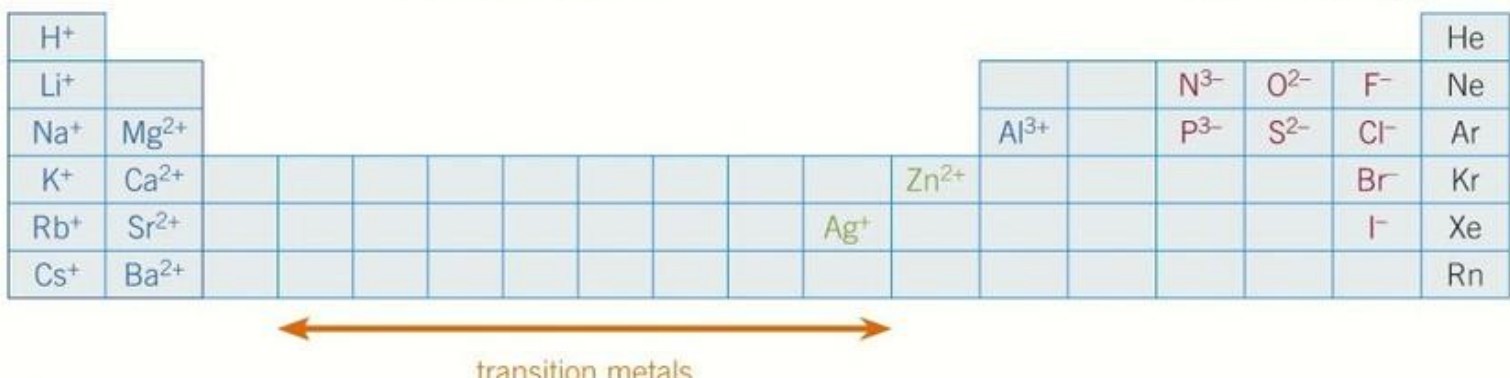
The diagram shows a clear pattern:
- Group 1 metals form 1+ ions (e.g., , , )
- Group 2 metals form 2+ ions (e.g., , , )
- Aluminium (Group 3) forms 3+ ions ()
- Group 5 non-metals form 3- ions (e.g., , )
- Group 6 non-metals form 2- ions (e.g., , )
- Group 7 non-metals (halogens) form 1- ions (e.g., , , , )
Important
Exceptions to memorise: Zinc () and silver () are important exceptions that don't follow the general transition metal pattern. You need to memorise these specific charges as they appear frequently in exam questions.
Transition metals and variable charges
Many transition metals can form ions with different charges. The ionic charge is indicated using Roman numerals in the name of the ion:
- Copper forms two ions: copper(I) () and copper(II) ()
- Iron forms two ions: iron(II) () and iron(III) ()
The Roman numeral tells you the charge on the metal ion.
Note
When you see a compound name like "iron(III) oxide", the Roman numeral (III) immediately tells you that iron has a 3+ charge in this compound. This systematic naming convention helps you work out the correct formula.
Binary compounds
A binary compound contains exactly two different elements.
To name a binary ionic compound:
- Write the name of the metal element first
- Change the ending of the non-metal element's name to -ide
- For ionic compounds, the metal ion always comes first in the formula
Example
Example: Sodium Oxide Formation
Sodium and oxygen combine to form sodium oxide ()
- Sodium = metal (comes first)
- Oxygen → oxide (change ending to -ide)
- Formula shows 2 sodium ions for every 1 oxide ion
Polyatomic ions
What are polyatomic ions?
Sometimes ions contain atoms of more than one element bonded together. These are called polyatomic ions. Unlike simple ions which consist of single atoms, polyatomic ions are groups of atoms that carry an overall charge.
Important
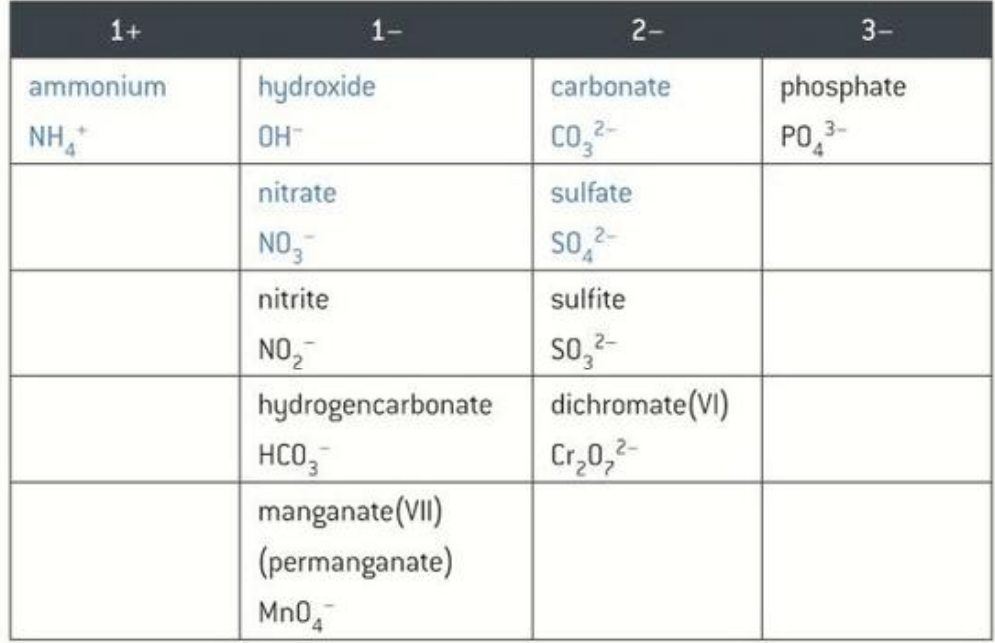
Memorisation Required: You need to memorise the names and formulae of all common polyatomic ions shown in the table. There are no shortcuts or patterns to help you work these out, so regular practice is essential. These ions appear frequently in exams and are fundamental to writing correct formulae.
Common polyatomic ions include:
- 1+ ions: Ammonium ()
- 1- ions: Hydroxide (), nitrate (), nitrite (), hydrogencarbonate (), manganate(VII) or permanganate ()
- 2- ions: Carbonate (), sulfate (), sulfite (), dichromate(VI) ()
- 3- ions: Phosphate ()
Writing formulae from ions
The charge balancing rule
An ionic compound contains both a cation and an anion. You can work out the correct formula by balancing the charges on each ion.
For a correct formula:
- The overall charge must be zero
- Sum of positive charges = sum of negative charges
This means you need to find the ratio of ions that makes the charges cancel out.
Note
Think of charge balancing like a see-saw that must be perfectly balanced. The positive charges on one side must exactly equal the negative charges on the other side. This is the fundamental rule for all ionic compounds.
Worked examples

Let's look at how to balance charges systematically:
Example
Worked Example 1: Zinc Chloride
- Ions present: and
- One zinc ion has a 2+ charge
- Each chloride ion has a 1- charge
- To balance: you need two chloride ions for every one zinc ion
- Charge check: ✓
- Formula:
Example
Worked Example 2: Aluminium Sulfate
- Ions present: and
- Each aluminium ion has a 3+ charge
- Each sulfate ion has a 2- charge
- To balance: you need 2 aluminium ions (total 6+) and 3 sulfate ions (total 6-)
- Charge check: ✓
- Formula:
Note
Tip: The charges must balance through multiplication. Think of it like finding the lowest common multiple of the two charge numbers. For aluminium (3+) and sulfate (2-), the LCM of 3 and 2 is 6, so you need charges totaling 6+ and 6-.
Writing the formula correctly
When writing the final formula, follow these rules:
- The number of each ion is shown as a subscript after the ion symbol or formula
- The ionic charges are not written in the final completed formula
- Brackets must be used if there is more than one polyatomic ion
Example
Example: Aluminium Sulfate Notation
Aluminium sulfate contains 2 ions and 3 ions, so the formula is .
Note the brackets around because we need three sulfate ions, and the subscript 3 goes outside the bracket.
Important
Common Mistake: Writing magnesium hydroxide as is incorrect because it means one oxygen and two hydrogens. The correct formula is , which means two complete hydroxide ions. Always use brackets for multiple polyatomic ions!
Writing and balancing chemical equations
Representing elements in equations
In chemical equations, elements are shown using their chemical symbols, but there's an important exception:
Diatomic molecules: Some elements exist naturally as molecules containing two atoms bonded together. These are:
- (hydrogen)
- (nitrogen)
- (oxygen)
- (fluorine)
- (chlorine)
- (bromine)
- (iodine)
Note
Memory aid: Remember "BrINClHOF" or "Have No Fear Of Ice Cold Beer"
These mnemonics help you remember all seven diatomic elements that must always be written with a subscript 2 in equations.
The only other elements that exist as small molecules are phosphorus () and sulfur (). However, sulfur is usually written simply as S in equations (otherwise you'd need to multiply everything by 8).
Representing compounds in equations
Covalent compounds exist as molecules with a fixed number of atoms bonded together. In equations, you use the molecular formula (e.g., , ).
Ionic compounds don't exist as molecules - they form giant lattice structures. In equations, you use the formula unit worked out from the ionic charges (e.g., , ).
State symbols in equations
State symbols are written in brackets after each formula to indicate the physical state:
- (g) = gas
- (l) = liquid
- (s) = solid
- (aq) = aqueous (dissolved in water)
Note
State symbols are an essential part of a complete chemical equation. Many exam questions will specifically ask you to include state symbols, and marks can be lost if they are omitted or incorrect.
Balancing chemical equations
A balanced equation shows the same number of atoms of each element on both sides, representing the conservation of mass during a chemical reaction.
Key rules for balancing:
- Never change a chemical formula - the formulae are fixed by the rules above
- Balancing numbers go in front of formulae (on the line, not as subscripts)
- Multiply each formula by a balancing number until the atoms of each element match on both sides
- The equation is balanced when atom counts are equal on both sides
Important
Critical Rule: Never change the subscripts in a chemical formula when balancing. For example, if you need more oxygen atoms, write not . Changing subscripts changes the identity of the substance completely!
Worked example: constructing a balanced equation
Reaction: Aluminium reacts with oxygen to form aluminium oxide
Example
Worked Example: Balancing Aluminium Combustion
Step 1: Work out the formula of the product
- Aluminium oxide contains and ions
- Balancing charges: 2 aluminium ions (6+) and 3 oxide ions (6-)
- Formula:
Step 2: Write an equation using formulae for all reactants and products
- Aluminium is a metal element, so just Al
- Oxygen exists as diatomic molecules, so
- Unbalanced equation:
Step 3: Balance the equation
- Start with the formulae of compounds and count atoms
- Left side: 1 Al, 2 O
- Right side: 2 Al, 3 O
- The key is to get oxygen atoms equal on both sides
- Try:
Check:
- Left side: 4 Al and O
- Right side: Al and O ✓
Step 4: Add state symbols
Note
Alternative approach: Some students find fractions easier initially. For the worked example, you could write:
Then multiply through by 2 to remove the fraction, giving the same final answer. This method works well when dealing with diatomic elements.
Balancing formulae with brackets
Take extra care when balancing formulae containing brackets - the balancing number multiplies the entire formula.
Example
Example: Counting Atoms in Zinc Nitrate
means
This gives:
- 3 Zn atoms
- N atoms
- O atoms
The 3 multiplies everything, and the subscript 2 outside the bracket multiplies everything inside the bracket (one N and three O atoms per nitrate ion).
Remember!
Summary
Key Points to Remember:
- Metal atoms lose electrons to form positive ions (cations); non-metal atoms gain electrons to form negative ions (anions)
- You can predict many ionic charges from the element's group in the periodic table, but transition metals form ions with variable charges shown using Roman numerals
- Polyatomic ions are groups of atoms bonded together with an overall charge - you must memorise the common ones
- To write ionic formulae correctly, balance the charges so the sum of positive charges equals the sum of negative charges, giving an overall charge of zero
- When balancing equations, never change the chemical formulae - only add balancing numbers in front of formulae
- Seven elements exist as diatomic molecules (, , , , , , ) and must be written this way in equations
Exam focus checklist
Summary
Self-Assessment Questions:
- Can you predict ionic charges from the periodic table position?
- Can you recall the formulae of all common polyatomic ions?
- Can you balance ionic charges to write correct formulae?
- Do you remember to use brackets when there is more than one polyatomic ion?
- Can you write and balance equations for unfamiliar reactions?
- Do you always include state symbols in equations?
- Can you recognise and correctly represent diatomic elements?