Intermolecular Forces (OCR A-Level Chemistry A): Revision Notes
📚Revision Notes
Intermolecular forces
Introduction to intermolecular forces
Within a molecule, atoms are held together by strong covalent bonds. However, between separate molecules, much weaker forces exist called intermolecular forces. These forces operate between the dipoles of different molecules and play a crucial role in determining the physical properties of substances.
Understanding intermolecular forces helps explain why substances have different melting points, boiling points, and solubilities. While covalent bonds determine a molecule's identity and chemical behaviour, intermolecular forces largely control its physical characteristics.
Types of intermolecular forces
There are three main categories of intermolecular forces, listed in order of increasing strength:
- Induced dipole-dipole interactions (commonly called London forces)
- Permanent dipole-dipole interactions
- Hydrogen bonding
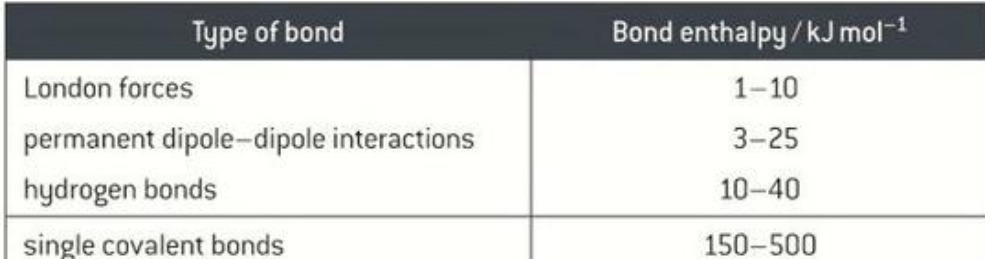
All of these forces are significantly weaker than covalent bonds. The table below shows how the strength of different intermolecular forces compares with covalent bonding:
Important
Notice that even the strongest intermolecular force (hydrogen bonding at 10-40 kJ mol⁻¹) is still much weaker than a typical single covalent bond (150-500 kJ mol⁻¹). This difference in strength explains why substances can change state relatively easily (by breaking intermolecular forces) but require much more energy to break apart into atoms (by breaking covalent bonds).
Induced dipole-dipole interactions (London forces)
London forces represent the weakest type of intermolecular force, yet they are universally present between all molecules, regardless of whether those molecules are polar or non-polar. These forces arise from temporary fluctuations in electron distribution.
How London forces arise
The origin of London forces can be understood through a step-by-step process:
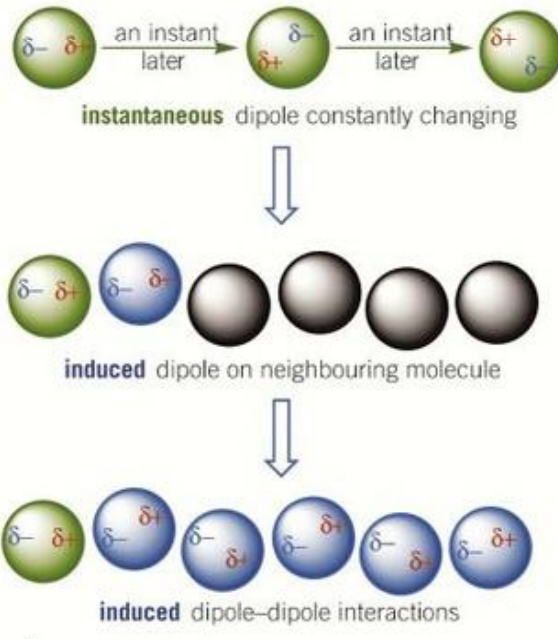
Step 1 - Formation of instantaneous dipoles: Electrons in a molecule are constantly moving. At any given moment, the electron distribution may be uneven, creating a temporary or instantaneous dipole where one side of the molecule has slightly more negative charge () and the other side has slightly more positive charge (). This dipole is constantly changing position as electrons move.
Step 2 - Induction of dipoles in neighbouring molecules: When an instantaneous dipole forms, it can affect nearby molecules. The instantaneous dipole induces a corresponding dipole in neighbouring molecules through electrostatic interactions. The electron clouds of nearby molecules shift in response to the temporary dipole.
Step 3 - Attraction between induced dipoles: Once dipoles are induced in neighbouring molecules, these can induce further dipoles in other nearby molecules. The result is a cascade of induced dipole-dipole interactions that create weak attractive forces between molecules.
Note
It's important to understand that these induced dipoles are only temporary - they continuously appear and disappear as electrons move. However, at any given moment, there are always some induced dipoles present, creating a net attractive force between molecules.
Factors affecting the strength of London forces
The strength of London forces between molecules depends primarily on the number of electrons present. This relationship can be understood as follows:
More electrons lead to stronger London forces. When molecules contain more electrons:
- The instantaneous dipoles that form are larger in magnitude
- The induced dipoles in neighbouring molecules are also larger
- The resulting attractive forces between molecules are stronger
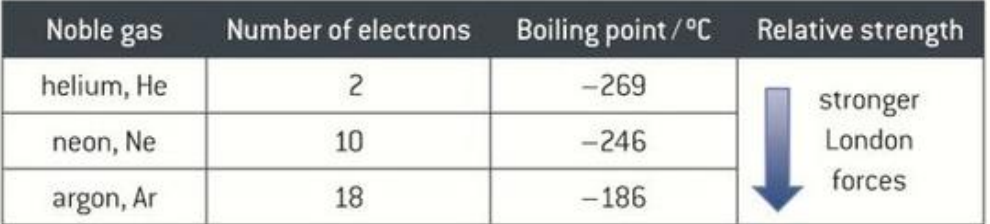
This electron-based trend can be clearly observed in the noble gases, which only have London forces between their atoms:
Example
Worked Example: Electron Count and Boiling Point in Noble Gases
Looking at helium, neon, and argon, we can see a clear pattern:
- Helium has 2 electrons and boils at -269°C
- Neon has 10 electrons and boils at -246°C
- Argon has 18 electrons and boils at -186°C
As the number of electrons increases, the boiling point rises because stronger London forces exist between the atoms. More thermal energy is therefore required to separate the atoms and convert the substance to a gas.
Note
Exam tip: The shape of molecules also affects London forces strength. Longer, more spread-out molecules typically have stronger London forces than compact molecules with the same number of electrons, because they have a larger surface area for interactions. This is particularly important in organic chemistry when comparing isomers.
Van der Waals forces - a note on terminology
You may encounter the term "van der Waals forces" in some sources. The International Union of Pure and Applied Chemistry (IUPAC) recommends using "van der Waals forces" as an umbrella term covering both permanent and induced dipole-dipole interactions. However, this terminology can be ambiguous.
Note
In this course and in OCR examinations, London forces specifically refers to induced dipole-dipole interactions. Some textbooks may also use the term "dispersion forces" to mean the same thing. Whichever term you encounter, the underlying science remains the same.
Permanent dipole-dipole interactions
While London forces exist between all molecules, some polar molecules experience an additional type of intermolecular force called permanent dipole-dipole interactions.
Understanding permanent dipole-dipole interactions
Polar molecules contain permanent dipoles due to differences in electronegativity between bonded atoms. When polar molecules approach each other, the permanently positive end of one molecule () is attracted to the permanently negative end of another molecule ().
Unlike the temporary induced dipoles in London forces, these dipoles are permanent features of the molecule's structure, though they still involve relatively weak electrostatic attractions between molecules.
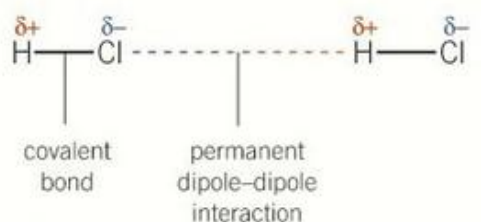
The diagram above shows hydrogen chloride (HCl) molecules. Within each molecule, the H-Cl covalent bond creates a permanent dipole because chlorine is more electronegative than hydrogen. Between molecules, the permanent dipoles attract each other through dipole-dipole interactions.
Comparing molecules with different intermolecular forces
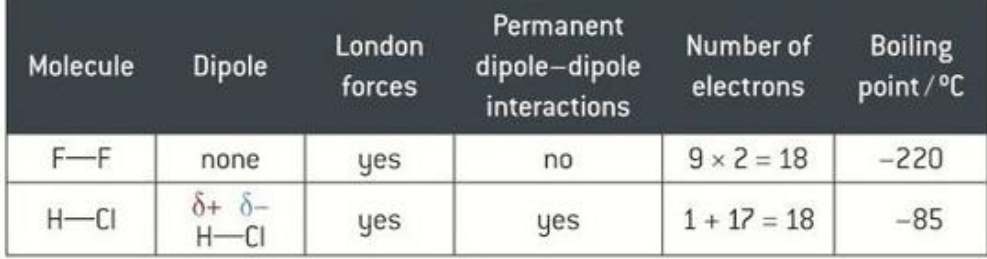
To understand the impact of permanent dipole-dipole interactions, we can compare molecules with similar numbers of electrons but different polarities:
Example
Worked Example: Comparing F₂ and HCl
This comparison between fluorine () and hydrogen chloride (HCl) is particularly instructive:
- Both molecules contain 18 electrons, so they have similar strength London forces
- Fluorine molecules are non-polar and only experience London forces between molecules
- Hydrogen chloride molecules are polar and experience both London forces and permanent dipole-dipole interactions
- The additional permanent dipole-dipole interactions in HCl mean extra energy is needed to separate the molecules
- As a result, HCl has a higher boiling point (-85°C) compared to (-220°C)
Important
Common mistake: Students often forget that polar molecules have induced dipole interactions as well as permanent dipole-dipole interactions. Remember: London forces exist between all molecules, and polar molecules have permanent dipole-dipole interactions in addition to London forces.
Simple molecular substances
A simple molecular substance consists of small molecules with a definite molecular formula. Each molecule contains a specific number of atoms bonded together by covalent bonds. Examples include neon (Ne), hydrogen (), water (), and carbon dioxide ().
Structure of simple molecular substances
In the solid state, simple molecules arrange themselves into a regular three-dimensional structure called a simple molecular lattice. The key features of this structure are:
Note
Key Features of Simple Molecular Lattices:
- Molecules are held in position by weak intermolecular forces
- Within each molecule, atoms are bonded together strongly by covalent bonds
- The covalent bonds within molecules remain intact when the substance changes state
- Only the weak intermolecular forces between molecules are broken during melting or boiling
This dual nature - strong bonds within molecules, weak forces between molecules - explains many properties of simple molecular substances.
Properties of simple molecular substances
Melting and boiling points
Simple molecular substances typically have low melting and boiling points. This characteristic arises directly from the weak intermolecular forces holding the molecules together:
When a simple molecular substance is heated, the thermal energy provided needs only to overcome the weak intermolecular forces to separate the molecules. The strong covalent bonds within each molecule do not break. Since intermolecular forces are relatively weak, only small amounts of energy are needed, resulting in low melting and boiling points.
For example, at room temperature:
- Many simple molecular substances exist as gases (like oxygen and carbon dioxide)
- Some exist as liquids (like water and ethanol)
- Only a few exist as solids (like iodine)
Important
Important distinction: When a simple molecular lattice melts:
- Only the weak intermolecular forces break
- The covalent bonds within molecules remain intact
- The molecules themselves stay whole and unchanged
Solubility of simple molecular substances
The solubility of simple molecular substances depends on whether the substance and solvent are polar or non-polar. The general rule is: like dissolves like.
Solubility of non-polar simple molecular substances
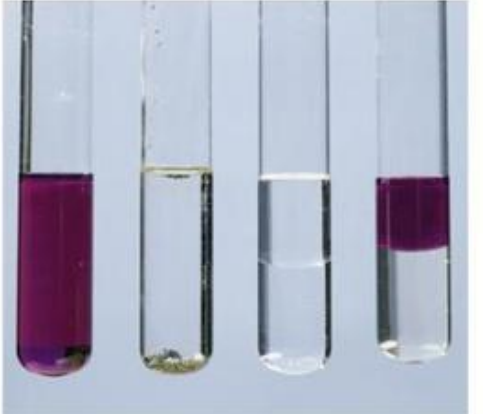
When a non-polar simple molecular compound (such as iodine) is added to a non-polar solvent (such as hexane or cyclohexane):
- Intermolecular forces form between the solute molecules and the solvent molecules
- These new interactions weaken the intermolecular forces within the simple molecular lattice
- The lattice structure breaks down and the compound dissolves
- Therefore, non-polar simple molecular substances tend to be soluble in non-polar solvents
However, when a non-polar simple molecular substance is added to a polar solvent (such as water):
- There is little interaction between the non-polar solute molecules and the polar solvent molecules
- The intermolecular bonding within the polar solvent is too strong to be broken by the non-polar solute
- The lattice structure remains intact
- Therefore, non-polar simple molecular substances tend to be insoluble in polar solvents
Solubility of polar simple molecular substances
Polar simple molecular substances can dissolve in polar solvents because the polar solute molecules and polar solvent molecules can attract each other through dipole-dipole interactions.
Example
Worked Example: Sugar Dissolving in Water
A good example is sugar dissolving in water. Sugar is a polar covalent compound with many O-H bonds. These can form strong dipole-dipole interactions with water molecules, which also contain O-H bonds. This process is similar to how ionic compounds dissolve.
Similarly, hydrogen chloride gas (which has a polar H-Cl bond) is extremely soluble in water, forming hydrochloric acid.
Note
Complex cases: Some compounds, like ethanol (), contain both polar parts (the O-H group) and non-polar parts (the carbon chain). These compounds can dissolve in both polar and non-polar solvents to varying degrees, depending on which part of the molecule dominates.
Biological molecules often have hydrophobic (water-repelling, non-polar) and hydrophilic (water-attracting, polar) regions. The hydrophilic parts typically contain electronegative atoms like oxygen and can interact with water, while the hydrophobic parts consist of non-polar carbon chains.
Electrical conductivity
Simple molecular substances do not conduct electricity. This property can be explained by examining their structure:
- Simple molecular structures contain no mobile charged particles
- Electrons are localized in covalent bonds within molecules
- There are no free electrons or ions available to carry charge
- Without mobile charge carriers, there is nothing to complete an electrical circuit
Therefore, simple molecular substances are non-conductors (or insulators) of electricity. This is true whether the substance is in solid, liquid, or gas form.
This property clearly distinguishes simple molecular substances from:
- Metals (which conduct due to delocalized electrons)
- Ionic compounds when molten or dissolved (which conduct due to mobile ions)
Remember!
Summary
Key Points to Remember:
-
Intermolecular forces are weak attractions between molecules, much weaker than covalent bonds (compare 1-40 kJ mol⁻¹ for intermolecular forces versus 150-500 kJ mol⁻¹ for covalent bonds)
-
London forces exist between all molecules and arise from temporary induced dipoles caused by electron movement; their strength increases with the number of electrons in the molecule
-
Polar molecules experience both London forces and permanent dipole-dipole interactions, giving them higher boiling points than non-polar molecules with similar numbers of electrons
-
Simple molecular substances have low melting and boiling points because only weak intermolecular forces need to be broken during state changes - the strong covalent bonds within molecules remain intact
-
Solubility follows the "like dissolves like" rule: non-polar substances dissolve in non-polar solvents, and polar substances dissolve in polar solvents; simple molecular substances do not conduct electricity as they lack mobile charged particles