The pH of Weak Acids (OCR A-Level Chemistry A): Revision Notes
📚Revision Notes
The pH of Weak Acids
Understanding weak acid dissociation
When a monobasic acid (HA) is dissolved in water, it can behave in two different ways depending on its strength:
-
Strong acids completely dissociate in aqueous solution, meaning all acid molecules break apart. For a strong acid, the concentration of hydrogen ions equals the original acid concentration:
-
Weak acids only partially dissociate in aqueous solution, meaning only some of the acid molecules break apart. For a weak acid, the hydrogen ion concentration is not equal to the original acid concentration:
Because weak acids only partially dissociate, they establish an equilibrium in solution. The dissociation can be represented by the following equilibrium equation:
Note
The concentration of hydrogen ions, , in a weak acid solution depends on two key factors:
- The concentration of the acid,
- The acid dissociation constant,
When weak acid molecules dissociate, hydrogen ions and conjugate base ions are formed in equal quantities. This is a crucial point that will help simplify our calculations later.
The equilibrium expression for weak acids
To understand how to calculate the pH of weak acids, we need to consider what happens at equilibrium. An ICE (Initial, Change, Equilibrium) table helps us organise the concentrations:

At the start, we have only the undissociated weak acid present, with concentrations of and both equal to zero. At equilibrium, some of the acid has dissociated, producing equal concentrations of and .
The acid dissociation constant, , can be calculated using equilibrium concentrations:
We can also express this as:
This expression looks complex, but we can simplify it significantly using two important approximations.
Simplifying calculations with approximations
The equilibrium expression shown above can be greatly simplified by making two reasonable approximations. These approximations are valid for most weak acids you'll encounter at A-Level, and they make pH calculations much more straightforward.
Approximation 1: Hydrogen ions from water are negligible
When a weak acid dissociates, it produces equal concentrations of and ions. However, water itself also dissociates slightly to produce a small concentration of hydrogen ions. In practice, this contribution from water is extremely small and can be neglected compared to the hydrogen ions produced by the weak acid.
Therefore, we can state:
Important
When does this approximation break down?
At 25°C, water dissociation produces . If the pH is greater than 6, then the hydrogen ion concentration from the weak acid becomes similar to that from water, and the approximation is no longer valid. This typically occurs with very weak acids or very dilute solutions.
Note
Exam tip: To put this in perspective, for a weak acid with , only 1 molecule in every 1000 dissociates. At equilibrium, there are still 999 molecules of undissociated weak acid present for every 1 dissociated. This is why the approximations work so well.
Approximation 2: The acid concentration remains essentially constant
Because weak acids dissociate to such a small extent, the equilibrium concentration of the undissociated acid is very similar to the starting concentration. We can assume that:
This means we can neglect any decrease in the concentration of undissociated acid:
Important
When does this approximation break down?
This approximation holds for weak acids with small values. It breaks down when the hydrogen ion concentration becomes significant compared to the starting acid concentration. This occurs when:
- The weak acid is relatively strong (typically )
- The solution is very dilute
In these cases, there is a real difference between and , and the approximation cannot be justified.
The simplified expression
By applying both approximations, we can dramatically simplify the expression:
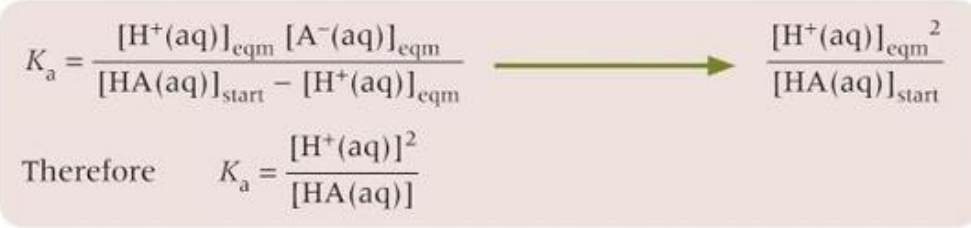
Starting with the full expression and substituting in our approximations:
Using approximation 1:
Using approximation 2:
Therefore:
Note
This simplified expression is much easier to use. Note that we can drop the subscripts (eqm and start) when using this approximation. If you know any two of the three quantities (, , and ), you can always calculate the third.
Calculating the pH of weak acids
To calculate the pH of a weak acid, we need to rearrange the simplified expression to make the subject.
Starting with:
Rearranging:
Important
This is the key equation for calculating the pH of a weak acid. It's well worth memorising.
Once you have calculated , you can find the pH using:
Example
Worked Example: Calculating pH from concentration and
Question: Calculate the pH of ethanoic acid, , at 25°C, where .
Step 1: Calculate from and
Ethanoic acid is a weak acid and partially dissociates:
Using the simplified expression:
Calculator tip: When using your calculator for the square root, make sure to use brackets around the values for . Calculate first, then take the square root of the answer afterwards.
Step 2: Use your calculator to find the pH
Determining experimentally
The acid dissociation constant for a weak acid can be determined experimentally by following these steps:
- Prepare a standard solution of the weak acid with a known concentration
- Measure the pH of the standard solution using a pH meter
Once you have these two values, you can calculate by rearranging the simplified expression.
Example
Worked Example: Calculating from pH measurement
Question: The pH of propanoic acid, , is 3.04. Calculate .
Step 1: Use your calculator to find
Step 2: Calculate from and
When do the approximations break down?
Both worked examples above use the two approximations we discussed earlier. But are these approximations always justified? Understanding when they fail is important for accurate calculations.
Limitations of approximation 1
The first approximation assumes that the dissociation of water is negligible:
Important
At 25°C, dissociation of water produces . If the pH is greater than 6, then the hydrogen ion concentration from dissociation of water becomes significant compared to dissociation of the weak acid. This approximation breaks down for:
- Very weak acids
- Very dilute solutions
In these cases, you must account for the contribution from water dissociation (this is covered in more detail in Topic 20.5).
Limitations of approximation 2
The second approximation assumes that the concentration of acid is much greater than the hydrogen ion concentration at equilibrium:
This allows us to approximate:
Important
This approximation holds for weak acids with small values. It breaks down when the hydrogen ion concentration becomes significant and there is a real difference between and .
This approximation is not justified for:
- Stronger weak acids (typically )
- Very dilute solutions
Checking your approximations
You can carry out weak acid pH calculations without making the approximation, but you will then need to solve a quadratic equation. A far easier method is to use one of the many quadratic equation solver websites available online.
Example
Worked Example: When approximations break down
Calculate the pH of a solution of chlorous acid, ().
Without approximations, the full expression gives:
Rearranging:
This is a quadratic equation of the form where:
Solving the quadratic equation (using a quadratic solver website) gives:
Now compare this with the simpler approximation method:
Comparing the pH values of 1.53 and 1.46, the approximation does not seem to be justified. There is an 18% difference between the values from both methods, which is significant.
Note
Exam tip: Don't worry - you do not need to know how to solve quadratic equations as part of your A-Level chemistry course. If the approximations break down significantly in an exam question, you'll usually be guided through the calculation or given additional information.
Summary
Key Points to Remember:
-
Weak acids only partially dissociate in solution, establishing an equilibrium:
-
Two approximations simplify weak acid calculations: (1) hydrogen ions from water dissociation are negligible, and (2) the acid concentration remains essentially constant
-
The simplified expression for weak acid pH calculations is: - memorise this!
-
Approximations break down for very weak or very dilute acids (approximation 1) and for stronger weak acids with (approximation 2)
-
can be determined experimentally by measuring the pH of a solution with known acid concentration