The pH Scale and Strong Acids (OCR A-Level Chemistry A): Revision Notes
📚Revision Notes
The pH Scale and Strong Acids
Introduction to the pH scale
The pH scale is a fundamental concept in chemistry that provides a simple numerical way to measure and express the concentration of hydrogen ions in a solution. This scale was developed over 100 years ago by Danish chemist Søren Sørensen, who recognized that hydrogen ion concentrations vary enormously in different solutions and can be difficult to work with directly.
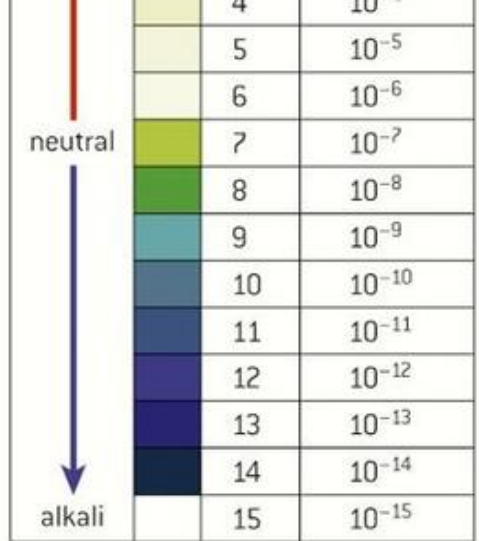
Sørensen discovered that hydrogen ion concentrations in solutions typically range across many orders of magnitude, from very small to relatively large values, all expressed as negative powers of 10. To make these values more manageable and easier to compare, he created the pH scale using the negative logarithm of the hydrogen ion concentration. This clever approach converts a wide range of concentration values (from to mol dm⁻³) into a convenient scale running from 1 to 14.
Note
Today, pH is measured accurately using pH meters, which are electronic devices based on electrochemical cells. These meters contain an electrode that measures the electrical potential created by hydrogen ions in solution.
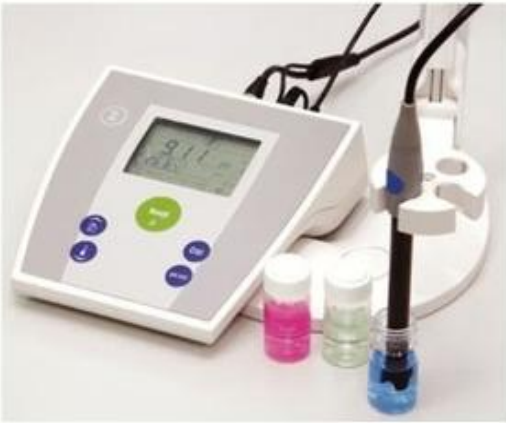
The pH scale helps us classify solutions based on their acidity or alkalinity:
- Solutions with pH less than 7 are acidic (the lower the pH, the more acidic)
- Solutions with pH equal to 7 are neutral
- Solutions with pH greater than 7 are alkaline or basic (the higher the pH, the more alkaline)
The pH scale as a logarithmic scale
Understanding the logarithmic nature of the pH scale is crucial for working with pH values correctly. The table below shows how pH values relate to hydrogen ion concentrations across the full range of the scale.
The mathematical relationship
The relationship between pH and hydrogen ion concentration is defined by two key equations:
And the reverse relationship:
Important
Critical Inverse Relationship
These equations reveal an important pattern you must understand:
- A low concentration of H⁺(aq) corresponds to a high pH value
- A high concentration of H⁺(aq) corresponds to a low pH value
This inverse relationship is the opposite of what many students initially expect!
Understanding logarithmic changes
Because pH is a logarithmic scale, a change of just one pH unit represents a tenfold (10×) change in hydrogen ion concentration. This means:
- A solution with pH 1 has 10 times the concentration of H⁺ ions compared to a solution with pH 2
- A solution with pH 1 has 10¹³ times (10 trillion times) more H⁺(aq) ions than a solution with pH 14
- To dilute a solution from pH 1 to pH 4 (a change of 3 pH units) requires dilution by 10 × 10 × 10 = 1000 times
This logarithmic property makes the pH scale much more convenient than expressing concentrations directly. Comparing pH 1 with pH 14 is far easier than comparing with mol dm⁻³.
Converting between pH and [H⁺(aq)]
Being able to convert between pH values and hydrogen ion concentrations is an essential skill. You will use both equations frequently in calculations.
Using your calculator
Note
Calculator Functions You'll Need
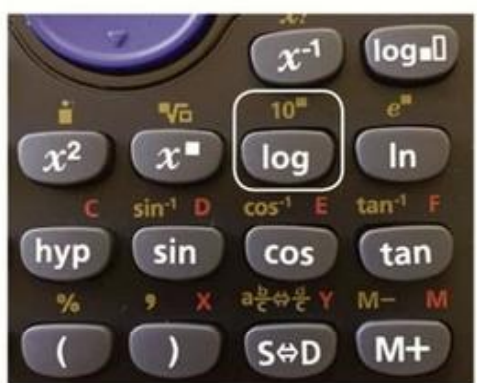
Most scientific calculators have the necessary functions to perform these conversions. You will need to become familiar with:
- The log button for calculating pH from [H⁺(aq)]
- The 10ˣ button for calculating [H⁺(aq)] from pH
Practice using these buttons now to ensure you're comfortable with them before exams!
Example
Worked Example: Converting from [H⁺(aq)] to pH
Question: What is the pH of a solution with a H⁺(aq) concentration of mol dm⁻³?
Solution:
Use the equation:
(to 2 decimal places)
Important check: Does this answer make sense? The hydrogen ion concentration is between and mol dm⁻³, so the pH should be between 2 and 3. It is, so the answer is sensible.
Example
Worked Example: Converting from pH to [H⁺(aq)]
Question: What is the [H⁺(aq)] of a solution with a pH of 8.75?
Solution:
Use the equation:
(to 2 decimal places)
Important check: A pH of 8.75 is between 8 and 9, so the concentration should be between and mol dm⁻³. It is, confirming our answer is reasonable.
Significant figures in pH calculations
Important
Understanding Significant Figures in pH
When working with pH values, remember that:
- The whole number before the decimal point represents the power of 10 (the order of magnitude)
- Significant figures start after the decimal point
For example, a pH of 2.66 has only two significant figures, not three. As a general rule, show pH values to two decimal places unless specifically asked for a different level of precision. This reflects the accuracy of typical pH meters.
Calculating the pH of strong acids
A strong monobasic acid is one that completely dissociates (breaks apart) into ions when dissolved in water. Common strong acids include hydrochloric acid (HCl), nitric acid (HNO₃), and sulfuric acid (H₂SO₄, though this is dibasic).
Complete dissociation
When a strong monobasic acid HA dissolves in water, it completely dissociates according to the equation:
Important
Key Principle: Complete Dissociation
This complete dissociation is crucial because it means that the concentration of hydrogen ions in solution equals the original concentration of the acid:
Therefore, the pH of a strong acid can be calculated directly from the concentration of the acid without any further equilibrium calculations. This simple 1:1 relationship only applies to strong acids!
Example
Worked Example: Calculating pH from Acid Concentration
Question: A sample of nitric acid has a concentration of mol dm⁻³. What is the pH?
Solution:
Step 1: Convert [HA(aq)] into [H⁺(aq)]
HNO₃ is a strong acid and completely dissociates:
Step 2: Use your calculator to find the pH:
Example
Worked Example: Calculating Acid Concentration from pH
Question: A sample of hydrochloric acid has a pH of 3.79. What is the concentration of the hydrochloric acid?
Solution:
Step 1: Use your calculator to find [H⁺(aq)]:
Step 2: Convert [H⁺(aq)] into [HA(aq)]:
HCl is a strong acid and completely dissociates:
Important
Strong Acids vs Weak Acids
This simple method only works for strong acids that completely dissociate. Weak acids require a different approach involving equilibrium calculations, which you will study later.
pH changes on dilution
When you dilute an acid solution by adding water, you decrease the concentration of hydrogen ions, which increases the pH. The relationship is logarithmic, so the pH change is relatively modest even for significant dilutions.
As established earlier, a solution with pH 1 has 10 times the concentration of H⁺ ions as a solution with pH 2. This means that halving the concentration of a solution changes the pH by approximately 0.30 units.
Example
Worked Example: pH on Dilution
Question: 50 cm³ of 0.100 mol dm⁻³ hydrochloric acid is diluted to 100 cm³ with water. What is the change in pH?
Solution:
Step 1: Find the concentration of the diluted hydrochloric acid, [HCl(aq)]
When diluted to 100 cm³, the concentration has been halved to 0.0500 mol dm⁻³.
Step 2: Find the pH values before and after dilution
HCl is a strong acid and completely dissociates:
Before dilution: [H⁺(aq)] = 0.100 mol dm⁻³
After dilution: [H⁺(aq)] = 0.0500 mol dm⁻³
Conclusion: Changing the concentration by a factor of 2 changes the pH by 0.30 units.
Note
Understanding Dilution Effects
This demonstrates an important principle: because pH is logarithmic, dilutions have a smaller effect on pH than you might initially expect.
- A 100-fold dilution only changes the pH by 2 units
- A 1000-fold dilution changes it by 3 units
This is why acids remain dangerous even when diluted - a 10-fold dilution only increases the pH by 1 unit!
Summary
Key Points to Remember
-
The pH scale is a logarithmic scale ranging from 0-14, where pH < 7 is acidic, pH = 7 is neutral, and pH > 7 is alkaline
-
The two key equations are: pH = -log[H⁺(aq)] and [H⁺(aq)] = 10⁻ᵖᴴ - learn both as you will use them constantly
-
A change of 1 pH unit represents a 10-fold change in hydrogen ion concentration, making the pH scale much more manageable than using concentrations directly
-
For strong acids, complete dissociation means [H⁺(aq)] = [HA(aq)], allowing direct calculation of pH from acid concentration
-
Always check your answers are sensible: [H⁺(aq)] should have a negative power of 10 within one unit of the pH value, and acidic solutions should have pH < 7 while alkaline solutions have pH > 7