Enthalpy Changes in Solution (OCR A-Level Chemistry A): Revision Notes
📚Revision Notes
Enthalpy Changes in Solution
Introduction
When ionic compounds dissolve in water, there is an overall energy change associated with the process. Understanding these energy changes helps explain why some ionic compounds dissolve easily whilst others do not, and whether the dissolution process absorbs or releases heat.
Dissolving ionic compounds
Water molecules possess a remarkable ability to break apart the giant ionic lattice structure and overcome the strong electrostatic forces between oppositely-charged ions. This property makes water an excellent solvent for many ionic compounds.
When an ionic salt dissolves in water:
- The regular arrangement of ions in the solid lattice is disrupted
- Water molecules surround and separate the individual ions
- The ions become dispersed throughout the solution as aqueous ions
Note
The ability of water to dissolve ionic compounds stems from its polar nature - the partial charges on water molecules interact with the charged ions in the lattice, gradually pulling them away from their fixed positions.
For example, when sodium chloride dissolves:
In the solid lattice, and ions are held together by strong electrostatic attractions. In the aqueous solution, these ions are separate but now surrounded by water molecules.
Water molecules interact with the ions through their partial charges. The oxygen atom in water carries a partial negative charge (), which is attracted to positive ions. The hydrogen atoms carry partial positive charges (), which are attracted to negative ions.
Standard enthalpy change of solution
The standard enthalpy change of solution () is defined as the enthalpy change that occurs when one mole of a solute dissolves completely in a solvent under standard conditions. When the solvent is water, the ions from the ionic lattice become surrounded by water molecules to form aqueous ions.
The enthalpy change of solution can be either:
- Exothermic (negative ) - heat is released to the surroundings, temperature increases
- Endothermic (positive ) - heat is absorbed from the surroundings, temperature decreases
For sodium chloride dissolving in water:
Note
The positive value indicates this process is endothermic - the solution gets cooler as sodium chloride dissolves. This is why adding salt to ice can lower the temperature further, as the dissolving process absorbs heat from the surroundings.
Experimental determination of enthalpy change of solution
You can determine the enthalpy change of solution directly in the laboratory using simple calorimetry equipment. The method involves measuring the temperature change when a known mass of ionic compound dissolves in a known volume of water.
Procedure for potassium chloride
- Weigh out a sample of accurately
- Using a measuring cylinder, transfer a known volume of distilled water (e.g. 25.0 cm³) into a plastic cup in a beaker
- Measure the initial temperature of the water to the nearest 0.5°C
- Quickly add all the to the water and stir with the thermometer
- Record the lowest temperature reached (for endothermic) or highest temperature (for exothermic) to the nearest 0.5°C
Calculation steps
Example
Exemplo Trabalhado: Determining the enthalpy change of solution for KCl
Step 1: Calculate the energy change in the solution using:
where:
- = mass of solution (NOT just water)
- = specific heat capacity of solution (≈ 4.18 J g⁻¹ K⁻¹)
- = temperature change (in °C or K)
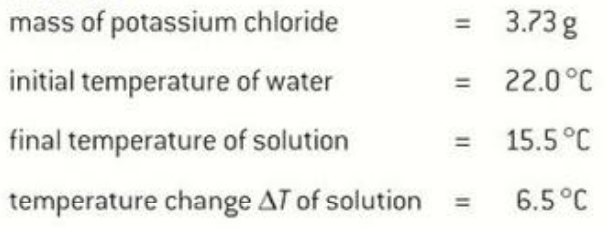
For the potassium chloride example:
- Density of water = 1.00 g cm⁻³
- Therefore, 25.0 cm³ of water has mass = 25.0 g
- Mass of solution = mass of water + mass of KCl = 25.0 + 3.73 = 28.73 g
Step 2: Calculate the amount in moles of compound that dissolved.
Step 3: Calculate in kJ mol⁻¹.
The equation shows:
In the experiment, 0.0500 mol KCl absorbed 0.781 kJ of energy from the solution (temperature decreased).
Therefore, 1 mol KCl would absorb:
The positive sign indicates the process is endothermic.
Important considerations
Important
Mass in calculations: When using , the mass must be the mass of the solution (water + dissolved compound), not just the mass of water. The thermometer measures the temperature of the entire solution. Using only the water mass would introduce a significant error - in the example above, this would give 13% error.
Important
Sign conventions: Take care with signs. If the temperature decreases, the dissolution is endothermic and is positive. If the temperature increases, the dissolution is exothermic and is negative.
The dissolving process
When a solid ionic compound dissolves in water, two distinct processes occur:
- The ionic lattice breaks apart to form separate gaseous ions
- Water molecules surround the gaseous ions to form hydrated aqueous ions
Each process involves an enthalpy change.
Stage 1: Breaking the lattice
Breaking up the ionic lattice requires energy input to overcome the strong electrostatic attractions between oppositely-charged ions. This process is endothermic.
For sodium chloride:
Note
This is the opposite of lattice formation. The lattice enthalpy (lattice formation) would be:
Breaking the lattice is therefore the negative of lattice enthalpy (endothermic process).
Stage 2: Hydration of ions
The separate gaseous ions then interact with polar water molecules to form hydrated aqueous ions. This process releases energy and is exothermic. The energy change is called the enthalpy change of hydration.
The enthalpy change of hydration () is the enthalpy change that occurs when gaseous ions dissolve in water to form one mole of aqueous ions.
For sodium and chloride ions:
Both hydration processes are exothermic (negative values).
Energy cycles and Hess's law
We can link the enthalpy change of solution, lattice enthalpy, and hydration enthalpies using an energy cycle and Hess's law.
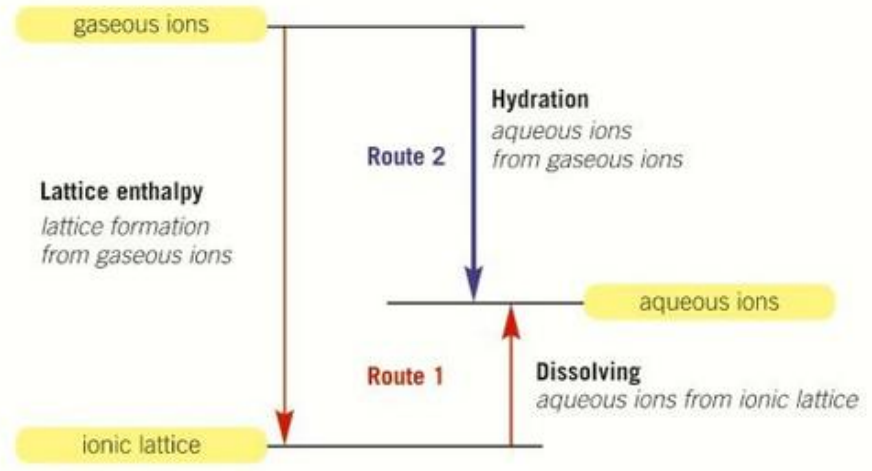
The energy cycle shows two routes from ionic lattice to aqueous ions:
- Route 1 (direct): Ionic lattice dissolves directly to form aqueous ions - this is
- Route 2 (indirect): Ionic lattice breaks into gaseous ions (lattice breaking), then gaseous ions hydrate to form aqueous ions (hydration)
According to Hess's law, the total enthalpy change is the same regardless of route:
Therefore:
Or rearranging:
Note
This relationship allows us to calculate any one of these values if we know the other three. It's particularly useful because lattice enthalpies and hydration enthalpies cannot be measured directly but can be calculated from measurable quantities.
Whether dissolution is exothermic or endothermic
The enthalpy change of solution can be exothermic or endothermic depending on the relative magnitudes of:
- The lattice enthalpy (breaking the lattice - endothermic)
- The sum of hydration enthalpies (forming aqueous ions - exothermic)
Note
If the energy released during hydration is greater than the energy required to break the lattice, dissolution is exothermic overall. If less energy is released during hydration than is required to break the lattice, dissolution is endothermic overall.
Worked example: Calculating lattice enthalpy of sodium chloride
Example
Exemplo Trabalhado: Calculating the lattice enthalpy of sodium chloride
Given information:
Calculate the lattice enthalpy of sodium chloride.
Step 1: Construct the energy cycle
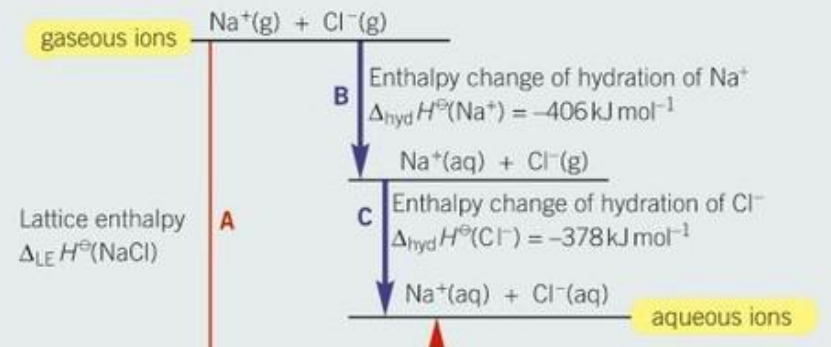
The energy cycle must show:
- Gaseous ions at the top
- Ionic lattice at the bottom left
- Aqueous ions at the bottom right
Label the arrows:
- Arrow A: Lattice enthalpy (gaseous ions → ionic lattice) - we want to find this
- Arrow B: Hydration of Na⁺
- Arrow C: Hydration of Cl⁻
- Arrow D: Enthalpy change of solution
Step 2: Apply Hess's law
Identify the two routes:
- Route 1: A + D
- Route 2: B + C
Using Hess's law: A + D = B + C
Substitute the values:
The lattice enthalpy of sodium chloride is -788 kJ mol⁻¹.
Important
Important study tip: Between each horizontal energy level in the cycle, only one chemical species changes state or form, and all other species remain balanced. This helps ensure your energy cycle is correctly constructed.
Worked example: Calculating enthalpy change of hydration
Example
Exemplo Trabalhado: Calculating the enthalpy change of hydration of Ca²⁺
Given information:

Calculate the enthalpy change of hydration of ions.
Solution
This example differs from the previous one in two important ways:
- Two ions are involved, so we must multiply the hydration enthalpy of by 2
- The enthalpy change of solution of calcium bromide is exothermic (negative), which affects the positioning in the energy cycle
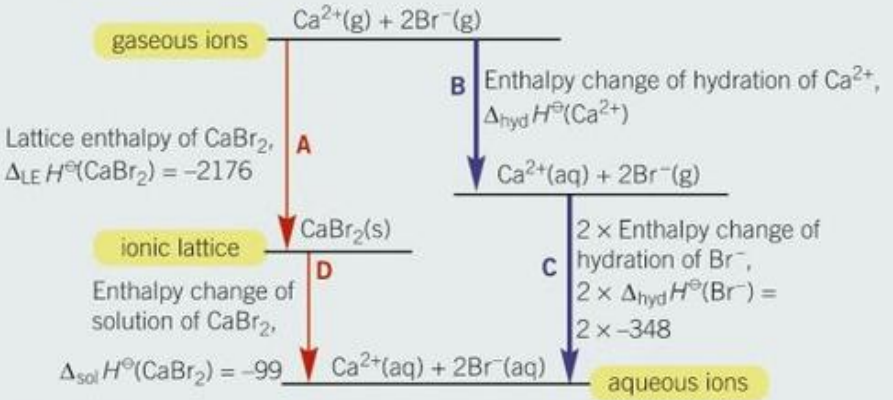
Energy cycle construction
The cycle shows:
- Gaseous ions at the top
- Ionic lattice at the middle left
- Aqueous ions at the bottom
Applying Hess's law
Two routes from gaseous ions to aqueous ions:
- Route 1: A + D
- Route 2: B + C
Using Hess's law: A + D = B + C
Substitute the values:
The enthalpy change of hydration of ions is -1579 kJ mol⁻¹.
Application: Cold packs
Cold packs used for sports injuries demonstrate an endothermic dissolution process. These packs contain two separate compartments - one with a chemical (commonly ammonium nitrate, ), and the other with water. When the pack is squeezed, the seal breaks and the chemical dissolves in the water.

Note
Since the dissolution of ammonium nitrate is endothermic, it absorbs heat energy from the surroundings (the injured area), causing a cooling effect. This reduces swelling and provides pain relief.
The dissolving process involves:
- Breaking the ionic lattice (endothermic - requires energy)
- Hydrating the ions (exothermic - releases energy)
For the cold pack to work, the energy required to break the lattice must be greater than the energy released during hydration, making the overall process endothermic.
Remember!
Summary
Key Points to Remember:
-
Enthalpy change of solution () is the enthalpy change when one mole of solute dissolves in a solvent to form aqueous ions. It can be exothermic or endothermic.
-
Dissolving occurs in two stages: (1) Breaking the ionic lattice into gaseous ions (endothermic), and (2) Hydrating the gaseous ions to form aqueous ions (exothermic).
-
Enthalpy change of hydration () is the enthalpy change when gaseous ions dissolve in water to form one mole of aqueous ions. This is always exothermic.
-
Energy cycles and Hess's law connect solution enthalpy, lattice enthalpy, and hydration enthalpies:
-
Experimental determination uses where is the mass of the entire solution (not just water), and careful attention to signs is essential.
-
Multiple ions: When more than one of a particular ion is present (e.g., has two ions), multiply that ion's hydration enthalpy by the appropriate factor in calculations.