Rate Constants and Temperature (OCR A-Level Chemistry A): Revision Notes
📚Revision Notes
Rate constants and temperature
Introduction
Temperature has a significant effect on the rate constant of a reaction. Understanding this relationship is crucial for predicting and controlling reaction rates in both laboratory and industrial settings.
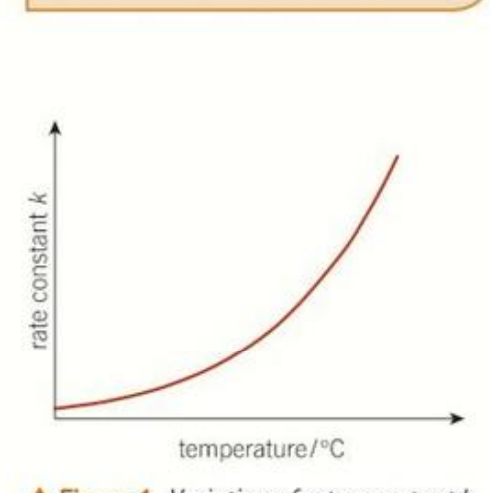
As temperature increases, the rate constant () increases, which in turn increases the rate of reaction.
Note
A useful rule of thumb: for many reactions, each 10°C rise in temperature approximately doubles the rate constant and therefore doubles the reaction rate.
The relationship between rate constant and temperature is not linear but exponential, as shown in the graph below.
Factors affecting the rate constant
When temperature increases, two distinct factors contribute to the increased rate constant. Understanding these factors helps explain why temperature has such a powerful effect on reaction rates.
Shift in the Boltzmann distribution
The primary factor is that increasing temperature shifts the Boltzmann distribution to the right. This shift increases the proportion of particles that have energy equal to or greater than the activation energy (). These particles possess sufficient energy for a successful reaction to occur.
Important
This change in the distribution of molecular energies is the dominant factor in determining how rate changes with temperature. The shift in the Boltzmann distribution has a far greater effect than increased collision frequency.
Increased collision frequency
The secondary factor is that as temperature increases, particles move faster on average. This means they collide more frequently with each other.
However, this increased collision frequency has a relatively small effect compared to the change in the proportion of molecules exceeding the activation energy.
Collision orientation
It is important to remember that for a reaction to occur, particles must not only collide with sufficient energy (exceeding ) but also with the correct orientation. The pre-exponential factor in the Arrhenius equation accounts for this requirement.
The Arrhenius equation
The Arrhenius equation provides a mathematical relationship between the rate constant and temperature. This exponential relationship can be expressed in two forms: the exponential form and the logarithmic form.
Exponential form
The Arrhenius equation in its exponential form is:
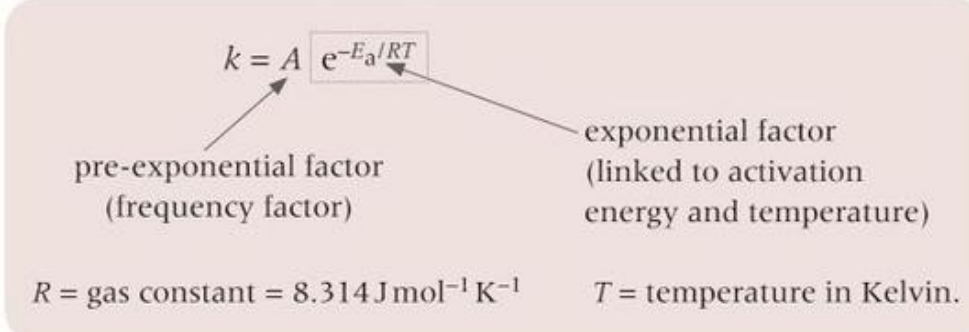
This equation has several important components, as shown in the diagram below:
Components of the equation:
The pre-exponential factor (), also called the frequency factor, takes into account the frequency of collisions with the correct orientation. This term increases slightly with temperature as collision frequency increases, but it is essentially constant over a small temperature range. The frequency factor represents what the rate would be if there were no activation energy barrier.
The exponential factor () represents the proportion of molecules that exceed the activation energy () and have sufficient energy for the reaction to take place. This term is directly linked to both the activation energy and the temperature.
Constants in the equation:
- is the gas constant = 8.314 J mol⁻¹ K⁻¹
- is the temperature measured in Kelvin (K)
- is the activation energy measured in J mol⁻¹
- is the rate constant (units depend on the order of reaction)
Note
When using this equation, it is essential to ensure that temperature is in Kelvin and that the units for and are compatible (both using joules).
Logarithmic form of the Arrhenius equation
Deriving the logarithmic form
The Arrhenius equation can be rearranged into a logarithmic form, which is particularly useful for graphical analysis. By taking the natural logarithm (ln) of both sides of the exponential equation, we obtain:
This can be rearranged to:
Graphical interpretation
This logarithmic form is very useful because it has the structure of a straight-line equation:
By comparing the equations:
- (gradient)
- (intercept on the y-axis)
Therefore, a plot of (on the y-axis) against (on the x-axis) produces a straight line with a downward slope.
Determining activation energy and pre-exponential factor
From the graph of versus :
To find the activation energy:
- Gradient =
- Therefore:
- Since J mol⁻¹ K⁻¹, we can calculate in J mol⁻¹ (then convert to kJ mol⁻¹)
To find the pre-exponential factor:
- Intercept on y-axis =
- Therefore:
Important
Remember the negative sign! The gradient is negative (), so when calculating , you must use:
This means if your gradient is negative, you multiply by negative to get a positive activation energy.
Note that depending on your data, the graph may have a positive or negative ln value. It may even cross the x-axis. However, the principle remains the same: the gradient is and the intercept is .
Worked example: using the Arrhenius equation
Example
Worked Example: Determining Activation Energy and Frequency Factor
Question: Hydrogen peroxide decomposes to form water and oxygen according to the equation:
The rate constant varies with temperature as shown in the table below:
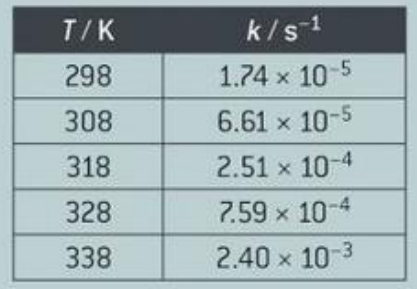
Plot a suitable graph and calculate the activation energy and frequency constant for this reaction.
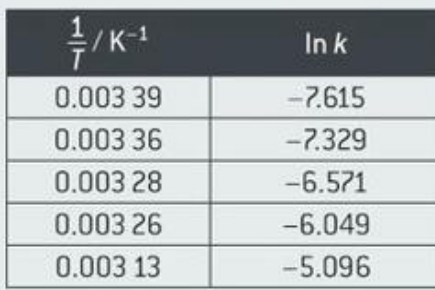
Step 1: Calculate the values of ln k and 1/T
First, we need to convert the raw data into the form needed for our graph. We need to calculate:
- values (in K⁻¹)
- values
The calculated values are shown in the table below:
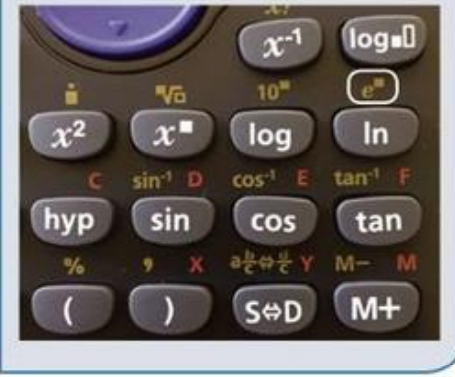
Calculator Tip: To find natural logarithms, use the ln button on your calculator. For the exponential function (e to the power of x), you typically need to use [shift] or [2nd] followed by the ln button to access the or exp function.
Step 2: Plot the graph
Plot (y-axis) against (x-axis):
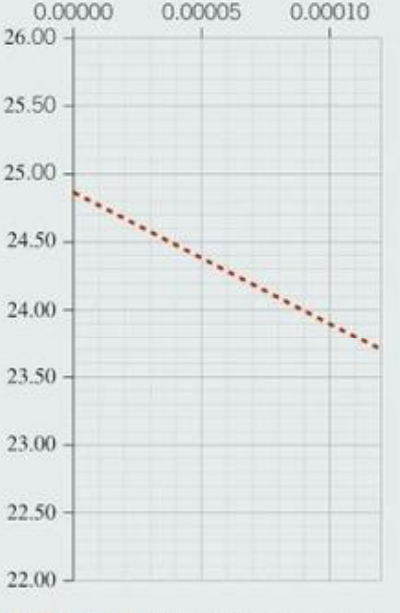
The graph should show a straight line with a negative gradient, as predicted by the logarithmic form of the Arrhenius equation.
Step 3: Calculate the activation energy
To find , we need to determine the gradient of the straight line.
Choose two points that are well separated on your line (preferably not data points but points on your best-fit line).
From the graph:
Since gradient = :
Converting to kJ mol⁻¹:
Step 4: Calculate the pre-exponential factor A
To find , we need the y-intercept of the graph. This requires extrapolating the straight line back to the y-axis (where ).
From the extrapolation shown in the diagram, the intercept = 25.40
Since intercept = :
To find , we need to use the exponential function (the inverse of ln):
Using a calculator:
The units of are the same as the units of (in this case s⁻¹ for a first-order reaction). :::
Study tips
Using the Arrhenius equation
Note
While there are two forms of the Arrhenius equation, you will mainly use the logarithmic form () to determine and graphically. However, it is important to recognise and understand the exponential form () as well, as it shows the direct relationship between variables.
Calculator functions
Make sure you are familiar with using these functions on your calculator:
- ln button for natural logarithms
- exp or function (usually accessed via [shift] or [2nd] button followed by ln)
These functions are essential for converting between ln and , and between ln and .
Key points about the graphs
When plotting versus :
- Always plot on the y-axis and on the x-axis
- The gradient will be negative
- Make sure to use appropriate scales
- Draw a best-fit straight line through the points
- Extrapolate carefully back to the y-axis to find the intercept
- Show your working clearly, including how you calculated the gradient
Common mistakes to avoid
Important
Watch out for these common errors:
- Temperature units: Always convert temperature to Kelvin (K = °C + 273)
- Sign of gradient: Remember the gradient is negative, so = -gradient ×
- Units consistency: Ensure and use the same energy units (joules)
- Exponential function: To find from ln , use , NOT
- Graph axes: Don't swap the axes - ln must be on the y-axis
Summary
Summary
Key Points to Remember:
- Temperature increases cause exponential increases in the rate constant
- The main effect is the shift in the Boltzmann distribution, not increased collision frequency
- The Arrhenius equation links , , , and :
- The logarithmic form allows graphical determination:
- Plot ln versus to get a straight line with:
- Gradient =
- Intercept = ln
- Always use temperature in Kelvin and ensure consistent units for energy
- Use your calculator's ln and functions correctly to convert between forms
- Remember: and