Formation and Shapes of Complex Ions (OCR A-Level Chemistry A): Revision Notes
📚Revision Notes
Formation and Shapes of Complex Ions
Introduction to complex ions
Transition metals have a unique ability to form complex ions, which is one of their most important chemical properties. When you dissolve certain metal compounds in water, they often produce coloured solutions. For example, when hydrated copper(II) sulfate () dissolves in water, it creates a distinctive blue solution containing the complex ion .

Note
While complex ion formation is particularly characteristic of d-block elements, it's important to note that other elements, such as aluminium, can also form complex ions. This demonstrates that the phenomenon isn't exclusive to transition metals, though they show this behaviour most prominently.
What are complex ions?
A complex ion forms when one or more molecules or negatively charged ions bond to a central metal ion. The molecules or ions that attach themselves to the metal are called ligands. Understanding how these ligands interact with the metal ion is fundamental to grasping complex ion chemistry.
Ligands and coordinate bonds
A ligand is a molecule or ion that donates a pair of electrons to a central metal ion, forming what we call a coordinate bond (also known as a dative covalent bond). This type of bond is special because both electrons in the shared pair come from the same atom - in this case, from the ligand rather than being contributed by both bonding partners.
Note
Key features of a coordinate bond:
- Both electrons in the bond come from one atom (the ligand)
- The ligand must have a lone pair of electrons available to donate
- The metal ion must have empty orbitals to accept the electron pair
Coordination number
The coordination number tells you how many coordinate bonds are attached to the central metal ion. This number is crucial because it determines the shape of the complex ion. The most common coordination numbers you'll encounter are 6 and 4, though other values are possible.
Representing complex ions using formulas
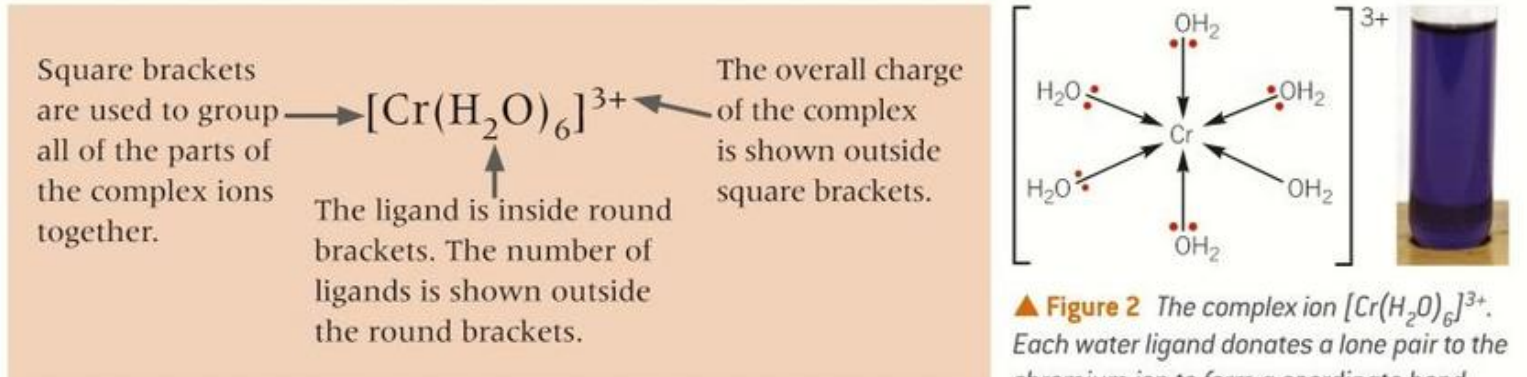
When writing the formula of a complex ion, chemists use a specific notation system that provides important information about the structure:
- The entire complex ion is enclosed in square brackets
- The ligands are written inside the brackets, shown in round brackets with a subscript indicating how many of each ligand are present
- The overall charge of the complex is written outside the square brackets as a superscript
Important
The overall charge of a complex ion equals the sum of the charge on the central metal ion plus the charges of all the ligands present.
Example
Worked Example: Analyzing
In the complex ion , formed when chromium(III) chloride () dissolves in water:
Step 1: Identify the metal ion and its oxidation state
- Chromium has an oxidation state of +3
Step 2: Identify the ligands
- Water molecules () act as ligands
- Each water molecule donates a lone pair from its oxygen atom
Step 3: Determine the coordination number
- There are six water ligands
- Therefore, the coordination number is 6
Note
Exam tip: Ligands typically contain atoms with lone pairs of electrons. Nitrogen and oxygen atoms are common sites for lone pairs, making molecules containing these atoms good candidates for acting as ligands.
Types of ligands
Ligands can be classified based on how many lone pairs of electrons they can donate to the central metal ion. Understanding the difference between monodentate and bidentate ligands is essential for A-Level chemistry.
Monodentate ligands
A monodentate ligand is able to donate just one pair of electrons to a central metal ion. The word "monodentate" comes from "mono" (one) and "dentate" (tooth), suggesting the ligand has one "binding site".
Common monodentate ligands include both neutral molecules and negatively charged ions:
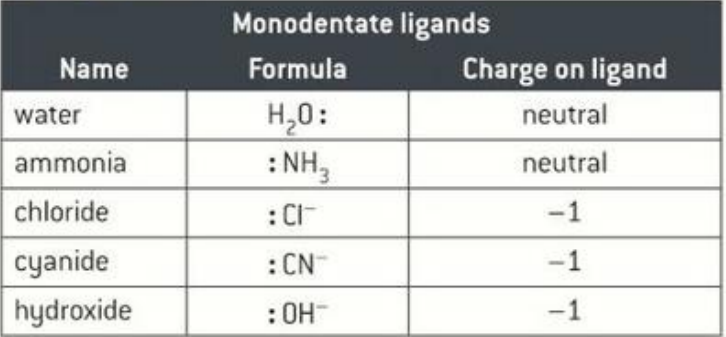
Notice that neutral ligands like water () and ammonia () have no charge, while ionic ligands like chloride (), cyanide (), and hydroxide () carry a negative charge. This affects the overall charge of the resulting complex ion.
Note
Study point: All ligands contain at least one lone pair of electrons - this is what enables them to form coordinate bonds with metal ions.
Bidentate ligands
Some ligands can donate two lone pairs of electrons to the central metal ion, forming two coordinate bonds. These are called bidentate ligands (from "bi" meaning two). The most common bidentate ligands you need to know are:
- 1,2-diaminoethane (often abbreviated as "en")
- Ethanedioate ion (also called oxalate ion)
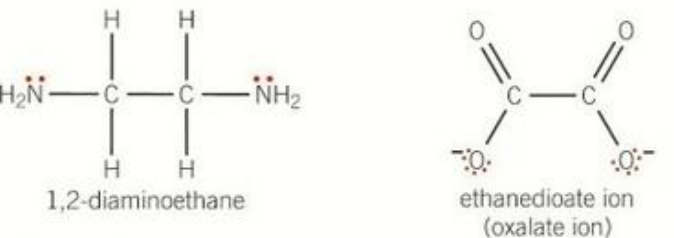
In 1,2-diaminoethane, each nitrogen atom has a lone pair of electrons available to donate, allowing the ligand to form two coordinate bonds to the central metal ion. Similarly, in the ethanedioate (oxalate) ion, each negatively charged oxygen atom can donate a lone pair of electrons to form a coordinate bond.
An example of a complex containing bidentate ligands is :
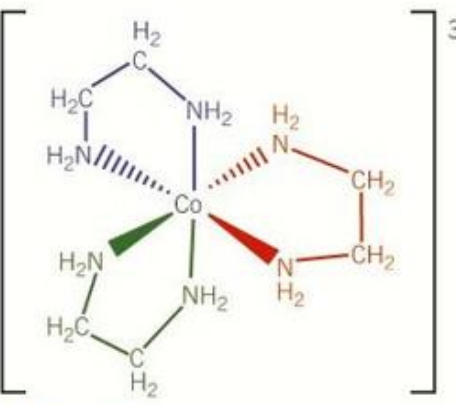
In this complex:
- The oxidation state of cobalt is +3
- The coordination number is 6 (because there are three bidentate ligands, and each forms two coordinate bonds: )
Important
When counting the coordination number for bidentate ligands, remember that each bidentate ligand contributes 2 to the coordination number, even though it's only one molecule.
Shapes of complex ions
The three-dimensional shape of a complex ion depends directly on its coordination number. Understanding these shapes and their associated bond angles is crucial for exam success.
Six-coordinate complexes: octahedral shape
Many complex ions have a coordination number of six, which results in an octahedral shape. In this arrangement, the ligands are positioned at the corners of an octahedron around the central metal ion, with bond angles of approximately 90° between adjacent ligands.
A common example is the manganese complex formed when manganese sulfate () dissolves in water, producing :

The octahedral shape is also shown by the cobalt complex mentioned earlier, which has six coordinate bonds (three bidentate ligands, each forming two bonds), giving it an octahedral geometry with 90° bond angles.
Note
Key features of octahedral complexes:
- Coordination number: 6
- Bond angles: 90°
- Very common shape for transition metal complexes
Four-coordinate complexes
Complexes with a coordination number of four can adopt two different shapes: tetrahedral or square planar. The shape that forms depends on the specific metal ion and its electronic configuration.
Tetrahedral complexes
The tetrahedral shape is by far the more common of the two four-coordinate geometries. In this arrangement, the four ligands are positioned at the corners of a tetrahedron around the central metal ion, with bond angles of approximately 109.5°.
Common examples include and :

Note
Key features of tetrahedral complexes:
- Coordination number: 4
- Bond angles: 109.5°
- Common for chloride complexes
- Different metal ions produce different coloured solutions (cobalt gives blue, copper gives yellow)
Square planar complexes
A square planar shape is less common and occurs mainly with transition metals that have eight d-electrons in their highest energy d-sub-shell. Metals that commonly form square planar complexes include platinum(II), palladium(II), and gold(III).
In a square planar complex, the four ligands are arranged at the corners of a square around the central metal ion, all in the same plane. The bond angles between adjacent ligands are 90°, similar to those in an octahedral complex, but unlike the octahedral shape, there are no ligands above or below the plane.
An example is , where four ammonia ligands are arranged in a square around the platinum ion.
Note
Key features of square planar complexes:
- Coordination number: 4
- Bond angles: 90°
- All ligands lie in the same plane
- Less common than tetrahedral geometry
- Typical for Pt(II), Pd(II), and Au(III) complexes
Important
Exam tip: You should be able to draw 3D representations of these shapes, showing appropriate bond angles. Use wedged and dashed lines to indicate bonds coming forward and going backward from the plane of the paper.
Colours in transition metal chemistry
The characteristic colours of transition metal complexes arise from electronic transitions within the d-orbitals of the metal ion. The colour you observe depends on several factors: the identity of the metal, its oxidation state, and the ligands coordinated to it.
When white light passes through a solution containing a complex ion, certain wavelengths are absorbed while others are transmitted or reflected. The colour we see is complementary to the colour absorbed. For instance:
- If a compound absorbs red light, it appears cyan (blue-green)
- If a compound absorbs blue light, it appears yellow/orange
- If all wavelengths are absorbed, the compound appears black
- If no wavelengths are absorbed, the compound appears colourless or white
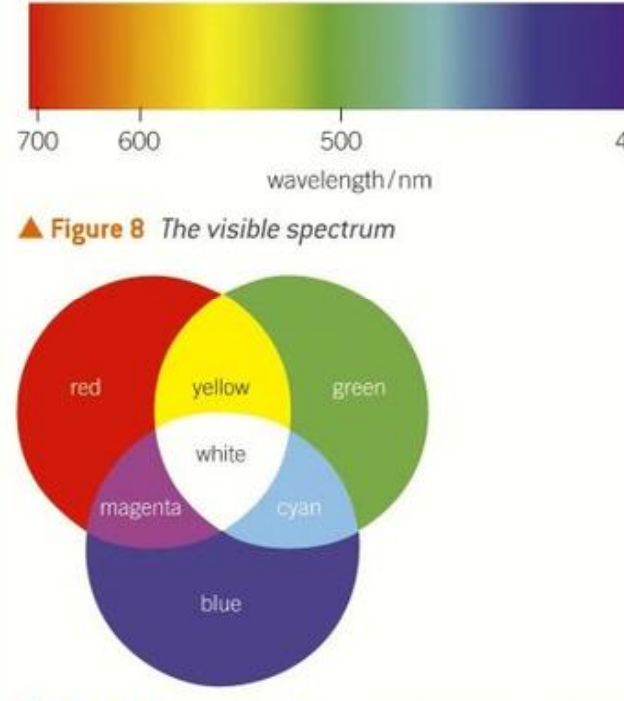
Example
Example: Complex Ion Colours
Different complex ions show different colours based on light absorption:
- absorbs red light and appears pale blue
- absorbs cyan light and appears orange
- absorbs blue light and appears yellow
Important
The colour of chromium complexes varies significantly with oxidation state:
- Chromium(VI) is orange
- Chromium(III) appears in various colours (green, cyan, blue, magenta) depending on ligands
Summary of key shapes and bond angles
| Coordination Number | Shape | Bond Angles | Example |
|---|---|---|---|
| 6 | Octahedral | 90° | |
| 4 | Tetrahedral | 109.5° | |
| 4 | Square planar | 90° |
Summary
Key Points to Remember:
- Complex ions form when ligands donate electron pairs to a central metal ion through coordinate (dative covalent) bonds
- Monodentate ligands donate one lone pair (e.g., , , ), while bidentate ligands donate two lone pairs (e.g., 1,2-diaminoethane, ethanedioate)
- The coordination number indicates how many coordinate bonds attach to the metal ion and determines the shape of the complex
- Six-coordinate complexes are octahedral with 90° bond angles
- Four-coordinate complexes can be tetrahedral (109.5° angles) or square planar (90° angles)
- Complex ion formulas use square brackets with the overall charge outside the brackets
- The overall charge equals the metal ion charge plus the sum of all ligand charges
- Colours of transition metal complexes arise from absorption of specific wavelengths of visible light
Exam focus checklist
Note
Check your understanding:
✓ Can you define ligand, coordinate bond, and coordination number?
✓ Can you calculate the overall charge of a complex ion from the metal charge and ligand charges?
✓ Can you identify whether a ligand is monodentate or bidentate from its structure?
✓ Can you draw accurate 3D structures of octahedral, tetrahedral, and square planar complexes with correct bond angles?
✓ Can you work out the coordination number when bidentate ligands are present?
✓ Can you write the formula of a complex ion correctly using square brackets?