Modification of properties for specific purposes (AQA GCSE Design and Technology): Revision Notes
📚Revision Notes
Modification of properties for specific purposes
Metal properties like hardness, toughness, ductility, and malleability can be changed through specialised heat treatment processes. Understanding these modification techniques allows engineers and manufacturers to create materials perfectly suited for their intended applications.
Note
These heat treatment processes are essential for modern manufacturing, allowing the same base materials to be customised for vastly different applications - from precision cutting tools to flexible components that must withstand repeated stress.
Hardening and tempering
The hardening process
Hardening transforms steel into a much harder material, though this comes with the trade-off of increased brittleness. The process involves heating carbon steel to its critical temperature of 900°C, then rapidly cooling it by plunging it into water. This quick cooling, called quenching, fundamentally alters the carbon's internal structure, creating a harder but more brittle material.
Important
The rapid temperature change during quenching is crucial - slow cooling would not achieve the desired hardness increase. However, the resulting material is often too brittle for practical use without further treatment.
The tempering process
Since hardened steel is often too brittle for practical use, tempering provides a way to reduce this brittleness while maintaining much of the increased hardness. The tempering process involves four key steps:
- Clean the steel surface with emery cloth until the oxide colours become clearly visible
- Heat the steel to a specific temperature, which can be determined by observing the colour changes on the cleaned surface
- Once the desired temperature is reached, quench the steel in water to achieve the perfect balance of reduced brittleness and increased toughness
- Different temperatures are chosen depending on the intended use of the tool or component
Example
Worked Example: Tempering a Cold Chisel
Step 1: Clean the chisel surface with emery cloth until it's bright and shiny Step 2: Heat gradually while watching for colour changes - pale yellow appears at around 221°C Step 3: Continue heating until a darker straw yellow appears (around 238°C) Step 4: Immediately quench in water to lock in the desired properties
The result is a chisel that maintains hardness for cutting while having enough toughness to withstand impact.
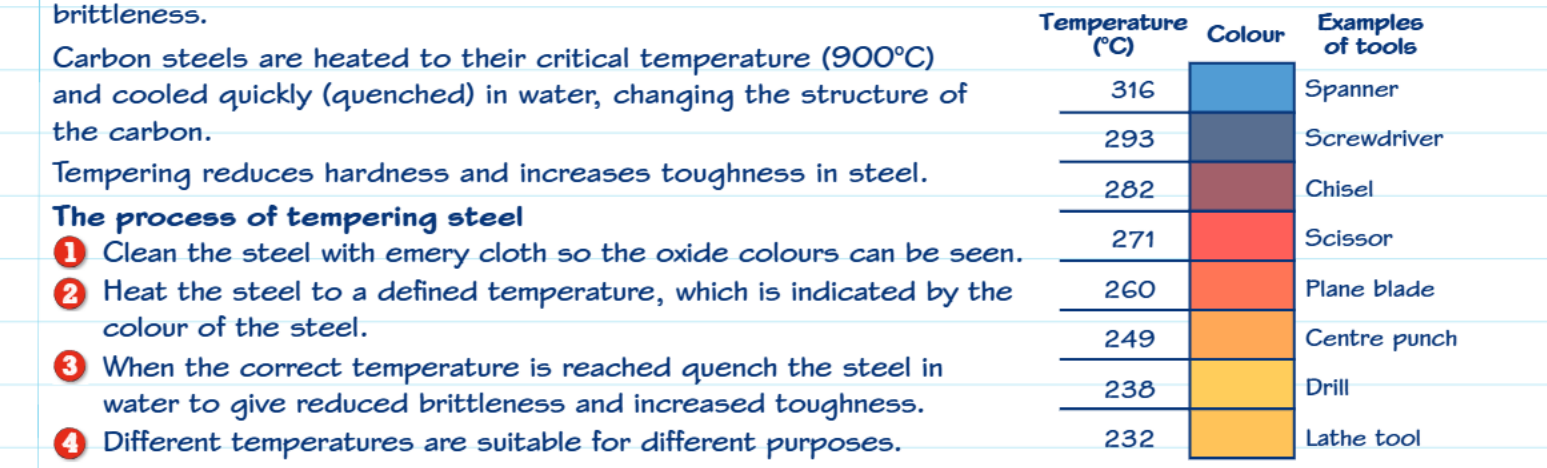
Temperature guide for tempering different tools
The tempering temperature directly affects the final properties of the steel. A visual colour guide helps determine the correct temperature for various applications.
Note
The colour changes provide a reliable visual indicator of temperature, making this process accessible even without precision temperature measuring equipment. Tools that need maximum hardness, like centre punches and drills, are tempered at lower temperatures (around 232-238°C), while tools that need more flexibility, like spanners, are tempered at higher temperatures (around 316°C).
Annealing
Annealing serves the opposite purpose to hardening - it makes metals softer and more workable. This process is essential when metals need to be shaped, cut, or formed more easily.
Annealing copper and silver
The annealing process for copper and silver follows these steps:
- Clean the metal surface with emery cloth to ensure you can observe colour changes clearly
- Heat the metal until it glows bright red
- Maintain this temperature long enough for the crystal structure to reorganise and reform
- Allow the metal to cool very slowly in air, which is crucial for achieving the desired softness
Important
The slow cooling is absolutely critical for successful annealing. Rapid cooling would prevent the crystal structure from properly reorganising, failing to achieve the desired softness and workability.
Annealing other metals
Different metals show different colour indicators when they reach their annealing temperature. Mild steel turns bright red, copper becomes cherry red, and brass appears dull red. Aluminium requires a different approach - it's covered with a soap solution and heated until the soap turns black, indicating the correct temperature has been reached.
Note
The soap method for aluminium is necessary because aluminium doesn't show clear colour changes like other metals. The soap acts as a temperature indicator, turning black at approximately the right annealing temperature.
Case hardening
Case hardening creates components that combine the best of both worlds - a hard, wear-resistant surface with a tough, flexible core. Rather than changing the properties of the entire piece, this process only increases the carbon content on the outer surface.
How case hardening works
The increased carbon content on the surface creates greater hardness in just the outer layer, improving the component's resistance to wear while keeping the interior tough and flexible. This makes it ideal for parts like bearings, gears, and cam surfaces where surface wear is a concern but overall toughness is still needed.
Note
Case hardening is particularly valuable for components that experience both wear and shock loading. The hard surface resists abrasion while the tough core prevents catastrophic failure under impact.
The case hardening process
Case hardening involves several steps:
- Heat the steel to 950°C until it glows cherry red
- Place the heated steel in a carbon-rich environment, such as a bath of powdered carbon
- Repeat this process until enough carbon has been absorbed into the surface layer to achieve the desired level of surface hardness
Example
Worked Example: Case Hardening a Gear Tooth
Step 1: Heat the gear to 950°C (cherry red colour) Step 2: Immerse in powdered carbon for 30 minutes Step 3: Reheat to 950°C and repeat the carbon bath process Step 4: After 2-3 cycles, the surface will have absorbed sufficient carbon Step 5: Final quench to harden the carbon-rich surface layer
The depth of hardening can be controlled by adjusting the time and temperature of the treatment, allowing engineers to customise the component for specific applications.
Summary
Key Points to Remember:
- Hardening increases strength but creates brittleness - steel heated to 900°C and quenched in water becomes much harder but needs tempering to be practical
- Tempering balances hardness and toughness - different temperatures (232°C to 316°C) create different properties suitable for specific tools
- Annealing softens metals for easier working - heating metals until red hot and cooling slowly makes them more ductile and easier to shape
- Case hardening gives surface hardness with core toughness - only the outer layer becomes hard while the interior remains flexible
- Visual colour changes indicate temperature - cleaned metal surfaces show specific colours at different temperatures, providing a reliable guide for heat treatment