Geometric mean (AQA GCSE Statistics): Revision Notes
📚Revision Notes
Geometric mean
What is the geometric mean?
The geometric mean is a special type of average that's different from the arithmetic mean (the normal average you're probably familiar with). While the arithmetic mean adds up all values and divides by how many there are, the geometric mean multiplies all the values together and then finds the nth root of that product.
Note
The geometric mean is particularly useful when dealing with data that involves growth rates, such as population growth, interest rates, or percentage changes over time. This is because it better represents the central tendency when values are meant to be multiplied rather than added.
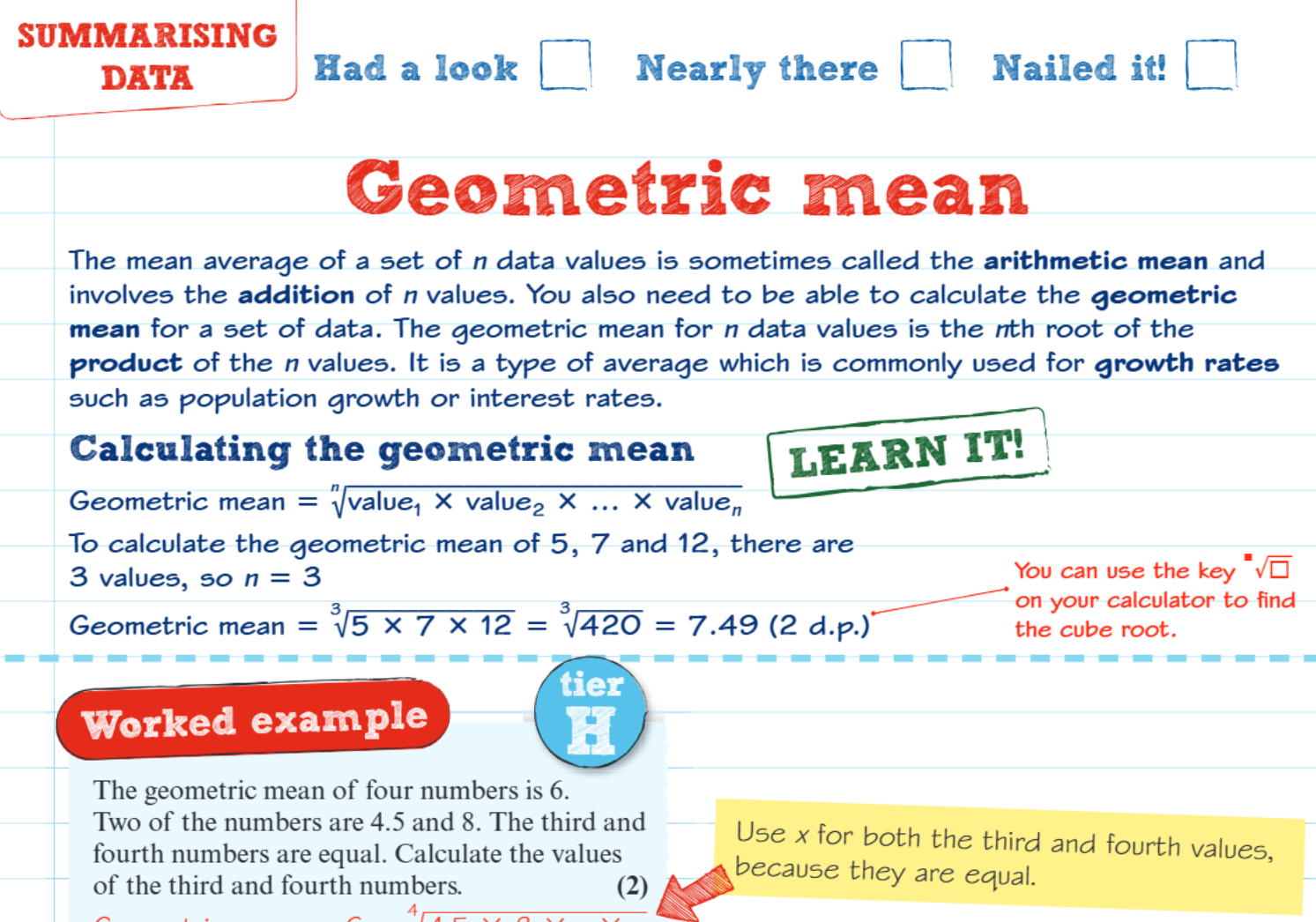
The geometric mean formula
Important
The formula for calculating the geometric mean is:
Where:
- is the number of values you have
- The symbol means "the nth root of"
- You multiply all the values together first, then take the nth root
Calculating the geometric mean step-by-step
Let's work through a straightforward example to understand the process:
Example
Worked Example: Find the geometric mean of 5, 7, and 12
Step 1: Count the number of values
- We have 3 values, so
Step 2: Multiply all values together
Step 3: Take the nth root (in this case, the cube root)
- Geometric mean = (to 2 decimal places)
Calculator tip: You can use the function on your calculator, or raise 420 to the power of (since ).
Worked example 1: Finding unknown values
Example
Worked Example: Finding Unknown Values
Problem: The geometric mean of four numbers is 6. Two of the numbers are 4.5 and 8. The third and fourth numbers are equal. Calculate the values of the third and fourth numbers.
Solution: Since we know the geometric mean is 6, we can work backwards:
Step 1: Set up the equation
- Geometric mean =
- Where represents both the third and fourth numbers (since they're equal)
Step 2: Rearrange the equation
Step 3: Solve for x
Therefore, the third and fourth numbers are both 6.
Worked example 2: Using percentage multipliers
Example
Worked Example: Using Percentage Multipliers
Problem: The number of cars sold by a car manufacturer increased by 4% in year 1 and decreased by 5% in year 2. Calculate the geometric mean of these two percentage changes.
Solution: When dealing with percentage changes, we use multipliers rather than the percentage values themselves:
Step 1: Convert percentages to multipliers
- An increase of 4% means multiplying by 1.04
- A decrease of 5% means multiplying by 0.95
Step 2: Apply the geometric mean formula
- Geometric mean =
- Geometric mean = (to 3 decimal places)
This tells us that the overall effect is a slight decrease, with an average multiplier of 0.994.
Key exam tips and techniques
Note
When to use geometric mean:
- Growth rates and percentage changes over time
- Population studies
- Financial calculations involving compound interest
- Any situation where values are meant to be multiplied together
Note
Important points to remember:
- The geometric mean is always less than or equal to the arithmetic mean for the same set of positive numbers
- When working with percentage changes, convert to multipliers first
- For increases: add the percentage to 100% then divide by 100 (e.g., 4% increase = 1.04)
- For decreases: subtract the percentage from 100% then divide by 100 (e.g., 5% decrease = 0.95)
- Use your calculator's root functions or fractional powers to calculate roots accurately
Important
Common exam traps:
- Don't confuse geometric mean with arithmetic mean
- Remember to convert percentages to multipliers when dealing with growth rates
- Make sure you're taking the correct root (if you have values, you need the th root)
- Round to the appropriate number of decimal places as specified in the question
Remember!
Summary
Key Points to Remember:
- The geometric mean is the th root of the product of values
- It's used for growth rates, percentage changes, and compound situations
- Convert percentage changes to multipliers before calculating
- The formula is: Geometric mean =
- Always check you're taking the correct root for the number of values you have