Outliers (AQA GCSE Statistics): Revision Notes
📚Revision Notes
Outliers
What are outliers?
An outlier is an extreme value in a data set that stands out as being unusually high or low compared to the other values. These values can significantly affect statistical measures and may indicate errors in data collection or genuinely exceptional cases that deserve special attention.
Note
Outliers can occur naturally in data sets or may indicate measurement errors, data entry mistakes, or genuinely exceptional cases that warrant further investigation.
Outliers on box plots
When working with box plots, we can identify outliers using the quartile method. This approach involves calculating the interquartile range and using it to determine which values fall outside the normal range of the data.

The quartile method criteria
Important
Outlier Criteria for Box Plots
A data value is considered an outlier if it meets either of these conditions:
- Less than
- Greater than
Where:
- = first quartile (the value that 25% of data falls below)
- = third quartile (the value that 75% of data falls below)
- = interquartile range =
Representing outliers visually
On a box plot, outliers appear as crosses (×) positioned beyond the whiskers. It's important to remember that the whiskers should only extend to the most extreme data values that are NOT outliers. This creates a clear visual distinction between normal variation and truly exceptional values.
Worked example: social media usage
Example
Worked Example: Social Media Usage
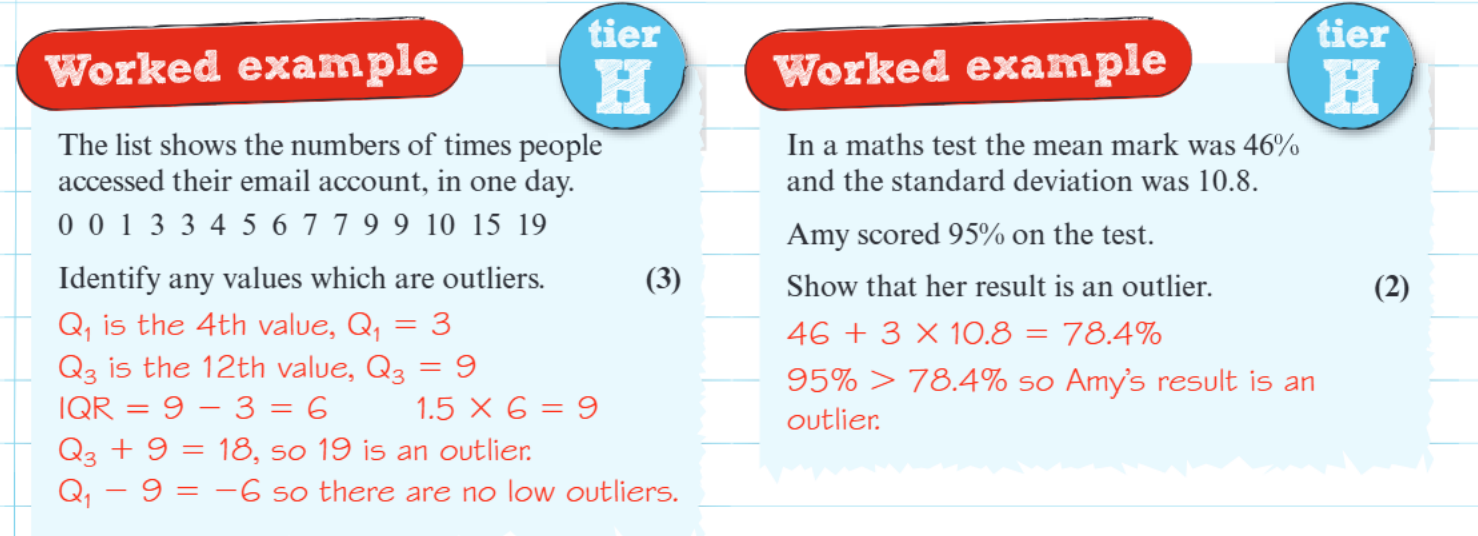
Let's examine data showing the number of times people accessed their email accounts in one day: 0, 0, 1, 3, 3, 4, 5, 6, 7, 7, 9, 9, 10, 15, 19
Step 1: Identify the quartiles
- is the 4th value = 3
- is the 12th value = 9
Step 2: Calculate the interquartile range
Step 3: Determine the outlier boundaries
- Lower boundary:
- Upper boundary:
Step 4: Identify any outliers Looking at our data, we need to find values less than -6 or greater than 18. The value 19 exceeds our upper boundary of 18, making it an outlier. There are no values below -6, so we have no lower outliers.
Outliers in standard deviation calculations
The standard deviation method provides another approach to identifying outliers, particularly useful for larger data sets that follow a roughly normal distribution.
The standard deviation rule
Important
The Standard Deviation Rule
An outlier is defined as any value that lies more than 3 standard deviations away from the mean. This creates a range around the mean where we expect most normal values to fall:
Where:
- = mean of the data set
- = standard deviation of the data set
Calculating outlier boundaries using standard deviation
The process involves these steps:
- Calculate or identify the mean ()
- Calculate or identify the standard deviation ()
- Find the lower boundary:
- Find the upper boundary:
- Compare each data value to these boundaries
Worked example: test results
Example
Worked Example: Test Results
In a mathematics test, the mean mark was 46% and the standard deviation was 10.8. Amy achieved a score of 95%. Let's determine whether her result qualifies as an outlier.
Step 1: Calculate the outlier boundaries
- Lower boundary:
- Upper boundary:
Step 2: Compare Amy's score Amy's score of 95% exceeds the upper boundary of 78.4%
Step 3: Draw conclusion Since 95% > 78.4%, Amy's result is classified as an outlier.
Understanding the difference between methods
Both approaches serve important but different purposes in statistical analysis:
Note
Box plot method advantages:
- Works well with smaller data sets
- Doesn't assume the data follows any particular distribution
- Provides excellent visual representation
- Based on actual data positions rather than calculated parameters
Standard deviation method advantages:
- More appropriate for larger data sets
- Works best when data follows a normal distribution
- Uses the overall spread of the data
- Provides a consistent mathematical threshold
Common examination strategies
When tackling outlier questions in your GCSE exam, it's essential to follow a systematic approach that demonstrates clear understanding of the concepts and methods involved.
Important
Key Exam Tips for Outlier Questions
- Always show your working - examiners want to see each calculation step clearly laid out
- Double-check your arithmetic - outlier calculations involve multiple steps where errors can accumulate
- State your method clearly - specify whether you're using the quartile method or standard deviation approach
- Write a clear conclusion - explicitly state which values (if any) are outliers
- Pay attention to context - sometimes the question will specify which method to use
Remember!
Summary
Key Points to Remember:
- An outlier represents an extreme value that differs significantly from the rest of the data set
- For box plots: values are outliers if they're less than or greater than
- For standard deviation: values are outliers if they fall outside
- Box plot outliers are marked with crosses (×), and whiskers extend only to the most extreme non-outlier values
- Choose your method based on the data size and distribution - quartile method for smaller sets, standard deviation for larger normally distributed data