Weighted mean (AQA GCSE Statistics): Revision Notes
📚Revision Notes
Weighted mean
What is a weighted mean?
A weighted mean is a type of average where different values have different levels of importance. Instead of treating all data values equally, each value is multiplied by a specific number called a weight that reflects how significant or important that particular value should be in the final calculation.
This is particularly useful in real-world situations where some measurements, scores, or results matter more than others. For example, a final exam might be worth more towards your overall grade than a small homework assignment.
Note
Weighted means are everywhere in real life! You'll find them in academic grading systems, financial calculations like stock market indices, quality control in manufacturing, and even in sports rankings where recent performance might count more than older results.
The weighted mean formula
The weighted mean is calculated using this formula:
Where:
- represents the weighted mean
- represents the weight given to each value
- represents each individual data value
- means "multiply each value by its weight, then add all these products together"
- means "add up all the weights"
Note
Understanding the Formula Components:
The numerator () gives you the total "weighted value" - this accounts for how much each data point contributes based on its importance. The denominator () ensures we're averaging correctly by dividing by the total weight rather than just the number of values.
Step-by-step method
To calculate a weighted mean, follow these three essential steps:
- Multiply each data value by its corresponding weight
- Add up all these products (this gives you )
- Divide this total by the sum of all weights ()
Note
This systematic approach ensures you never miss a step and helps prevent common calculation errors. Always work through these steps in order, showing your working clearly.
Worked example 1: Academic performance
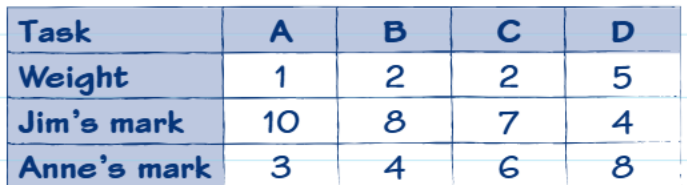
Let's look at how Jim and Anne performed across four different tasks with different weightings.
Example
Worked Example: Comparing Academic Performance
Jim's weighted mean calculation:
Step 1: Multiply each mark by its weight
- Task A: 1 × 10 = 10
- Task B: 2 × 8 = 16
- Task C: 2 × 7 = 14
- Task D: 5 × 4 = 20
Step 2: Add these products together Total = 10 + 16 + 14 + 20 = 60
Step 3: Divide by the sum of weights Sum of weights = 1 + 2 + 2 + 5 = 10 Jim's weighted mean = 60 ÷ 10 = 6
Anne's weighted mean calculation:
Following the same process:
- Task A: 1 × 3 = 3
- Task B: 2 × 4 = 8
- Task C: 2 × 6 = 12
- Task D: 5 × 8 = 40
Total = 3 + 8 + 12 + 40 = 63 Anne's weighted mean = 63 ÷ 10 = 6.3
Even though Jim had higher marks on some individual tasks, Anne achieved a better overall weighted mean because she performed well on Task D, which had the highest weighting.
Worked example 2: Flower show competition
In a flower show, displays are judged on different qualities with different importance levels.

Mr Smith received these marks:
- Shape: 7 (weight = 1)
- Colour: 9 (weight = 2)
- Ambience: 8 (weight = 2)
Example
Worked Example: Flower Show Judging
Calculating the weighted mean:
Step 1: Multiply each mark by its weight
- Shape: 1 × 7 = 7
- Colour: 2 × 9 = 18
- Ambience: 2 × 8 = 16
Step 2: Add the products Total = 7 + 18 + 16 = 41
Step 3: Divide by sum of weights Sum of weights = 1 + 2 + 2 = 5 Weighted mean = 41 ÷ 5 = 8.2
Notice how colour and ambience have more influence on the final score because they have higher weights.
Worked example 3: Exam percentages
When dealing with percentage marks across different papers, you might need to convert marks to percentages first, then apply the weighted mean formula.
Consider an exam with:
- Paper 1: 52 marks out of 80 possible marks
- Paper 2: 56 marks out of 70 possible marks
- Both papers equally weighted
Example
Worked Example: Converting Marks to Percentages
Step 1: Convert to percentages
- Paper 1: (52 ÷ 80) × 100 = 65%
- Paper 2: (56 ÷ 70) × 100 = 80%
Step 2: Calculate weighted mean Since both papers are equally weighted, you can simply add the percentages and divide by 2: Overall percentage = (65% + 80%) ÷ 2 = 72.5%
Key exam tips
Important
Watch out for these common mistakes:
- Forgetting to multiply by the weights before adding
- Using the wrong denominator (should be sum of weights, not number of values)
- Not converting marks to percentages when required
- Mixing up which values get which weights
Note
Calculator tips:
- Write down all calculations clearly
- Double-check your arithmetic
- Make sure your final answer makes sense in context
When papers are equally weighted: You can treat this as having weights of 1 each, or simply add the values and divide by the number of items.
Remember!
Summary
Key Points to Remember:
-
Weighted means give more importance to certain values - those with higher weights have more influence on the final result
-
Always follow the three-step process: multiply by weights, add products together, divide by sum of weights
-
The formula is - memorise this as it's essential for exam success
-
Check your weights add up correctly - a common source of errors is miscounting the total weight
-
Higher weighted items matter more - someone can score lower on individual tasks but still get a better overall weighted mean if they perform well on highly weighted components