Core Practical: Food Tests (Edexcel GCSE Biology Combined Science): Revision Notes
📚Revision Notes
Core Practical: Food Tests
Note
Aim
To investigate the use of various chemical reagents to identify the presence of starch, reducing sugars, proteins, and fats (lipids) in food samples.
Note
Risks and Control Measures
- Potassium hydroxide is harmful to skin and eyes, so wear eye protection and wash off any splashes immediately.
- Take care with hot water in the water bath to avoid scalding. Use heatproof gloves if necessary.
- Do not taste any of the food samples.
- Handle chemicals carefully to prevent irritation.
Note
Tools and Equipment
- Food samples (e.g., beef, vegetable oil, rice, breakfast cereal)
- Iodine solution (for starch test)
- Benedict's solution (for reducing sugars test)
- Biuret reagent (for protein test)
- Potassium hydroxide
- Copper sulphate solution
- Ethanol (for lipid test)
- Test tubes and rack
- Water bath (set at 95°C)
- Dropper and spatulas
- Distilled water
- Goggles and protective equipment
- Heatproof gloves
Note
Methods:
Iodine Test for Starch
- Place one spatula of the food sample or 1 cm³ if the sample is liquid onto a dish.
- Using a dropper, add a few drops of iodine solution to the food sample.
- Observe and record any colour change.
- Positive Result: If starch is present, the iodine solution will turn blue-black.
Benedict's Test for Reducing Sugars
- Place two spatulas of the food sample or 1 cm³ of a liquid sample into a test tube.
- Add 1 cm³ of water and stir to mix.
- Add an equal volume of Benedict's solution.
- Place the test tube in a water bath at 95°C for a few minutes.
- Observe and record the colour of the solution.
- Positive Result: If reducing sugars are present, the Benedict's solution will change from blue to cloudy orange or brick red.
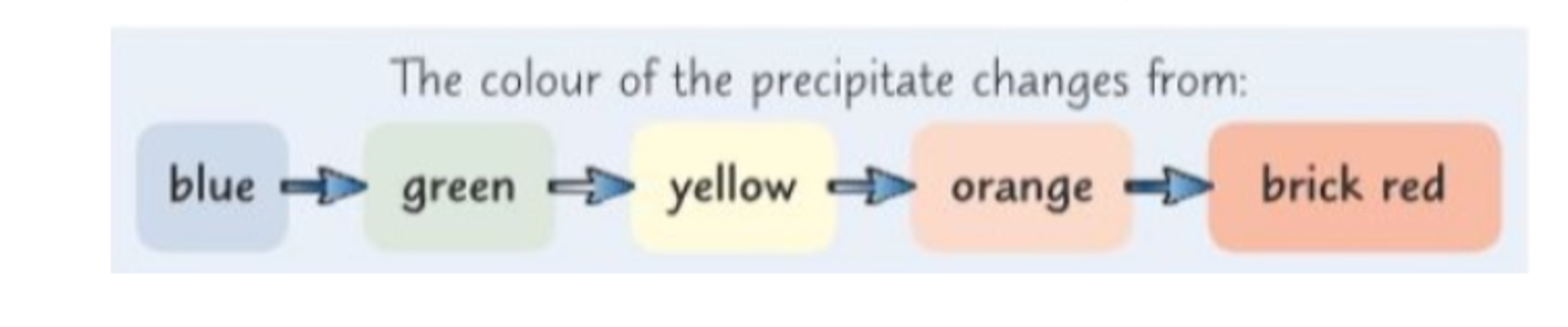
Sugars - Benedicts reagant test results
Biuret Test for Proteins
- Place one to two spatulas of the food sample or 1 cm³ of liquid sample into a test tube.
- Add 1 cm³ of water and stir to mix.
- Add an equal volume of potassium hydroxide solution and stir.
- Add two drops of copper sulphate solution and stir for two minutes.
- Observe and record the colour of the solution.
- Positive Result: If proteins are present, the solution will turn mauve or purple.
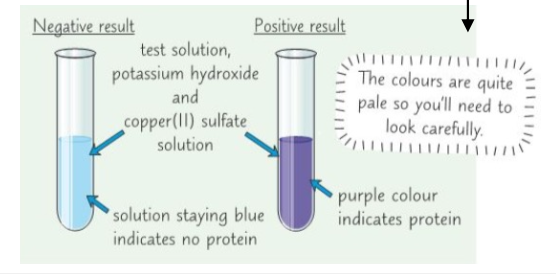
Proteins - biuret test results
Emulsion Test for Lipids
- Place two spatulas of the food sample or 1 cm³ of a liquid sample into a test tube.
- Add 2 cm³ of ethanol and shake vigorously.
- Allow the mixture to settle.
- Pour the liquid from the top into a test tube half-filled with distilled water.
- Observe and record whether the water becomes cloudy or remains clear.
- Positive Result: If lipids are present, a milky-white emulsion will form.
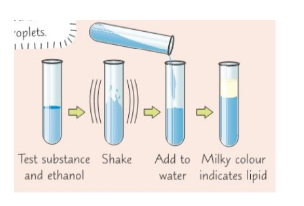
Lipids - emulsion test results
Results
| Food | Iodine Test (Starch) | Benedict's Test (Reducing Sugars) | Biuret's Test (Proteins) | Emulsion Test (Lipids) |
|---|---|---|---|---|
| Beef | Orange-brown | Blue | Purple | Milky white |
| Vegetable Oil | Orange-brown | Blue | Blue | Milky white |
| Rice | Blue-black | Blue | Blue | Colourless |
| Breakfast Cereal | Blue-black | Orange | Blue | Milky white |
Conclusion
The tests show the presence of starch, reducing sugars, proteins, and lipids in different food samples:
- Beef contains proteins and lipids.
- Vegetable oil contains lipids but no proteins or starch.
- Rice contains starch but no reducing sugars, proteins, or lipids.
- Breakfast cereal contains starch, reducing sugars, and lipids.