Core Practical: Investigating osmosis in potatoes (Edexcel GCSE Biology Combined Science): Revision Notes
📚Revision Notes
Core Practical: Investigating osmosis in potatoes
Putting potato cylinders into different concentrations of sucrose solutions to see the effect of water concentrations
Note
Aims
- To investigate the effect of different concentrations of sucrose solution on the mass of potato cylinders.
- To determine the concentration of the cell sap within potato cells by observing changes in mass due to osmosis.
Note
Risks and Safety
- Ensure the potato is placed on a ceramic tile when using the cork borer to prevent accidents.
- Take care when handling the scalpel to avoid cuts.
- Wear eye protection when working with chemical solutions to avoid eye irritation or injury.
Note
Method
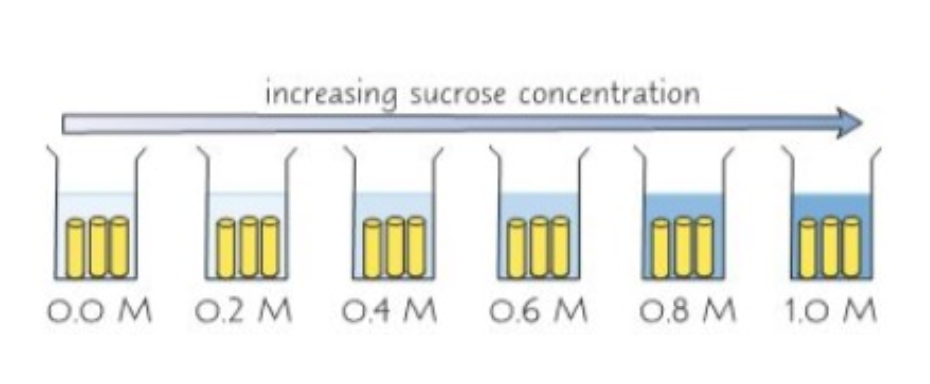
- Prepare Sucrose Solutions:
- Make a range of sucrose solutions with concentrations of 0%, 20%, 30%, 40%, 60%, 80%, and 100%.
- Cut the Potato Cylinders:
- Use a cork borer to cut potato cylinders of equal diameter (1 cm) from the same potato to ensure consistency.
- Trim the cylinders to equal lengths, and divide them into three groups.
- Weigh the Potato Cylinders:
- Use a mass balance to measure and record the initial mass of each group of potato cylinders.
- Place Potato Cylinders in Solutions:
- Place one group of potato cylinders into each solution (one in water, others in sucrose solutions of increasing concentrations).
- Leave the potato cylinders in the solutions for at least 40 minutes.
- Remove and Dry the Cylinders:
- After 40 minutes, remove the cylinders from the solution.
- Gently dry the potato cylinders with a paper towel to remove any excess surface water, ensuring an accurate mass measurement.
- Weigh the Cylinders Again:
- Weigh each group of potato cylinders again after the drying process.
- Record the final mass of each group.
Note
Variables
- Independent Variable: The concentration of sucrose solutions (0%, 20%, 30%, 40%, 60%, 80%, and 100%).
- Dependent Variable: The change in mass of the potato cylinders.
- Control Variables:
- The time each potato cylinder is left in the sucrose solution.
- The size and shape of the potato cylinders (all should be identical in diameter and length).
- The temperature and other environmental conditions should remain constant.
Note
Results
- Osmosis is the movement of water from an area of high water concentration (low solute concentration) to an area of low water concentration (high solute concentration) through a semi-permeable membrane.
- The potato cylinders will change in mass depending on whether they gain or lose water due to osmosis:
- In low sucrose concentrations (high water concentration), water will move into the potato cells, increasing their mass.
- In high sucrose concentrations (low water concentration), water will move out of the potato cells, decreasing their mass.
Note
Conclusion
The experiment demonstrates the effect of osmosis on plant tissue. The change in mass of the potato cylinders will indicate the movement of water in or out of the cells. By analysing the results, you can estimate the concentration of the cell sap in potato cells. This will be the point where there is no change in mass, indicating that the solution has the same concentration as the cell sap, causing no net movement of water.
Results:
- Calculate percentage change in mass
- Plot graph to analyse Then you can plot a graph and analyse your results:
Where there is no change in mass (where the curve crosses the x-axis), the fluid inside the cylinders and the sucrose solution are isotonic — they have the same water concentration.
At the points above the x-axis, the water concentration of the sucrose solutions is higher than in the cylinders. The cylinders gain mass as water is drawn in by osmosis.
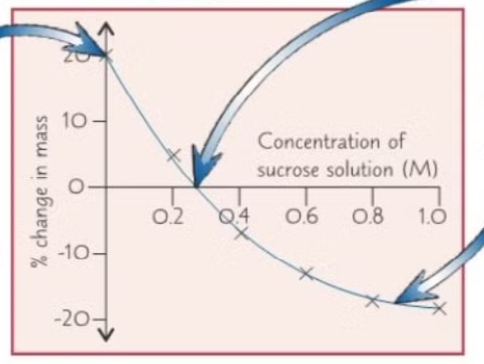
At the points below the x-axis, the water concentration of the sucrose solutions is lower than in the cylinders. This causes the cylinders to lose water so their mass decreases.