Core Practical: Investigating rate of enzymes (Edexcel GCSE Biology Combined Science): Revision Notes
📚Revision Notes
Core Practical: Investigating rate of enzymes
Rate of Enzymatic Reactions
Note
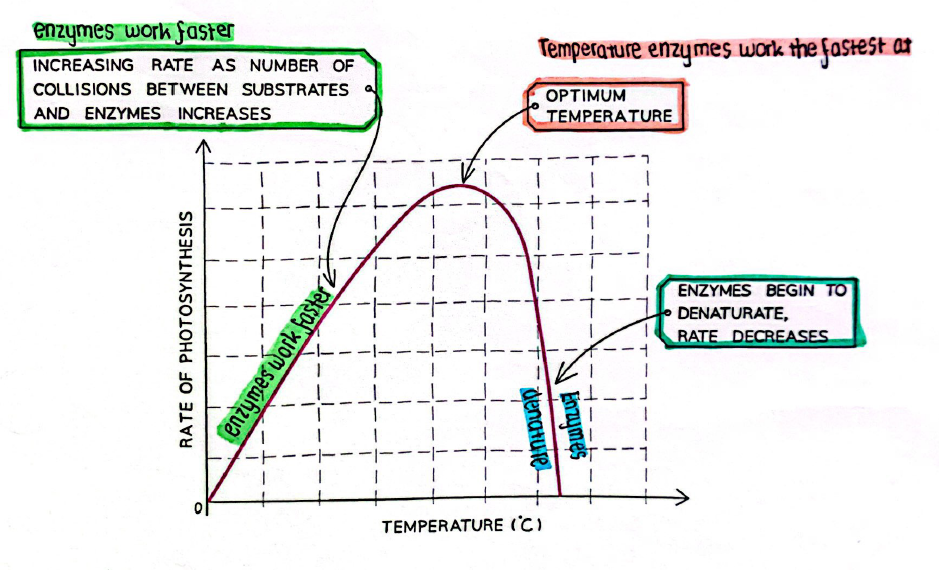
You can investigate the effect of pH on an enzyme-controlled reaction by carrying out a reaction at different pH's and timing how long it takes for the product to form. The practical detailed in the specification involves the breakdown of starch to maltose by amylase. It uses iodine, which turns blue-black in the presence of starch.
In experiments where you are measuring how much of a product forms over time or how much of a reactant is used up, you should calculate the rate using the equation: rate = change/time
Note
Aim
To determine the optimum pH at which an enzyme (amylase) exhibits the greatest activity.
Note
Risks
- Iodine solution is an irritant. If it comes into contact with the skin, it should be washed off immediately.
- Goggles should be worn throughout the experiment to protect the eyes.
Method
Note
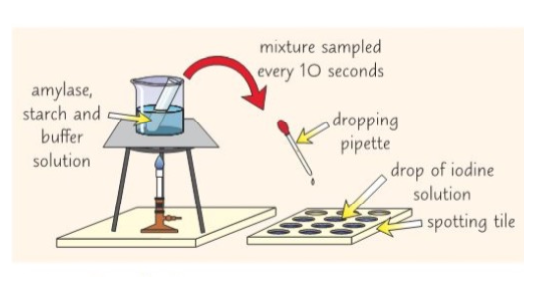
The enzyme amylase breakdown starch to maltose so you can detect starch using iodine solution which will go from browny-orange to blue-black
- Put a drop of iodine solution into every well of the spotting tile
- Place the Bunsen burner on a heat-proof mat & a tripod and gauze over it. Put a beaker of water on the tripod & heat till 35°c)- keep the temperature constant
- Use a syringe to add 3cm3 of amylase solution & 1cm3 of buffer solution (PH5) to boiling tube. Using test tube holders put the boiling tube into the beaker of water & wait 5 mins
- Use a different syringe to add 3cm3 of starch solution to the tube
- Immediately mix the contents of the tube & start the clock
- Use continuous sampling to see how long it takes for amylase to break down the starch- use a dropping pipette to sake fresh sample from a boiling tube every 10 seconds & put the drop into the well (when its browny orange starch is no longer present)
- The time for this to occur is recorded and the rate is calculated from the equations: 1000/time
- Repeat using different PH values to see how it affects the time for starch to be broken down
Control variables
- Concentration of amylase solution
- Volume of amylase solution Calculating the rate of reaction
Experiment just measuring the time: Rate = 1000/time
If an experiment measures how much something changes: Amount it has changed divided by time taken
Note
Conclusions
The enzyme amylase breaks down starch into glucose. When the enzyme is functioning efficiently, this reaction occurs rapidly. In this experiment, at pH 7, the reaction took the shortest time for the iodine solution to stop changing colour, indicating that the starch was broken down fastest at this pH. Therefore, the optimum pH for amylase activity is pH 7.