Mendel (Edexcel GCSE Biology Combined Science): Revision Notes
📚Revision Notes
Mendel
Note
Who was he?
- Was an Austrian
- Trained in maths & natural history
- On his garden plot at the monastery in mid 19th century he noted how characteristics in plants were passed on from each generation
- Results were published in 1866 & become foundation of modern genetics
Although Mendel didn't perform experiments on animals, similar experiments have since shown that heredity in animals works the same way.
In the mid-19th century, Gregor Mendel (1822-1884) conducted experiments on the inheritance of traits in pea plants. He discovered that when he crossed red-flowered plants with white-flowered plants, all of the offspring had red flowers. This result was surprising because, at the time, many people expected the flower colours to blend and produce pink flowers.
When Mendel bred the offspring with each other, he observed that most of the next generation had red flowers, but some had white flowers. This happened because the allele for red flowers is dominant, while the allele for white flowers is recessive.
Mendel's 3 conclusions
- Characteristics in plants are determined by 'hereditary units'
- Hereditary units are passed on to offspring unchanged from both parents, one unit from each parent
- Hereditary units can be dominant or recessive- if an individual has both the dominant and recessive unit for a characteristic, the dominant characteristic will be expressed Example of one of his experiments
He crossed 2 pea plants of different heights – a tall pea plant & a dwarf pea plant. The offspring produced were all tall pea plants
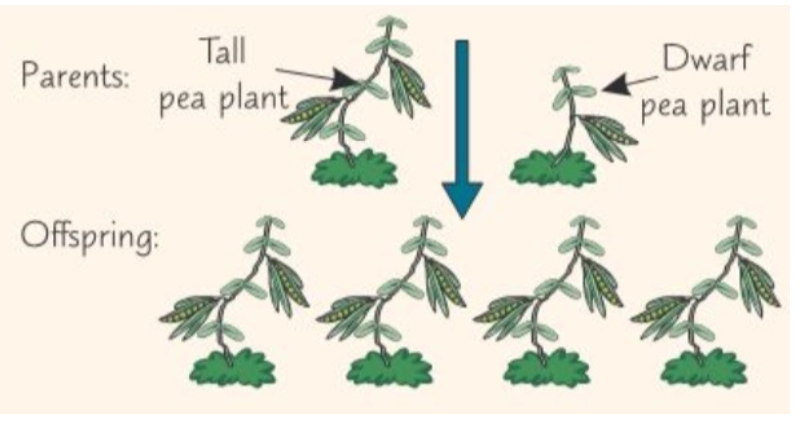
He then bred 2 of these tall offspring together & found the offspring from the first cross were crossed with each other, 3 tall offspring were produced for every 1 dwarf offspring (3:1)
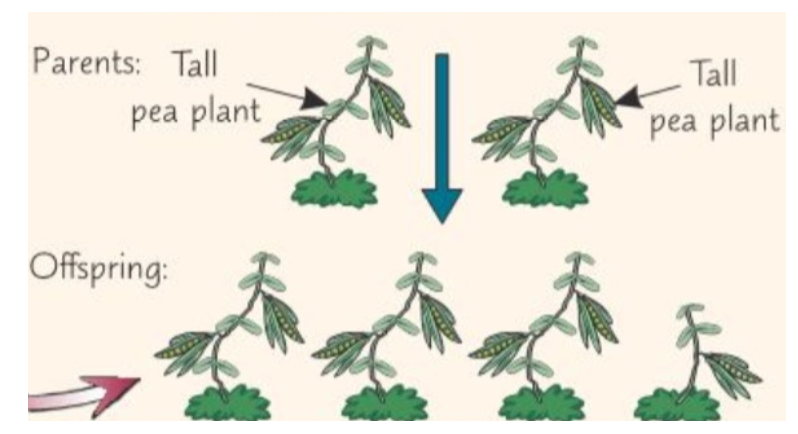
He showed that the height characteristic in pea plants was determined by separately inherited 'hereditary units' passed on from each parent. The ratios of tall & dwarf plants in the offspring showed that the unit for tall plants, I, was dominant over the unit for dwarf plants and sowed that other characteristics of pea plants were inherited in the same way
Problems
- His work was cutting edge and new to the scientists of the day
- His 'hereditary units' are genes but at the time, scientists didn't have the background knowledge to properly understand mendal's findings- they had no idea about genes, DNA and chromosomes
- It wasn't till after his death that people realised how significant his work was & that the mechanism of inheritance could be explained
Note
Mendel's work was not widely accepted by scientists during his lifetime for three main reasons:
- He struggled to effectively communicate his findings when presenting them, leading to confusion among other scientists.
- His research was published in a relatively obscure scientific journal, meaning it reached only a small audience.
- He was unable to provide a scientific explanation for how traits were inherited, which made it difficult for others to understand or believe his conclusions.