Stomata (Edexcel GCSE Biology Combined Science): Revision Notes
📚Revision Notes
Stomata
Stomata
Stomata are tiny pores found mainly on the underside of plant leaves, playing a key role in regulating gas exchange and water loss in plants. They are crucial for photosynthesis and maintaining water balance in the plant.
Function of Stomata
Gas Exchange:
Stomata allow carbon dioxide (CO₂) to enter the leaf, which is essential for photosynthesis. At the same time, oxygen (O₂), a byproduct of photosynthesis, is released through the stomata.
Water Loss (Transpiration):
Stomata also control the release of water vapour from the leaf during transpiration. This helps cool the plant and aids in the transport of water and nutrients from the roots via the xylem.
Structure of Stomata
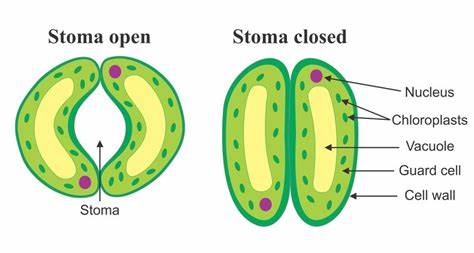
Each stoma is surrounded by two guard cells, which control its opening and closing. These guard cells are sausage-shaped and contain chloroplasts.
- Guard Cells:
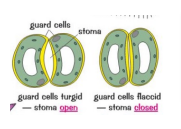
- In bright light, guard cells absorb water by osmosis, becoming turgid (swollen) and causing the stomata to open. This allows gas exchange and water vapour release.
- In low light or when water is scarce, guard cells lose water and become flaccid, causing the stomata to close. This prevents excessive water loss and conserves moisture.
Adaptations of Guard Cells
- Guard cells are adapted to their function by their ability to change shape to open and close the stomata:
- In the daytime, stomata are typically open to allow CO₂ into the leaf for photosynthesis.
- At night, stomata usually close since photosynthesis doesn't occur without light, and closing the stomata helps conserve water.
Stomata and Water Regulation
- Transpiration: Stomata play a major role in controlling transpiration, which is the process of water evaporating from the leaf. This creates a suction force that pulls water up from the roots through the xylem.
- Water Loss Control: In dry conditions, plants reduce water loss by closing their stomata. Plants adapted to dry environments, like cacti, have fewer or smaller stomata to minimise water loss.
Stomata in Different Conditions
- Plants in Drier Environments: These plants often have fewer stomata, and they may be located only on the lower surface of the leaf to reduce water loss.
- Wilting: When a plant loses more water than it can replace, it may wilt. By closing the stomata, the plant reduces water loss, helping to prevent wilting.
Summary
Stomata are essential for plants to balance their need for gas exchange during photosynthesis and to control water loss. The opening and closing of stomata are regulated by guard cells, which respond to light and water availability, ensuring that plants maintain their water balance while still allowing for photosynthesis.
- Tiny pores of plants surface normally found on the lower surface of leaves
- Allow CO2 & O2 to diffuse in & out of leaf
- Allow water vapour to escape during transpiration
- Needed for gas exchange
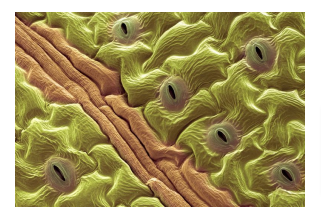
Transpiration is really a side effect of the way leaves are adapted for photosynthesis. They'd have to have stomata so gases can be exchanged easily as there's more water inside of the plant than in the air so water escapes from leaves through the stomata by diffusion