Circulatory system- blood (Edexcel GCSE Biology): Revision Notes
📚Revision Notes
Circulatory system- blood
Note
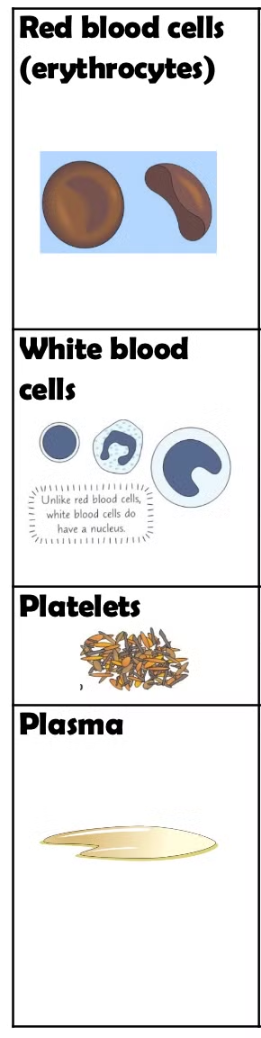
Blood plays a critical role in the body by transporting materials, distributing heat, and protecting against disease. It is composed of plasma, red blood cells (erythrocytes), white blood cells (phagocytes and lymphocytes), and platelets. Each component of the blood has a structure suited to its specific function.
Plasma
- Structure: Plasma is a straw-coloured liquid that makes up just over half the volume of blood.
- Function:
- Plasma acts as the transport medium for various substances.
- It carries carbon dioxide (from the cells to the lungs), digested food molecules (from the intestines to cells), urea (from the liver to the kidneys for excretion), and hormones.
- Plasma also helps in distributing heat around the body, maintaining a stable internal temperature.
Red Blood Cells (Erythrocytes)
- Structure:
- Red blood cells contain haemoglobin, a protein that binds to oxygen. This gives the cells their red colour.
- They are biconcave in shape, which increases their surface area for oxygen absorption.
- Red blood cells have no nucleus, allowing them to carry more haemoglobin.
- They are small and flexible, enabling them to pass through narrow capillaries.
- Their thinness allows oxygen to quickly diffuse to the centre of the cell.
- Function:
- The primary function of red blood cells is to transport oxygen from the lungs to body tissues for aerobic respiration.
- In the lungs, haemoglobin combines with oxygen to form oxyhaemoglobin. In body tissues, the oxygen is released from haemoglobin, providing cells with the oxygen they need to respire.
White Blood Cells (Phagocytes and Lymphocytes)
White blood cells are part of the body's immune system and play a key role in protecting against infections. There are two main types: phagocytes and lymphocytes.
Phagocytes:
- Structure: Phagocytes are large cells with an irregular shape.
- Function:
- Phagocytes engulf and destroy pathogens through a process called phagocytosis.
- They are able to surround and digest microorganisms that invade the body, helping to prevent infections.
Lymphocytes:
- Structure: Lymphocytes are smaller, round cells with a large nucleus.
- Function:
-
Lymphocytes produce antibodies, which are proteins that bind to pathogens (such as bacteria and viruses) to neutralise them. Antibodies help by:
-
Binding to pathogens and destroying them directly.
-
Coating pathogens, causing them to clump together, making it easier for phagocytes to engulf them.
-
Attracting more phagocytes by releasing chemical signals.
-
Neutralizing toxins produced by pathogens by releasing antitoxins.
-
These actions make the immune response more effective and help the body fight infections.
-
Platelets
- Structure: Platelets are cell fragments produced from large cells in the bone marrow.
- Function:
- Platelets are involved in blood clotting, which is crucial for stopping blood loss when a vessel is damaged.
- They have proteins on their surface that allow them to stick to the damaged walls of blood vessels.
- Platelets clump together at the site of a wound to form a temporary plug.
- They also release chemicals that trigger a series of reactions, resulting in the formation of a blood clot, which seals the wound and prevents further bleeding.
Summary of Blood Components and Their Functions:
| Component | Structure | Function |
|---|---|---|
| Plasma | Straw-coloured liquid | Transports carbon dioxide, digested food, urea, hormones, and heat |
| Red Blood Cells | Biconcave shape, no nucleus, contains haemoglobin | Transports oxygen for aerobic respiration |
| Phagocytes | Large, irregularly shaped cells | Engulf and destroy pathogens through phagocytosis |
| Lymphocytes | Round cells with large nucleus | Produce antibodies and antitoxins to neutralise pathogens |
| Platelets | Cell fragments | Involved in blood clotting to prevent blood loss |