Circulatory system- blood vessels (Edexcel GCSE Biology): Revision Notes
📚Revision Notes
Circulatory system- blood vessels
Note
The blood vessels in the circulatory system are crucial for transporting blood throughout the body. There are three main types of blood vessels: arteries, veins, and capillaries, each with a structure that is closely related to its function.
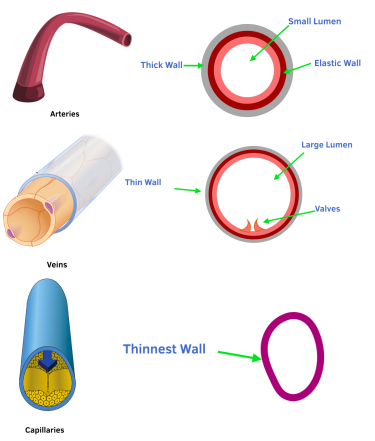
Arteries
Function: Arteries carry blood away from the heart to various parts of the body. Most arteries carry oxygenated blood, except for the pulmonary artery, which carries deoxygenated blood from the heart to the lungs.
Structure:
-
Thick muscular and elastic walls: The walls of arteries are thick to withstand the high pressure at which blood is pumped out of the heart. The elasticity allows the arteries to stretch as blood is forced through and then recoil to help push the blood forwards.
-
Narrow lumen: The lumen (the channel within the artery) is narrow to maintain high pressure.
-
Strong connective tissue: Arteries have connective tissue to provide additional strength and support, preventing them from bursting under high pressure. Key Adaptations:
-
The thick, elastic walls ensure arteries can handle high-pressure blood flow.
-
Elasticity allows arteries to help maintain blood flow by recoiling after being stretched by the surge of blood from the heart.
Veins
Function: Veins carry blood towards the heart. Most veins carry deoxygenated blood, except for the pulmonary vein, which carries oxygenated blood from the lungs to the heart.
Structure:
-
Thin walls: Veins have thinner walls compared to arteries because the blood they carry is under lower pressure.
-
Wide lumen: The lumen of veins is wider, allowing the blood to flow more easily even under low pressure.
-
Valves: Veins contain valves that prevent the backflow of blood, ensuring it flows in the correct direction towards the heart, especially against gravity (e.g., in the legs). Key Adaptations:
-
The thin walls and wide lumen accommodate the low-pressure blood flow.
-
Valves prevent the backflow of blood, ensuring blood flows in one direction towards the heart.
Capillaries
Function: Capillaries are the smallest blood vessels, and they connect the smallest branches of arteries (arterioles) to the smallest branches of veins (venules). They are the site of exchange of substances between the blood and body cells, including oxygen, carbon dioxide, nutrients, and waste products.
Structure:
-
One-cell thick walls: The walls of capillaries are only one cell thick, providing a short diffusion distance for gases (like oxygen and carbon dioxide), nutrients (like glucose), and waste products (like urea and carbon dioxide).
-
Small lumen: Capillaries have a very narrow lumen, just wide enough for red blood cells to pass through in single file, maximising the efficiency of substance exchange. Key Adaptations:
-
The thin walls allow for the rapid diffusion of molecules like oxygen, carbon dioxide, glucose, and urea between the blood and the cells.
-
The small size and extensive network of capillaries ensure that they are in close contact with all cells in the body, facilitating efficient exchange of substances.
Exchange of Molecules in Capillaries
- Into cells:
- Oxygen diffuses from the capillaries into the tissue fluid, then into the cells for respiration.
- Glucose also diffuses from the blood plasma through the capillary walls into the tissue fluid, then into the cells to be used for energy.
- Out of cells:
- Carbon dioxide diffuses out of cells into the tissue fluid, across the capillary walls, and into the blood plasma to be transported to the lungs for exhalation.
- Urea, a waste product from the breakdown of amino acids in the liver, diffuses from the cells into the blood plasma to be excreted by the kidneys.
| Blood vessel | Function | Details |
|---|---|---|
| Arteries | Pump blood away from the
heart | -high pressure
-strong and elastic
• thick walls
-stretchy | | Veins | Carry blood towards the
heart | | | Capillaries | Involved in the exchange of
materials at tissues | -Tiny
-Narrow
-Permeable walls, allows diffusion
-Supply food and oxygen, take away waster (carbond) |
Conclusion:
The structure of blood vessels is closely related to their functions:
- Arteries are adapted to carry blood away from the heart under high pressure with their thick, elastic walls.
- Veins return blood to the heart under low pressure, with valves to prevent backflow.
- Capillaries are specialised for the exchange of substances between the blood and body cells, with thin walls and a vast network covering tissues. These adaptations ensure efficient circulation and exchange of substances throughout the body.