Investigating plant growth responses (Edexcel GCSE Biology): Revision Notes
📚Revision Notes
Investigating plant growth responses
Core Practical: Investigating Plant Growth Responses
Note
Aim
To investigate the effect of light intensity on the growth of newly germinated seedlings. This experiment will compare the growth of seedlings placed in full light, partial light, and complete darkness, helping to understand how light intensity affects plant growth.
Note
Hypothesis
Seedlings grown in full light will show the most balanced and healthy growth, while those grown in the dark will exhibit elongated, weak growth (etiolation) due to the lack of light.
Note
Tools and Equipment
- Three petri dishes
- Cotton wool
- Mustard or cress seeds (10 seeds per dish)
- Measuring cylinder (to measure water volume)
- Ruler (to measure seedling height)
- Light source (for full light)
- Dark cupboard (for no light)
- Partially lit area (for partial light)
- Water (for maintaining moisture in cotton wool)
- Labelling materials (to differentiate between light conditions)
Note
Method
- Prepare the Petri Dishes:
- Place an equal amount of cotton wool in three separate petri dishes.
- Add the same volume of water to each dish to moisten the cotton wool.
- Plant the Seeds:
- Place 10 mustard or cress seeds evenly on the cotton wool in each dish.
- Keep the petri dishes in a warm place and ensure they are not disturbed.
- Allow Germination:
- Let the seeds germinate, ensuring the cotton wool remains moist by adding more water if necessary.
- After germination, check the number of seeds in each dish and ensure that each dish contains the same number of seedlings (remove extra seeds if needed).
- Light Exposure:
- Place the first dish on a windowsill for full light exposure.
- Put the second dish in a dark cupboard to prevent any light from reaching the seedlings.
- Position the third dish in a partially lit area.
- Measure Growth:
- Every day for one week, measure the height of each seedling using a ruler and record the results in a table.
- Calculate the mean height of the seedlings in each dish daily.
- Compare Growth:
- After one week, compare the mean heights of the seedlings in the three different light conditions (full light, partial light, and darkness).
Variables
Independent Variable:
-
Light intensity (full light, partial light, darkness). Dependent Variable:
-
Height of the seedlings, measured in millimetres (mm). Control Variables:
-
Number of seeds in each petri dish.
-
Type of seeds (mustard or cress).
-
Volume of water in each dish.
-
Temperature and environmental conditions.
-
Duration of the experiment (one week).
Data Collection
Record the height of each seedling in each petri dish daily. Use a table like the one below to organise the data:
| Day | Height of Seedlings (Full Light) | Height of Seedlings (Partial Light) | Height of Seedlings (Dark) |
|---|---|---|---|
| Day 1 | |||
| Day 2 | |||
| ... | |||
| Day 7 |
Data Analysis
- Calculate the Mean:
- Calculate the mean height of seedlings in each petri dish for each day. This will help smooth out individual variations in growth.
- Graphical Representation:
- Plot a graph with time (days) on the x-axis and the mean seedling height on the y-axis to compare growth across the three conditions.
- Compare Growth Patterns:
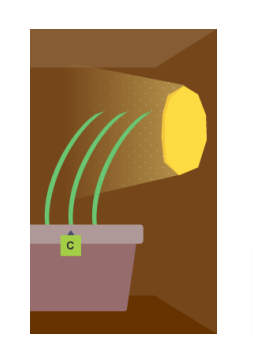
- Look for differences in growth between the seedlings in full light, partial light, and darkness. Seedlings in full light should exhibit healthy, compact growth, while those in darkness will likely show elongated growth due to the lack of light (etiolation). The partially lit seedlings may show growth somewhere in between.
Conclusion
By comparing the mean heights of seedlings grown under different light conditions, we can conclude how light intensity influences the growth of plants. The results will likely show that:
- Full light supports healthy growth.
- Partial light results in moderate growth.
- Dark conditions lead to elongated, weak growth due to etiolation, as the plant stretches towards potential light sources. These findings can be used to understand the importance of light in plant development and the adaptations plants make in low-light environments.