Positve ions - Metal Hydroxides (Edexcel GCSE Chemistry Combined Science): Revision Notes
📚Revision Notes
8.3.2 Metal Hydroxides
Identifying Metal Ions with Sodium Hydroxide
Note
Metal ions in a solution can be identified by adding sodium hydroxide (NaOH), which causes these ions to form metal hydroxide precipitates. The colour and behaviour of these precipitates can help identify which metal ion is present in the solution.
Formation of Metal Hydroxide Precipitates
Note
When sodium hydroxide is added to a solution containing metal ions, the metal ions react with the hydroxide ions (OH⁻) from the sodium hydroxide to form metal hydroxides, which are usually insoluble and appear as solid precipitates.
Note
The formation of metal hydroxides all follow the same pattern of equations
Identifying Specific Metal Ions
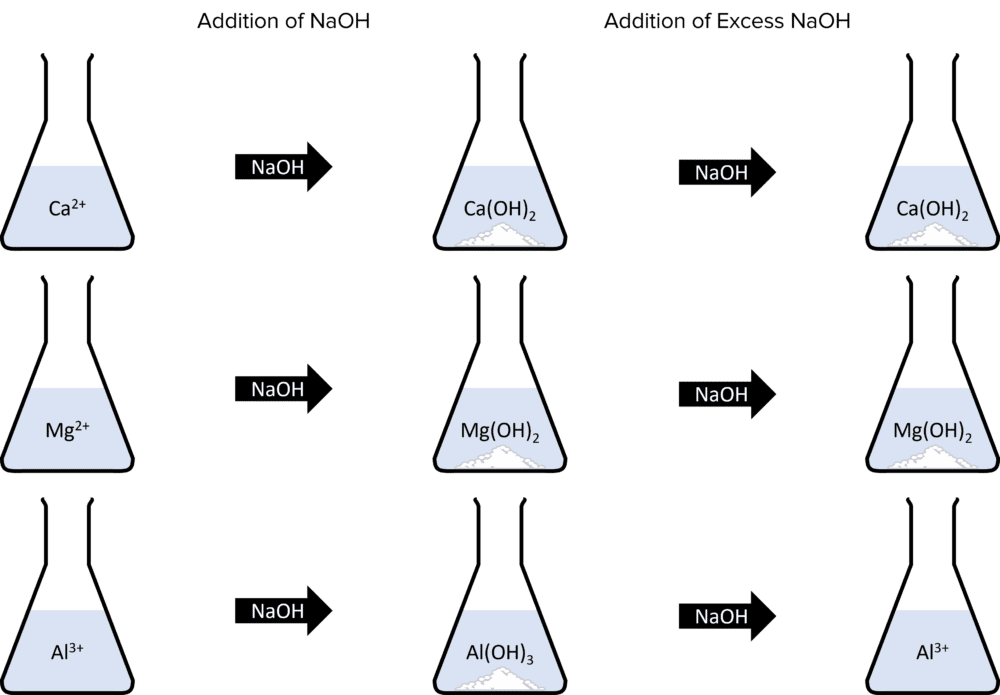
- Calcium (Ca²⁺):
- Reaction: Forms calcium hydroxide , which appears as a white precipitate.
- Magnesium (Mg²⁺):
- Reaction: Forms magnesium hydroxide , which also appears as a white precipitate.
- Aluminium (Al³⁺):
- Reaction: Forms aluminium hydroxide , a white precipitate.
- Note: Aluminium hydroxide is unique because it dissolves in excess sodium hydroxide, forming a colourless solution. This behaviour distinguishes it from calcium and magnesium hydroxides, which remain insoluble.
Coloured Precipitates with Sodium Hydroxide
In addition to white precipitates, certain metal ions produce coloured precipitates when reacted with sodium hydroxide.
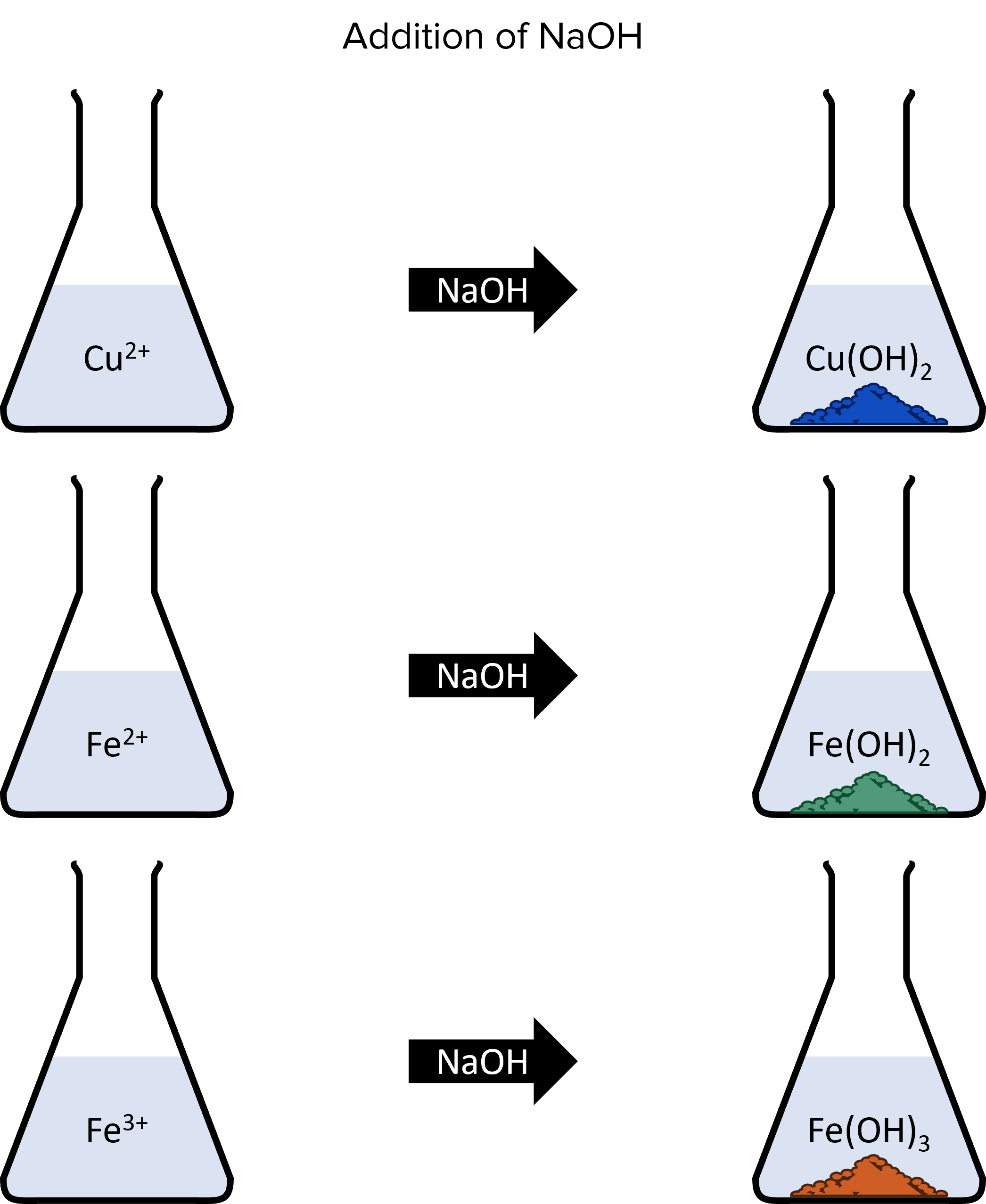
When copper and iron ions react with sodium hydroxide, they will produce coloured precipitates. Copper will form a blue precipitate of copper hydroxide and iron forms two precipitates, depending on the charge of the ion. Iron (II) forms a green precipitate and iron (III) forms a brown precipitate.
Note
Once again, the formation of these precipitates follows the same pattern:
Summary
Metal ions can be identified based on the colour of the precipitate they form when reacted with sodium hydroxide. The white precipitates of calcium, magnesium, and aluminium (which dissolve in excess NaOH) are typical, while copper and iron ions produce distinctive blue, green, and brown precipitates. These reactions are crucial in analytical chemistry for identifying specific metal ions in a solution.