Extracting metals using carbon (Edexcel GCSE Chemistry Combined Science): Revision Notes
📚Revision Notes
Extracting metals using carbon
Metals are often found in the Earth's crust in the form of metal ores. An ore is a rock that contains enough metal to make it economically worthwhile to extract the metal. Most ores contain the metal as an oxide (a compound of the metal with oxygen).\
Note
Key Facts About Metal Ores:
- Metal ores are mined from the Earth's crust.
- The metals are then extracted from their ores, often through reduction.
- Some unreactive metals, like gold and platinum, are found as uncombined elements in nature. These do not need to be extracted, but they may need to be refined before use.
Why Use Carbon for Extraction?
- Carbon is a cheap and widely available material.
- It acts as both a reducing agent and a fuel to provide the heat needed for the reaction.
- Reduction with carbon works by removing oxygen from the metal oxide, leaving behind the pure metal.
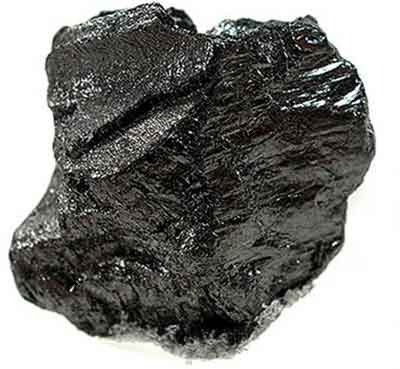
Extracting Metals by Reduction with Carbon
Metals that are less reactive than carbon in the reactivity series can be extracted from their ores using carbon. The process involves heating the metal oxide with carbon, which removes the oxygen, leaving behind the metal.
Note
Example: Extracting Iron from Iron(III) Oxide
Iron can be extracted from iron(III) oxide () by heating it with carbon in a blast furnace.
In this reaction:
- The carbon removes the oxygen from the iron oxide (reduction), producing iron and carbon dioxide.
- This is done in a blast furnace at high temperatures.
Position in the Reactivity Series and Extraction
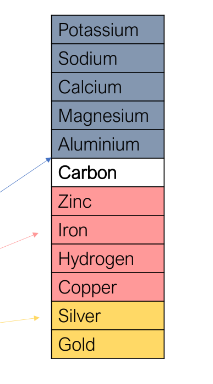
Whether a metal can be extracted using carbon depends on its position in the reactivity series:
- Metals below carbon (e.g., iron, zinc, and lead) can be extracted by reduction with carbon.
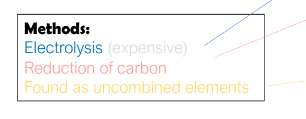
- Metals above carbon (e.g., aluminium, magnesium, and sodium) are too reactive to be extracted using carbon. Instead, they are extracted using electrolysis, which is a more expensive process.
Why Use Carbon?
- Cost-effective: Carbon is cheap and widely available.
- Dual role: Carbon acts as both a fuel (providing heat) and a reducing agent (removing oxygen from the metal oxide).
Key Takeaways:
- Carbon reduction is used to extract metals that are less reactive than carbon.
- Metals such as iron can be extracted by heating their oxides with carbon, producing the pure metal and carbon dioxide or carbon monoxide.
- Unreactive metals like gold and platinum do not need extraction and are found in their native form