Reactivity of metals (Edexcel GCSE Chemistry Combined Science): Revision Notes
📚Revision Notes
Reactivity of metals
The reactivity of a metal depends on how easily it loses its outer electrons to form positive ions. The more reactive a metal is, the faster it reacts with acids and water.
Reaction of Metals with Acids (e.g., HCl)
When metals react with acids, hydrogen gas (H₂) is produced, which can be identified by the burning splint test (a loud pop sound). The more reactive the metal, the faster the reaction and the more hydrogen is produced.
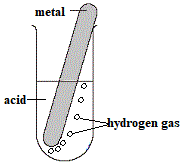
Observations with Common Metals:

Magnesium (Mg):
- Reacts vigorously with lots of fizzing.
- Produces a loud pop with a burning splint.
Aluminium (Al):
- Bubbles, but not as vigorous as magnesium.
- Still produces a pop sound.
Zinc (Zn):
- Produces some bubbles, but the reaction is slower.
- Results in a quiet pop.
Iron (Fe):
- Few bubbles and a very quiet squeaky pop.
Copper (Cu):
- No reaction with dilute acids like hydrochloric acid.
Key Experimental Notes:
To ensure a fair test, make sure the pieces of metal added to the acid are of the same size and shape.
- To prove how reactive a metal is:
- Bubbles: Use a gas syringe to measure the volume of gas given off (more gas = faster reaction).
- Hydrogen test: Use the burning splint test—the louder the pop, the more hydrogen produced.
- Temperature change: Use a thermometer to measure the temperature increase, as the reaction is exothermic (releases heat).
Note
General Rule:
The more easily a metal loses its outer electrons and forms positive ions, the more reactive it is.
Reaction of Metals with Water
When reactive metals are added to water, they form metal hydroxides and hydrogen gas (H₂).
Observations with Reactive Metals:
Very reactive metals like potassium, sodium, and calcium:
- React vigorously with cold water.
- Produce bubbles of hydrogen gas.
- Give a pop sound with a burning splint.
- Less reactive metals like magnesium react very slowly with water but will react faster with steam, forming a metal oxide and hydrogen gas.
Unreactive Metals:
- Copper (Cu) does not react with water or steam. It is very unreactive compared to other metals.
Summary of Reactivity:
| Metal | Reaction with Acid | Reaction with Water |
|---|---|---|
| Potassium, Sodium, Calcium | Very fast reaction with acid | Vigorous reaction with cold water |
| Magnesium | Fizzes quickly with acid | Reacts with steam |
| Aluminium | Slow bubbles with acid | Reacts with steam |
| Zinc | Fewer bubbles with acid | Reacts with steam |
| Iron | Very slow with acid | Reacts with steam |
| Copper | No reaction with acid | No reaction with water or steam |