New weapons and formations (Edexcel GCSE History): Revision Notes
📚Revision Notes
New weapons and formations (c1250-c1500)
Introduction to mediaeval warfare changes
The period between 1250 and 1500 witnessed revolutionary changes in mediaeval warfare through the introduction of new weapons and military formations. These innovations fundamentally transformed battlefield tactics and strategy, ultimately leading to the decline of the mounted knight as the dominant force in English warfare. By the end of this period, traditional feudal military structures were being replaced by more professional and technologically advanced approaches to combat.
Important
This period marked one of the most significant military transformations in European history, fundamentally changing how wars were fought and who held power on the battlefield.
The longbow revolution
Introduction and development
The longbow emerged as a game-changing weapon when it was introduced into English armies during the 1290s under Edward I. This powerful weapon became a cornerstone of English military success and remained a key component of English forces for approximately 150 years, fundamentally altering the nature of mediaeval combat.
Note
The longbow's introduction represented a shift towards relying on skilled common soldiers rather than noble knights, marking an early move away from traditional feudal military structures.
Superior capabilities and advantages
The longbow's effectiveness stemmed from several remarkable characteristics that made it superior to existing ranged weapons. English archers could achieve an impressive rate of fire, releasing up to 15 arrows per minute - a rate five times faster than crossbow operators could manage. This rapid firing capability gave English forces a significant tactical advantage in sustained combat situations.
The weapon's enhanced power allowed arrows to penetrate through a knight's chainmail armour, something that had previously provided reliable protection against most projectile weapons. Additionally, the longbow offered exceptional range capabilities, with an effective striking distance of 200 metres - double the range of shorter bows and crossbows used by other armies.
Note
The longbow's ability to penetrate chainmail armour was revolutionary, as it meant that heavily armoured knights could now be effectively targeted by common foot soldiers from a considerable distance.
Scottish pike formations - the schiltron
Wallace's tactical innovation
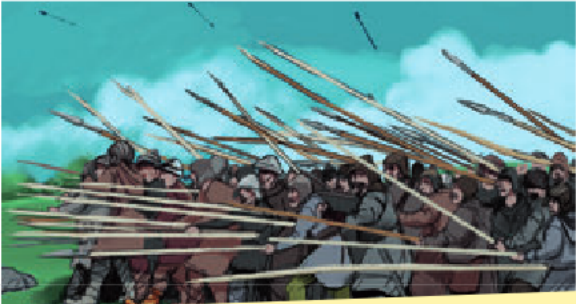
The Scots, under the leadership of William Wallace, developed an innovative defensive formation called the schiltron. This tactic involved organising infantry soldiers into tight, disciplined formations arranged in either circular or square patterns, with long pikes pointed outward towards approaching enemies.
Note
The schiltron formation required exceptional discipline and training from infantry soldiers, as breaking formation could lead to catastrophic defeat. This emphasised the growing importance of well-trained professional soldiers.
Military effectiveness
The schiltron proved remarkably effective as a defensive strategy, particularly against cavalry charges. Wallace successfully employed this formation to move infantry forces forwards and attack enemy positions, demonstrating its versatility beyond purely defensive applications. The tactic achieved notable success in battles against English infantry in 1297 and proved effective against English cavalry forces at the Battle of Stirling Bridge in 1314.
Gunpowder and cannon development
Origins and early adoption
Gunpowder technology arrived in Europe during the 13th century, having originated in China. This revolutionary substance was initially used to power cannon, and by 1450, these artillery pieces had become standard siege weapons across European armies. The introduction of cannon technology significantly impacted castle design, as traditional fortifications became increasingly vulnerable to cannon bombardment.
Important
The arrival of gunpowder from China represents one of the most significant technological transfers in military history, ultimately rendering traditional mediaeval fortifications obsolete.
Limitations and advantages of early cannon
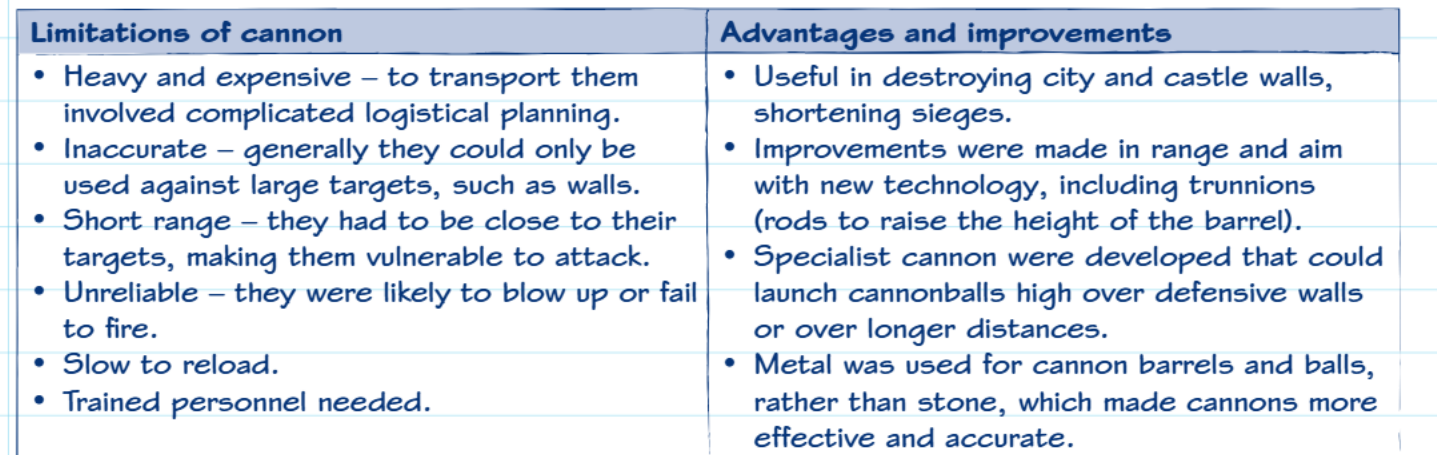
Early cannon faced numerous practical challenges that limited their battlefield effectiveness. These weapons were extremely heavy and expensive, requiring complex logistical planning for transportation and deployment. Their accuracy was generally poor, making them most effective against large, stationary targets like castle walls rather than mobile forces. The range was initially quite limited, and the weapons were unreliable, with a tendency to malfunction or explode during operation.
Despite these limitations, cannon offered significant advantages that made them valuable additions to mediaeval armies. They proved exceptionally useful for destroying city and castle walls during siege operations, shortening the length of traditional sieges. Technological improvements gradually addressed many early problems, including the development of trunnions (pivoting supports) that allowed for better aiming and height adjustment.
Note
Trunnions were a crucial technological advancement that allowed cannon operators to adjust the elevation and aim of their weapons, significantly improving accuracy and effectiveness in siege situations.
Specialised long-range cannon were developed that could launch projectiles over defensive walls or across longer distances. The transition from stone construction to metal barrels and projectiles made cannon more effective and accurate, while metal cannonballs proved more reliable than earlier stone ammunition.
The decline of the mounted knight
Factors leading to decline
The introduction of these new weapons and formations directly contributed to the decline of mounted knights as the dominant force in mediaeval warfare. Three primary factors drove this transformation.
Important
Three Key Factors in Knight Decline:
- The longbow's effectiveness in bringing down knights, horses, and infantry fundamentally challenged cavalry's battlefield superiority
- The schiltron formation proved highly effective at defeating cavalry charges, increasing infantry importance and confidence
- Cavalry units became more integrated into combined arms approaches, taking specialised roles like patrolling and scouting rather than serving as the primary striking force
Many cavalry units began dismounting to fight defensive battles on foot, further reducing their traditional role and demonstrating the changing nature of mediaeval combat tactics.
Social and political consequences
The decline of mounted knights had profound implications beyond military tactics. The feudal system had traditionally relied on small armies dominated by noble knights who served as the elite fighting class. As the effectiveness of mounted knights diminished, kings and commanders increasingly relied on mercenary companies rather than feudal obligations for their military needs.
Note
This shift towards professional mercenary forces marked the beginning of the end for the feudal system's military structure, as skill and effectiveness became more valuable than noble birth and traditional training.
This shift reduced the connection between social class and military command, as professional soldiers and effective tactics became more important than noble birth and traditional cavalry training.
Timeline of key developments
- 1290s: Longbow introduced into English armies under Edward I
- 1297: Scottish schiltron formation used effectively against English infantry
- 13th century: Gunpowder formula arrives in Europe from China
- 1314: Schiltron tactics prove successful against English cavalry at Stirling Bridge
- 1450: Cannon become standard siege weapons across European armies
Remember!
Summary
Key Points to Remember:
- The longbow could fire 15 arrows per minute with a 200-meter range, revolutionising English military capabilities
- Scottish schiltron formations used tightly packed infantry with outward-facing pikes to defeat cavalry charges effectively
- Gunpowder and cannon technology, arriving from China in the 13th century, transformed siege warfare despite early limitations
- The decline of mounted knights resulted from the combined effectiveness of longbows, pike formations, and changing military tactics
- These weapon innovations led to broader social changes, weakening the feudal system's connection between noble birth and military leadership