Changes in weaponry (Edexcel GCSE History): Revision Notes
📚Revision Notes
Changes in weaponry c1700-c1900
Introduction
The period between 1700 and 1900 witnessed revolutionary changes in military weaponry. These transformations were driven by significant advances in science, technology, and industrial production. The new weapons fundamentally altered battle strategies and tactics, moving warfare away from traditional methods towards more modern approaches.
Important
This period marked one of the most significant transformations in military history, as technological innovations completely changed how wars were fought and won.
The development of rifles and bullets
From muskets to rifles
Rifles represented a major advancement over traditional muskets. Although originally invented in the 16th century, technological improvements from the 1850s onwards made rifles far more effective and practical for military use. These weapons offered greater accuracy and range compared to the smoothbore muskets that had dominated battlefields for centuries.
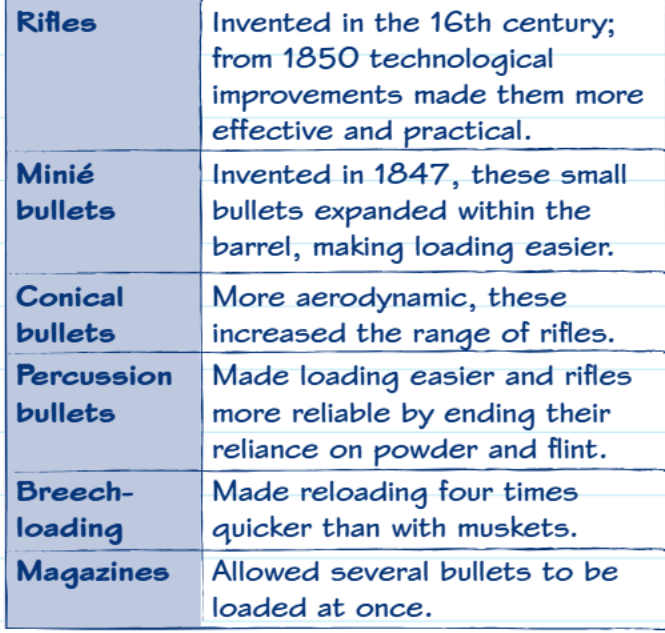
Key ammunition innovations
Several crucial developments transformed how rifles functioned and performed on the battlefield:
Minié bullets (1847) were a breakthrough invention that solved many loading problems. These specially designed bullets expanded within the rifle barrel when fired, creating a better seal and making the loading process much easier and faster for soldiers.
Conical bullets represented another significant advancement in ammunition design. Their improved aerodynamic shape allowed rifles to achieve much greater range and accuracy compared to traditional round musket balls.
Percussion bullets revolutionised rifle reliability by eliminating the need for gunpowder and flint ignition systems. This made rifles much more dependable in various weather conditions and reduced misfires significantly.
Breech-loading mechanisms transformed the speed of combat by allowing soldiers to reload their weapons four times faster than traditional musket-loading methods. This dramatically increased the rate of fire possible during battle.
Magazine systems enabled soldiers to load multiple bullets at once, further increasing their firing rate and reducing the time spent reloading during combat situations.
Note
These ammunition innovations worked together to create a weapon system that was not only more accurate and reliable than muskets, but also significantly faster to operate in combat conditions.
Field guns and heavy artillery
Light field artillery developments
Artillery technology experienced significant improvements during this period. John 'Iron Mad' Wilkinson pioneered the creation of thinner and lighter cannon barrels, making artillery more mobile on the battlefield. Experiments with bronze construction made cannons even lighter while maintaining their strength.
These innovations meant that horse-drawn field guns could move more quickly across battlefields and be repositioned as tactical situations changed. By 1890, field guns were specifically designed to recoil when fired, making them much quicker and easier to operate.
Heavy artillery advances
Heavy artillery saw dramatic improvements in both power and efficiency. Steel cannons proved much stronger than their bronze predecessors, allowing for larger charges and more devastating effects.
Breech-loading mechanisms in cannons allowed them to reload five times faster than older muzzle-loading designs. Rifled cannon barrels increased their effective range from mere hundreds of metres to an impressive 5 kilometres.
By 1900, percussion shells filled with explosive chemicals had replaced solid cannonballs, creating much more destructive potential. The introduction of smokeless powder in the 1890s was particularly significant, as it prevented smoke from revealing artillery positions to enemy forces.
Important
The combination of steel construction, rifled barrels, and breech-loading mechanisms meant that artillery by 1900 was both more powerful and more tactically flexible than anything available a century earlier.
Impact on tactics and formation
The improved accuracy and range of new weapons forced military commanders to completely rethink their battle strategies. At the Battle of Waterloo in 1815, British infantry could still form traditional squares to repel enemy attacks. However, by the time of the Crimean War (1853-56), muskets had been largely replaced by more accurate percussion rifles, making such formations extremely vulnerable.
Example
Historical Comparison: Formation Effectiveness
Battle of Waterloo (1815): Traditional infantry square formations were still effective against musket fire due to limited accuracy and range.
Crimean War (1853-56): The same formations became death traps when facing the improved accuracy and range of percussion rifles.
This dramatic change occurred in less than 40 years, showing how quickly military technology could transform battlefield tactics.
The increased range and precision of these new weapons meant that traditional defensive formations needed to be abandoned in favour of new tactical approaches that provided better protection from improved firepower.
Development of trench warfare
The Crimean War marked a crucial turning point in defensive strategy. Military forces began constructing systems of trenches to provide protection against increasingly deadly enemy fire. Troops and supply lines could move close to the front lines without being exposed to enemy weapons.
Military commanders recognised that the defensive advantages of trench systems were greater than those available to attacking forces. The superior firepower available to defending troops made traditional assault tactics extremely costly and often unsuccessful.
Note
The development of trench warfare during the Crimean War foreshadowed the massive trench systems that would dominate World War I battlefields just decades later.
Machine guns
The development of machine guns represented another revolutionary advancement in military technology. Early models like the Gatling gun featured multiple small revolving barrels and could fire up to 150 bullets per minute.
More practical designs like the Maxim gun became available in the 1880s and could be operated by a single person. Although machine guns were introduced to the British army in 1889, their most significant impact on warfare occurred after 1900, fundamentally changing the nature of battlefield tactics.
Note
While machine guns were developed in the 19th century, their devastating impact on military tactics would not be fully realised until the trench warfare of World War I.
Timeline of major developments
- 1815: Battle of Waterloo - traditional infantry square formations still effective
- 1847: Minié bullets invented, revolutionising rifle loading
- 1850s: Major technological improvements in rifle design begin
- 1853-56: Crimean War - muskets replaced by percussion rifles, trench warfare develops
- 1880s: Maxim machine guns developed
- 1889: Machine guns introduced to British army
- 1890: Recoiling field guns designed
- 1900: Percussion shells with explosive chemicals in widespread use
Factors affecting technological change
Several interconnected factors drove these weapons innovations:
Industrialisation provided the technological capabilities and manufacturing capacity needed to produce improved weapons on a large scale.
Social attitudes varied, with some embracing change while others remained conservative about costs and traditional methods.
Political factors included the upheaval caused by the French Revolution, which made governments uneasy about rapid military changes.
Individual resistance came from figures like Wellington, who viewed technological change as a threat to established social structures, and from inventors like Wilkinson who sometimes faced opposition to their innovations.
Note
The pace of weapons development was not just determined by technological capability, but also by complex social, political, and economic factors that could either accelerate or slow innovation.
Summary
Key Points to Remember:
-
Rifle improvements from 1850 onwards included Minié bullets, conical bullets, percussion systems, breech-loading, and magazines, making weapons more accurate, reliable, and faster to reload
-
Artillery advances created both lighter, more mobile field guns and more powerful heavy artillery with increased range (up to 5km) and explosive shells
-
Tactical changes were forced by improved weapon accuracy and range, leading to the abandonment of traditional formations like infantry squares and the development of trench warfare
-
Machine guns like the Gatling and Maxim guns could fire 150+ bullets per minute, though their major impact came after 1900
-
Multiple factors drove change including industrialisation, social attitudes, political upheaval, and individual resistance to innovation