Continuity and change in the army (Edexcel GCSE History): Revision Notes
📚Revision Notes
Continuity and change in the army (c1700-c1900)
Introduction to the period
The British army underwent significant transformation between 1700 and 1900, though the pace of change varied considerably. From around 1700 to 1850, military developments were relatively slow and gradual. However, the period from 1850 to 1900 brought dramatic changes driven by the Industrial Revolution and the expansion of the British Empire across the globe.
Note
The transformation of the British army during this 200-year period reflects broader changes in British society, technology, and imperial ambitions. Understanding this timeline helps explain why certain military traditions persisted while others evolved rapidly.
Army composition and scale

The most striking change in the British army during this period was its massive expansion in size and scope. At the beginning of the 18th century, Britain maintained a relatively small standing army of approximately 50,000 soldiers during peacetime. By 1899, this had grown dramatically to around 250,000 troops, reflecting Britain's new role as a global imperial power.
The composition of military forces also shifted significantly. Cavalry, which had traditionally formed a major part of European armies, saw its importance decline steadily throughout this period. By the end of the 19th century, cavalry units made up only about 20% of the total army. Artillery maintained a consistent role, comprising roughly 5% of military forces throughout the period.
Important
This five-fold increase in army size was not just about numbers—it represented a fundamental shift in Britain's military strategy from defending the home islands to maintaining control over a global empire spanning multiple continents.
This expansion was largely driven by the growth of the British Empire and the need to garrison and defend territories across multiple continents. The government became increasingly involved in organising army operations and managing military finances, both of which rose dramatically to support this enlarged military structure.
Specialisation and professionalisation
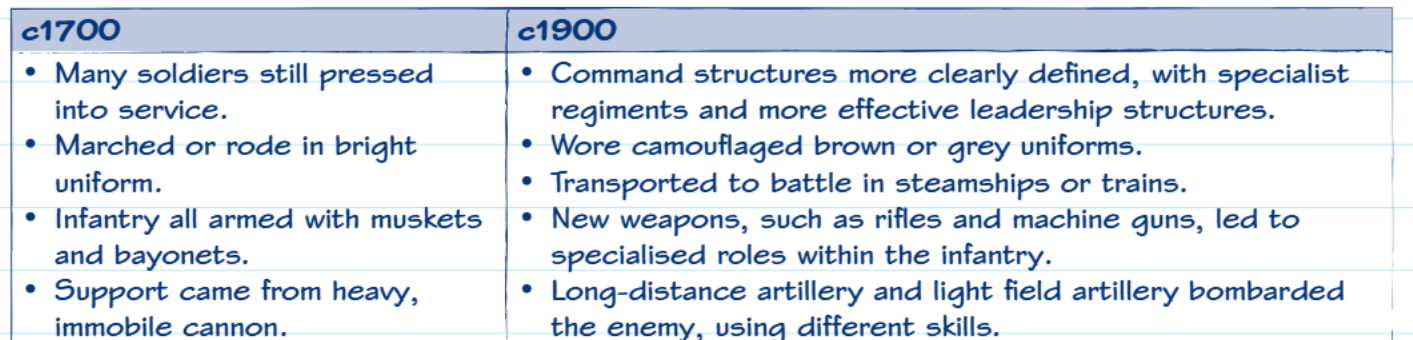
One of the most significant developments during this period was the transformation of the British army from a loose collection of pressed men into a professional military organisation with structured terms of enlistment and specialised roles.
Early period characteristics (c1700)
In the early 18th century, many soldiers were still pressed into service, often against their will. These troops marched and fought wearing bright, colourful uniforms that made them easily visible on the battlefield. The standard infantry weapon was the musket paired with a bayonet, while artillery support came from heavy, immobile cannons that were difficult to move during battle.
Later period developments (c1900)
By the end of the 19th century, the military had developed much clearer command structures with specialist regiments designed for specific roles. Soldiers now wore camouflaged brown or grey uniforms that provided better protection and concealment. Transportation to battlefields had been revolutionised by steam power and railways, allowing for rapid deployment of forces.
Example
Transformation Example: Infantry Equipment
1700: Soldier with bright red uniform, basic musket, bayonet, heavy equipment
- Visibility: Highly visible to enemies
- Weapon range: Limited musket accuracy
- Mobility: Slow, on foot only
1900: Professional soldier with camouflaged uniform, rifle, specialised equipment
- Visibility: Concealed by earth-tone uniforms
- Weapon range: Improved rifle accuracy and range
- Mobility: Steam transport to battlefield, better organised movement
Weapons technology had advanced significantly, with rifles and machine guns creating specialised infantry roles that required specific training and skills. Artillery had become mobile and long-range, capable of bombarding enemy positions using different tactical approaches than the static cannons of earlier periods.
Continuity on the battlefield
Despite these major changes, several aspects of military organisation and tactics showed remarkable continuity throughout the period.
Roles that persisted
Cavalry continued to play important reconnaissance and harassment roles, though new weapons like rifles and machine guns made traditional cavalry charges increasingly vulnerable and dangerous. Infantry remained the decisive factor in most battles, maintaining their central importance in military planning and battlefield success.
Tactical developments
Infantry tactics evolved gradually rather than through sudden changes. Soldiers continued to fight in organised lines, columns, and squares throughout most of the period. However, loading times improved significantly - infantry formations changed from four-deep lines to more efficient two-deep arrangements, allowing troops to fire volleys approximately every 20 seconds.
Note
The gradual nature of tactical change meant that many battle formations used in 1900 would have been recognisable to soldiers from 1700, even though the weapons and uniforms had changed dramatically.
The famous "Brown Bess" musket served as the standard British infantry weapon from 1715 until around 1850, demonstrating the slow pace of technological change in the earlier part of this period.
Resistance to change
Many military leaders were reluctant to accept new developments between 1850 and 1900. When faced with overwhelming firepower from modern weapons, some generals continued to rely on traditional ideas about combat rather than adapting their strategies to new realities.
However, some innovations did take hold. From around 1760, rhythmic marching to drum beats helped infantry units move and change formation more quickly, allowing commanders like Wellington to use manoeuvring as an effective military tactic.
Training developments
Military training during this period showed both the desire for improvement and the obstacles that prevented effective reform. Various attempts were made to enhance soldier preparation and combat effectiveness, but progress was often limited by social attitudes and institutional resistance.
Important
Training Reform Challenges
Officers frequently believed they already knew the most effective weapons training and tactical approaches. This overconfidence became a major barrier to military modernisation, as experienced leaders actively resisted new training methods that might have improved combat effectiveness.
Officers frequently believed they already knew the most effective weapons training and tactical approaches. This confidence led them to resist new methods and interfere with training innovations. Consequently, despite various reform efforts, relatively little practical improvement in military training had occurred by 1850.
The slow pace of training reform reflected broader social attitudes about military service and the role of the army in British society during this transitional period.
Timeline of key changes
- 1700-1750: Standing army of 50,000 men; bright uniforms; musket and bayonet standard
- 1715-1850: Brown Bess musket remains primary infantry weapon
- 1760s: Introduction of rhythmic marching improves infantry movement
- 1800-1850: Gradual decline in cavalry importance; artillery remains 5% of forces
- 1850-1900: Industrial Revolution transforms military capabilities
- 1850s onwards: Steam and rail transport revolutionise troop movement
- 1870s-1890s: Introduction of rifles and machine guns
- 1899: Army reaches 250,000 troops; cavalry reduced to 20% of forces
Summary
Key Points to Remember:
- Scale transformation: The British army grew from 50,000 to 250,000 soldiers between 1700 and 1899, driven by imperial expansion
- Gradual then rapid change: Little military innovation occurred from 1700-1850, but the Industrial Revolution accelerated changes from 1850-1900
- Professional development: The army evolved from pressed men in bright uniforms to specialised regiments with camouflaged clothing and defined roles
- Technology gap: While weapons advanced significantly (muskets to rifles and machine guns), military tactics and training were slow to adapt
- Persistent elements: Infantry remained crucial throughout the period, though their formations and loading techniques improved over time