The Battle of Waterloo, 1815 (Edexcel GCSE History): Revision Notes
📚Revision Notes
The Battle of Waterloo, 1815
Introduction
The Battle of Waterloo in 1815 stands as one of the most significant military encounters in British history. This decisive battle saw the famous British commander, the Duke of Wellington, inflict Napoleon Bonaparte's final defeat, ending the French emperor's remarkable military career and the Napoleonic Wars. Taking place in present-day Belgium, this confrontation would reshape European politics and demonstrate the effectiveness of British military strategy during this period.
Important
The Battle of Waterloo was not just another military engagement - it marked the definitive end of Napoleon's empire and over two decades of European warfare, fundamentally reshaping the balance of power across the continent.
The opposing forces
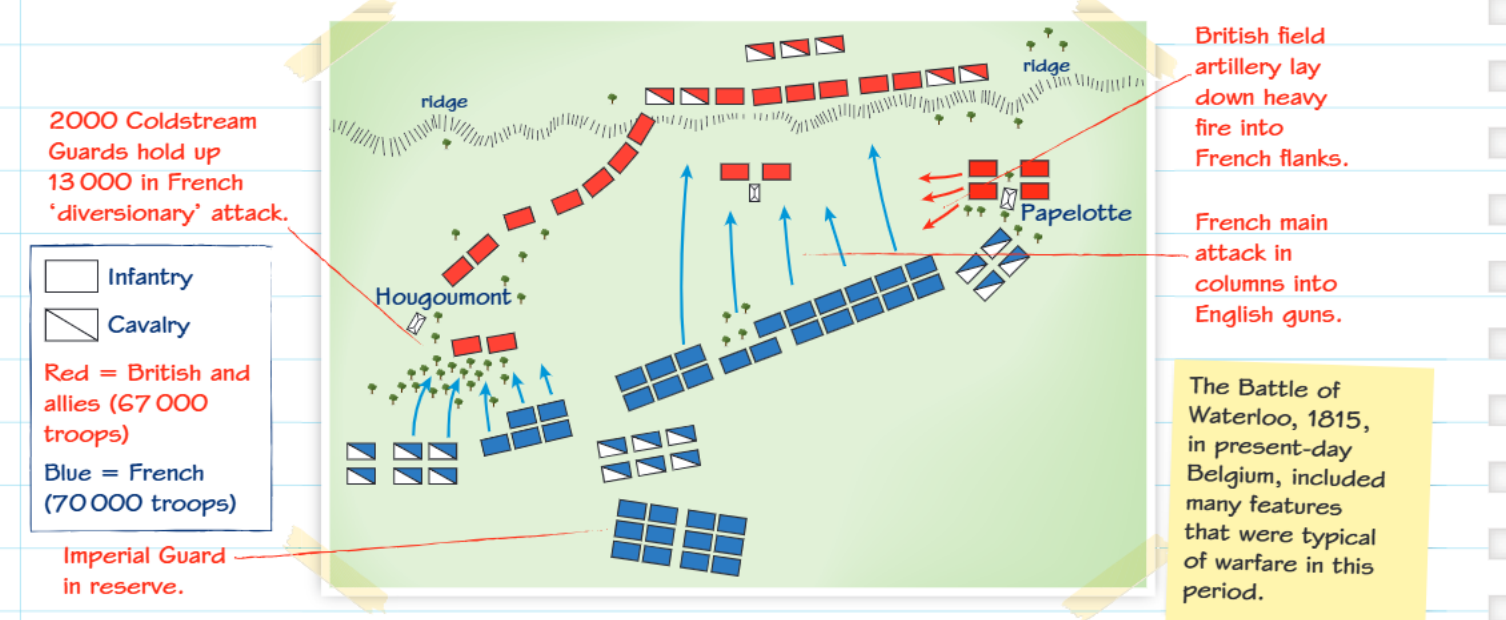
The battle featured two formidable armies facing each other across the Belgian countryside. Wellington commanded a coalition force of British and allied troops totaling 67,000 soldiers, while Napoleon led a slightly larger French army of 70,000 troops. Despite being outnumbered, the British and their allies possessed several advantages that would prove crucial in the coming fight.
The composition of both armies reflected the military practices of the early 19th century, with infantry forming the backbone of both forces, supported by cavalry units and artillery batteries. The battle would showcase how these different military arms could be coordinated effectively under skilled leadership.
Note
The numerical difference between the armies was relatively small - only 3,000 troops - making tactical decisions and leadership quality the determining factors rather than sheer numbers.
Wellington's masterful strategy
Wellington demonstrated exceptional strategic thinking in his approach to the battle. Understanding the importance of terrain, he chose an excellent defensive position that maximised his army's strengths while minimising French advantages. The battlefield itself proved ideal for defensive operations, featuring ridges and elevated positions that could shelter troops from enemy artillery fire.
The Duke deployed his forces behind a ridge, using this natural barrier to protect his men from the devastating effects of French cannon fire. This positioning forced Napoleon's artillery to fire blind or at extreme range, significantly reducing their effectiveness. Wellington also established two key strongpoints on the flanks of his main position - at Hougoumont and Papelotte - which would serve as anchors for his defensive line.
Perhaps most importantly, Wellington organised his infantry into squares when threatened by cavalry charges. These formations, with soldiers arranged in tight rectangular formations facing outward with bayonets fixed, proved nearly impregnable to mounted attacks. He also positioned field artillery strategically throughout his line, ready to pour devastating fire into attacking French columns.
Note
Tactical Innovation: The Infantry Square
Wellington's use of infantry squares was a masterpiece of defensive tactics. These formations could rapidly switch from line formation (effective against infantry) to square formation (effective against cavalry) depending on the threat, showcasing the flexibility and discipline of British troops.
Napoleon's tactical errors
Despite his reputation as one of history's greatest military minds, Napoleon made several critical mistakes at Waterloo that contributed to his ultimate defeat. His first error involved a fundamental misassessment of the battlefield conditions. Believing the ground was too muddy for effective cavalry operations, he delayed the start of the battle, giving Wellington more time to strengthen his positions and potentially allowing Prussian reinforcements to arrive.
Napoleon's battle plan relied heavily on traditional tactics that had served him well in previous campaigns. He attempted to break Wellington's line using massive infantry columns supported by cavalry charges and heavy artillery bombardments. However, these columns, though impressive and intimidating, presented large targets for British artillery and proved vulnerable to the disciplined volleys of Wellington's infantry squares.
The French emperor also made poor use of his numerical advantage. Rather than concentrating his entire force at Wellington's weakest points, he allowed himself to be drawn into costly diversionary attacks, most notably at Hougoumont where 2,000 British Coldstream Guards managed to tie down 13,000 French troops in what was meant to be merely a distraction from the main assault.
Important
Napoleon's Fatal Miscalculations
Three key errors sealed Napoleon's fate:
- Delaying the battle start due to muddy conditions
- Persisting with outdated column tactics against prepared defences
- Allowing a small British force to tie down a vastly superior number of French troops at Hougoumont
Key phases of the battle
The battle unfolded in several distinct phases, each demonstrating different aspects of 18th and 19th-century warfare. The initial French assault focused on softening up Wellington's positions with artillery bombardment, followed by probing attacks to test British resolve.
The main French offensive came in the form of massive infantry columns advancing directly towards the British lines. These formations, densely packed with soldiers, aimed to punch through Wellington's defences through sheer weight of numbers. However, Wellington's tactical preparations proved effective - his infantry squares held firm against French cavalry charges, while British artillery laid down devastating enfilade fire into the flanks of the attacking columns.
As the battle progressed, Wellington demonstrated remarkable tactical flexibility. When his defensive positions came under intense pressure, he skillfully switched from purely defensive tactics to carefully timed counterattacks. His cavalry units, held in reserve behind his main line, were deployed at crucial moments to exploit gaps in French formations and prevent Napoleon's forces from achieving breakthrough.
Leadership comparison
The contrasting leadership styles of Wellington and Napoleon during the battle highlight the importance of adaptability in military command. Wellington's approach emphasised careful preparation, defensive positioning, and patience. He avoided being drawn into premature attacks and instead waited for Napoleon to exhaust his forces against well-prepared positions.
Wellington's tactical discipline proved superior throughout the engagement. He maintained tight control over his reserves, particularly his cavalry and the elite troops, only committing them when the moment was most advantageous. His ability to coordinate different military arms - infantry, cavalry, and artillery - in mutual support demonstrated the sophistication of British military doctrine.
Napoleon, conversely, showed signs of the overconfidence that had crept into his decision-making during his later campaigns. He underestimated Wellington's defensive capabilities and overestimated his own army's ability to break through prepared positions. His failure to properly coordinate his attacks and his tendency to persist with failing tactics ultimately cost him the battle.
Note
Contrasting Command Styles
Wellington's patient, defensive approach perfectly countered Napoleon's aggressive, offensive tactics. Where Napoleon sought quick decisive action, Wellington demonstrated that careful preparation and tactical discipline could overcome even superior numbers and legendary military leadership.
Significance and outcome
The Battle of Waterloo marked the end of Napoleon's remarkable career and the conclusion of over two decades of nearly continuous European warfare. Wellington's victory established British military prestige at its peak and demonstrated the effectiveness of disciplined defensive tactics when properly executed.
The battle also showcased many features that were becoming typical of warfare during this historical period. The coordination of different military arms, the importance of artillery, the use of terrain for defensive advantage, and the critical role of disciplined infantry formations all represented the evolution of military tactics in the early 19th century.
For Britain, Waterloo confirmed the nation's position as Europe's dominant military power and validated the reforms and training that had transformed the British army since the disasters of the American Revolution.
Important
Historical Impact of Waterloo
This single battle fundamentally altered European history by:
- Ending Napoleon's empire permanently
- Establishing Britain as the dominant European power
- Demonstrating the effectiveness of combined arms tactics
- Ushering in a period of relative European peace
Timeline
Example
Chronological Breakdown: The Battle of Waterloo
- Morning, June 18, 1815: Napoleon delays attack due to muddy conditions
- Mid-morning: French artillery bombardment begins
- Early afternoon: Main French infantry assault on British centre
- Afternoon: Repeated French cavalry charges against British squares
- Late afternoon: Diversionary attack on Hougoumont ties down French reserves
- Evening: Napoleon commits the Imperial Guard in final desperate assault
- Night: French army collapses and retreats in disorder
Remember!
Summary
Key Points to Remember:
- Wellington's defensive genius: The Duke chose excellent terrain and positioned his forces to maximise their defensive advantages while minimising French strengths
- Napoleon's crucial mistakes: The French emperor delayed his attack, misused his numerical superiority, and persisted with failing tactics against prepared positions
- Infantry squares proved decisive: Wellington's disciplined infantry formations withstood repeated French cavalry charges and artillery bombardments
- Coordination was key: The successful integration of British infantry, cavalry, and artillery demonstrated the importance of combined arms tactics
- Waterloo ended an era: This battle concluded Napoleon's career and over twenty years of European warfare, establishing Britain as the dominant military power