Attitudes in society (Edexcel GCSE History): Revision Notes
📚Revision Notes
Attitudes in society (c1900-present)
How society shaped modern warfare
During the period from 1900 to the present day, public attitudes played a crucial role in determining how Britain approached and conducted warfare. The government became increasingly aware of the need to manage public opinion, while the rise of modern media fundamentally transformed how wars were reported and understood by civilians.
Conscientious objectors and changing social attitudes
What were conscientious objectors?
Note
Definition: Conscientious Objectors
Conscientious objectors (COs) were civilians who refused to fight in wars due to their moral, religious, or political beliefs. Their treatment by society reveals important changes in attitudes towards individual conscience and the duty to serve one's country.
First World War experiences
During the First World War, conscientious objectors faced harsh treatment from both the government and their communities. Many were publicly shamed and received hate mail from neighbours. Some were even given white feathers by women as a symbol of cowardice, marking them out for social disgrace. Military tribunals often rejected their appeals, forcing many to serve against their beliefs or face imprisonment.
Second World War developments
By the Second World War, attitudes had begun to shift. While COs still faced hostility and could lose friendships or employment opportunities, they were increasingly offered alternative forms of service rather than being forced into combat roles. This represented a growing recognition that people might have legitimate reasons for objecting to warfare.
Important
Dramatic Social Change
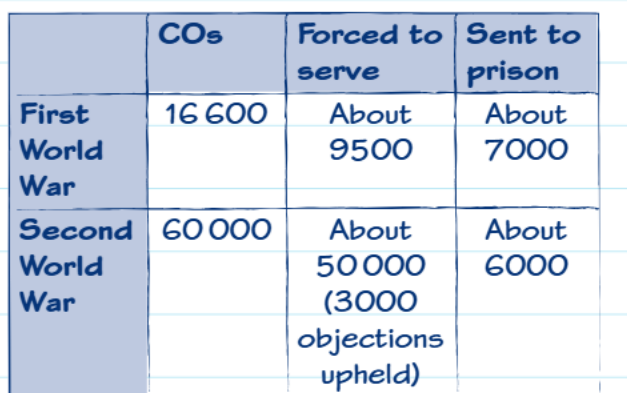
The dramatic increase in conscientious objectors between the two world wars - from 16,600 in WWI to 60,000 in WWII - suggests changing social attitudes. Importantly, the proportion sent to prison decreased significantly, indicating greater tolerance for different viewpoints.
The evolution of war reporting
Early restrictions on information
War reporting underwent massive changes throughout this period. In 1914, only one journalist - an army officer - was permitted to report from the battlefield. This severely limited what the public could learn about the reality of warfare.
Gradual expansion of coverage
By November 1916, five journalists were allowed at the front lines, though their reports were still heavily controlled. The real transformation came much later - by 2003, approximately 700 reporters were embedded with Coalition forces in Iraq, with many more working independently in the war zone.
Technology's impact on reporting
Note
Revolutionary Communication Changes
Modern communications technology, including television, satellite links, and the internet, revolutionised how wars were reported. This made it much harder for governments to control the flow of information, though they continued to try through various means.
Government control through censorship and propaganda
First World War methods
During the First World War, the government relied heavily on censorship to hide negative news from the public. Soldiers' letters home were read and censored to prevent morale-damaging information from spreading. Newspapers could be shut down if they criticised government policy.
Propaganda became equally important for maintaining support. The government promoted the idea that all Germans were evil and needed to be defeated, encouraging men to volunteer for military service. This propaganda often exaggerated victories while downplaying defeats.
Second World War approaches
In the Second World War, propaganda continued to play a vital role, but the approach became more sophisticated. Rather than simply hiding bad news, the government focused on building morale through emphasising the horrors of war and the necessity of victory. Morale-building posters encouraged support for the war effort, while the BBC played a crucial role in maintaining public spirit and providing information that supported the war effort.
The challenge of self-censorship
Important
Media Self-Regulation
Interestingly, the BBC was described as having a role in informing the public while being 'self-censored' - suggesting that media organisations began to regulate their own reporting to support national interests without direct government intervention.
Modern warfare and information control
Reduced government control
New technology has made it increasingly difficult for governments to completely control information about warfare. The bombing of Iraq in 1991 was reported before the war had even been officially declared to the public, demonstrating how quickly information could now travel.
Continued limitations
Despite technological advances, some information is still censored, and journalists sometimes present a patriotic viewpoint rather than completely objective reporting. For example, during the Iraq War in 2003, reports were often filtered through official channels, and Iraqi civilian casualties were typically reported much later than military actions.
Public opposition to war
Note
Changing Public Attitudes
Since 1945, public support for warfare has generally declined. This was dramatically illustrated in 2003 when a million protesters marched against the war in Iraq. Modern populations are more likely to question the human and financial costs of military action, putting pressure on governments to justify their decisions.
Strategic aims and public support
Modern military strategies now explicitly aim to minimise casualties on both sides in order to maintain public support. Governments understand that heavy losses can quickly turn public opinion against military action, making civilian attitudes a crucial factor in military planning.
Timeline of key changes
- 1914: Single army officer reports from battlefield
- 1916: Five journalists allowed at front lines
- 1945: End of WWII marks shift in public attitudes to war
- 1991: Iraq bombing reported before official war declaration
- 2003: 700 embedded reporters in Iraq; million-person anti-war protest
Summary
Key Points to Remember:
-
The number of conscientious objectors increased dramatically between WWI (16,600) and WWII (60,000), showing changing social attitudes towards individual conscience
-
War reporting evolved from extremely limited coverage (1 reporter in 1914) to embedded journalism with hundreds of reporters by 2003
-
Government control shifted from direct censorship and propaganda to more subtle influence, though technology made complete control increasingly difficult
-
Modern public attitudes are generally more sceptical of warfare, with people more likely to question the human and financial costs of military action
-
The rise of mass media fundamentally changed how the public experienced and understood warfare, making public opinion a crucial factor in military planning