The modern army (Edexcel GCSE History): Revision Notes
📚Revision Notes
The modern army
The British Army has undergone dramatic transformation since 1900, adapting to meet the challenges of modern warfare and changing technology. Understanding these developments helps explain how Britain's military evolved to face 20th and 21st-century conflicts.
Note
This overview examines the major changes in British Army structure, composition, and capabilities from 1900 to the present day, highlighting how military forces adapted to technological advances and changing strategic requirements.
Changes in army size
The size of Britain's professional army has fluctuated significantly over the past century, closely reflecting the nation's military commitments and strategic needs. During peacetime, Britain has consistently maintained a relatively small professional force, similar to the approach taken in 1840.
Key statistics show the dramatic variations:
- 1899: 250,000 personnel
- 1920: 200,000 personnel (post-WWI reduction)
- 1945: 3,500,000 personnel (wartime peak)
- 1963: 3,300,000 personnel (maintaining Cold War readiness)
- 2020: 170,000 personnel
- Present: Approximately 82,000 personnel
Important
These numbers demonstrate how Britain's army expanded massively during both world wars before contracting again during peacetime periods. The dramatic scale of these changes - from 250,000 to 3.5 million and back to 82,000 - shows the flexibility required in modern military planning.
The current small professional army reflects modern military doctrine that emphasises quality, training, and technological capability over sheer numbers.
Evolution of army composition
The makeup of Britain's armed forces has transformed dramatically since 1914, reflecting changes in military technology and tactical approaches to warfare.
Infantry forces have seen the most significant reduction, dropping from 65% of total forces in 1914 to just 25% by 2015. Despite this decline, infantry units remain the backbone of ground operations, though they now work more closely with supporting arms and technology.
Cavalry units maintained their 10% proportion from 1914 to 2015, but their role has completely transformed. Modern armoured units using tanks have replaced horse-mounted cavalry, now leading attacks while providing mobile artillery support and protection for infantry forces.
Artillery composition decreased from 20% in 1914 to 10% in 2015. However, this reduction reflects increased effectiveness rather than diminished importance. Modern artillery includes satellite-guided missiles and other precision weapons that can achieve greater impact with fewer personnel. Artillery units share their traditional bombardment role with tanks and aircraft.
Specialist troops have experienced the most dramatic growth, expanding from just 5% in 1914 to 55% by 2015. This category includes the Royal Engineers, Royal Electrical and Mechanical Engineers, Royal Logistics Corps, and Royal Medical Corps. These units provide crucial front-line support, reflecting the increasingly technical nature of modern warfare.
Example
Transformation Example: From Traditional to Modern Forces
In 1914, a typical British Army unit might consist of:
- 65% Infantry soldiers with rifles
- 20% Artillery personnel with field guns
- 10% Cavalry on horseback
- 5% Support specialists
By 2015, the same unit would include:
- 25% Infantry with advanced equipment
- 10% Artillery with precision weapons
- 10% Armoured units with tanks
- 55% Technical specialists and support personnel
This shows the shift from manpower-intensive to technology-intensive warfare.
Development of military logistics
Military logistics - the transportation of troops, supplies, ammunition, and communications - has evolved from chaotic beginnings to sophisticated modern systems.
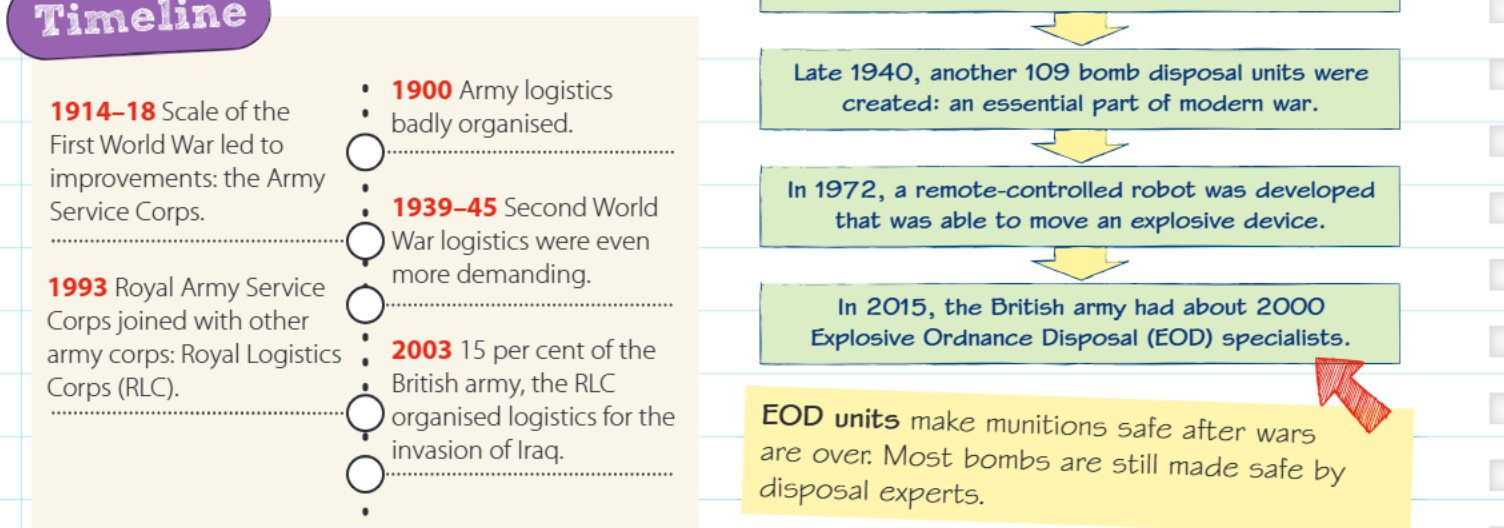
In 1900, army logistics were poorly organised and often inadequate for military needs. The scale and demands of the First World War (1914-18) exposed these weaknesses, leading to significant improvements and the formation of the Army Service Corps.
The Second World War (1939-45) placed even greater demands on logistics systems, requiring more complex supply chains across multiple theatres of operation. By 1993, the Royal Army Service Corps merged with other military units to form the Royal Logistics Corps (RLC), creating a more integrated approach to military support.
Note
The image reference above shows the evolution of military logistics capabilities, demonstrating how transportation and supply methods have advanced from basic systems to sophisticated modern operations.
A crucial milestone occurred in 2003 when the RLC represented 15% of the entire British army, demonstrating the central importance of logistics in modern military operations. This was particularly evident during the Iraq invasion, where sophisticated logistics planning proved essential for success.
Specialised bomb disposal operations
Bomb disposal capabilities have developed into one of the most technically advanced aspects of modern military operations. During the early stages of World War II in 1940, the British Army established 25 specialised bomb disposal units to address the threat from German bombing campaigns.
By late 1940, military leaders recognised the critical importance of this capability and expanded to 109 bomb disposal units, making them an essential component of modern warfare defence.
A significant technological breakthrough came in 1972 with the development of remote-controlled robots capable of moving and disarming explosive devices. This innovation greatly reduced risks to disposal experts while improving operational effectiveness.
By 2015, the British Army employed approximately 2,000 Explosive Ordnance Disposal (EOD) specialists. These units continue to perform vital work making munitions safe after conflicts end, though most dangerous bombs still require human disposal experts rather than fully automated systems.
Important
Despite advances in robotic technology, human expertise remains crucial in bomb disposal operations. The complexity and unpredictability of explosive devices means that experienced specialists are still essential for the most dangerous situations.
Structural military reforms
Two major reform periods have fundamentally shaped the modern British Army's organisation and capabilities.

Haldane's Reforms (1908) emerged as a direct response to lessons learned during the Boer War (1899-1902). These reforms established a professional army of 150,000 personnel supported by the Territorial Force, a national reserve of part-time soldiers. The Territorial Force was later renamed the Territorial Army in 1920, reflecting its growing importance in British military planning.
Army 2020 represents an ongoing comprehensive review of British military structure for the 21st century. This reform has created a smaller professional army of 82,000 personnel, supported by the Army Reserve (renamed from the Territorial Army in 2013) consisting of 30,000 part-time soldiers.
Summary
Key Principle of British Military Organisation:
Both major reform periods demonstrate continuity in British military thinking - maintaining a small, highly professional core force supported by trained reserves who can be mobilised when needed. This approach balances military effectiveness with economic efficiency while meeting modern strategic requirements.
Timeline of key developments
- 1900: Army logistics poorly organised
- 1908: Haldane's Reforms implemented
- 1914-18: WWI leads to Army Service Corps formation
- 1920: Territorial Force renamed Territorial Army
- 1939-45: WWII increases logistics demands
- 1940: 25 bomb disposal units formed, expanded to 109 by year-end
- 1972: Remote-controlled bomb disposal robots developed
- 1993: Royal Logistics Corps established
- 2003: RLC comprises 15% of British Army
- 2013: Territorial Army renamed Army Reserve
- 2015: 2,000 EOD specialists in service
- 2020: Army 2020 reforms ongoing
Remember!
Summary
Key Points to Remember:
-
The British Army has consistently maintained a small professional force during peacetime, expanding dramatically only during major conflicts like the World Wars.
-
Army composition has shifted from infantry-heavy forces to specialist-dominated units, reflecting the technical complexity of modern warfare.
-
Military logistics evolved from poorly organised systems in 1900 to sophisticated operations comprising 15% of the entire army by 2003.
-
Bomb disposal capabilities developed from basic 25-unit formations in 1940 to advanced robotic systems and 2,000 specialists by 2015.
-
Two major reform periods - Haldane's Reforms (1908) and Army 2020 - demonstrate consistent British military philosophy of small professional armies supported by trained reserves.