Straight-Line Graphs (Edexcel GCSE Maths): Revision Notes
📚Revision Notes
Straight-line graphs
Understanding straight-line graphs is a fundamental skill in coordinate geometry. These graphs represent linear relationships and have specific characteristics that make them easy to identify and work with.
Horizontal and vertical lines
Two of the most basic types of straight lines are horizontal and vertical lines, which have simple but important equations.
Vertical lines have the equation , where 'a' is any number. This creates a vertical line that passes through the point 'a' on the x-axis. For example, creates a vertical line through the point , and every point on this line has an x-coordinate of 3.
Horizontal lines have the equation , where 'a' is any number. This creates a horizontal line that passes through the point 'a' on the y-axis. For example, creates a horizontal line through the point , and every point on this line has a y-coordinate of 3.
Important
A common mistake students make is confusing with . Remember that means all points have the same x-coordinate, whilst means all points have the same y-coordinate.
Example
Worked Example: Identifying Points on Vertical and Horizontal Lines
For the vertical line :
- Points , , and all lie on this line
- Notice that the x-coordinate is always 5
For the horizontal line :
- Points , , and all lie on this line
- Notice that the y-coordinate is always -2

The main diagonals
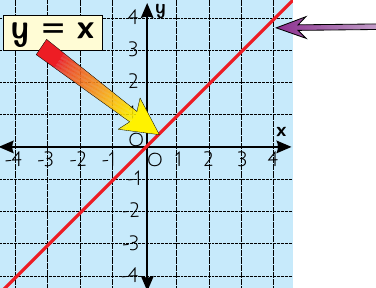
The main diagonal lines are special cases that pass through the origin and have slopes of exactly 1 or -1.
The line is known as the main diagonal that goes uphill from left to right. On this line, the x-coordinate and y-coordinate of each point are exactly the same.
Example
Worked Example: Points on the line
Points like , , and all lie on this line because in each case, the y-coordinate equals the x-coordinate.
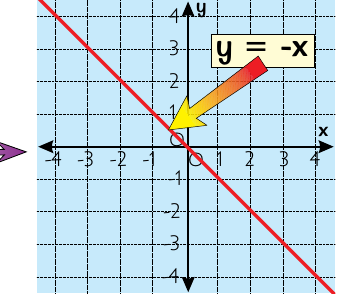
The line is the main diagonal that goes downhill from left to right. On this line, the x-coordinate and y-coordinate of each point are negatives of each other.
Example
Worked Example: Points on the line
Points like , , and all lie on this line because in each case, the y-coordinate is the negative of the x-coordinate.
Other sloping lines through the origin
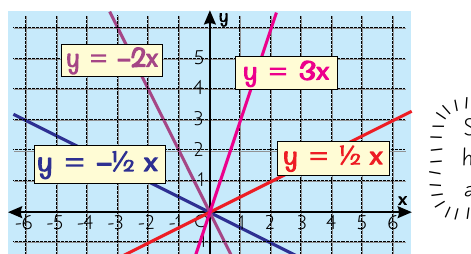
Lines that pass through the origin but have different slopes follow the general forms and , where 'a' represents the gradient or steepness of the line.
The value of 'a' (called the gradient) determines how steep the line is. A larger value of 'a' creates a steeper line, whilst a smaller value creates a gentler slope. When the equation has a minus sign (), this tells you the line slopes downhill from left to right.
Note
These lines are particularly useful because they show direct proportional relationships between x and y values. This means that as x increases, y increases by a constant multiple.
Identifying straight lines from equations
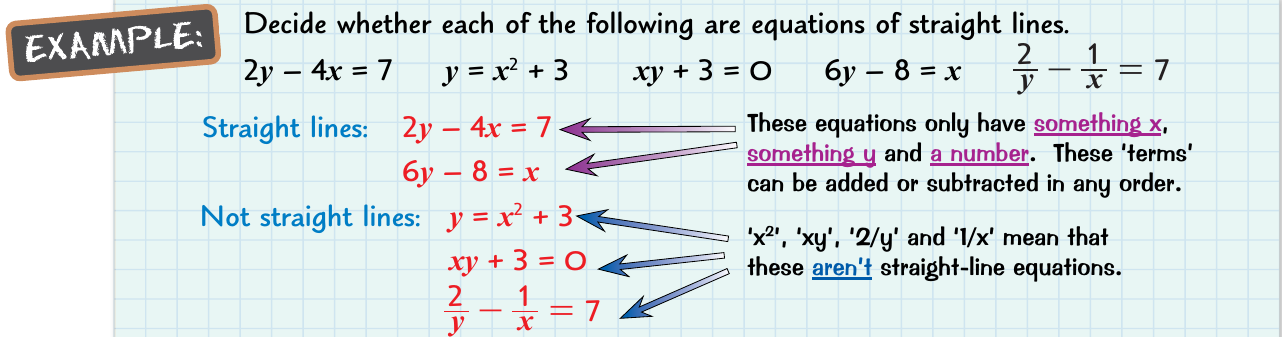
Not all equations represent straight lines, so it's important to know how to identify them. All straight-line equations contain only three types of terms: something involving x, something involving y, and a number. These terms can be added or subtracted in any order.
Example
Worked Example: Identifying Straight-Line Equations
Examples of straight-line equations include:
- (contains terms with y, x, and a number)
- (can be rearranged to )
- (contains terms with y, x, and a number)
Important
Examples of equations that are NOT straight lines include:
- (contains )
- (contains )
- (contains fractions with variables in denominators)
The key is to look for terms like , , or fractions where the variable appears in the denominator. These indicate that the equation represents a curved line rather than a straight line.
Working with coordinates
When working with straight-line graphs, understanding coordinates is essential. Each point on a line can be described using an coordinate pair, where x represents the horizontal position and y represents the vertical position.
For any straight line, you can find multiple coordinate pairs that satisfy the equation. This allows you to plot the line accurately on a coordinate grid and understand the relationship between the variables.
Note
Finding coordinate pairs is a key skill for graphing straight lines. You can substitute any value for x into the equation and calculate the corresponding y-value, or vice versa.
Summary
Key Points to Remember:
- Vertical lines have equation and pass through point
- Horizontal lines have equation and pass through point
- Main diagonals are (uphill) and (downhill)
- Gradient determines steepness - larger values mean steeper lines
- Straight-line equations only contain 'something x, something y and a number'