X, Y and Z Coordinates (Edexcel GCSE Maths): Revision Notes
📚Revision Notes
X, Y and Z Coordinates
Understanding coordinate systems
Coordinate systems help us describe the exact position of points in space. In mathematics, we use numbers to pinpoint locations on graphs and in three-dimensional space. This system is essential for solving problems involving distance, position, and geometric relationships.
The coordinate system provides a standardised way to communicate about locations, making it possible to precisely describe where objects are positioned relative to a fixed reference point called the origin.
The four quadrants
When working with coordinates, the coordinate plane is divided into four distinct regions called quadrants. Each quadrant has its own pattern of positive and negative values that you need to understand.
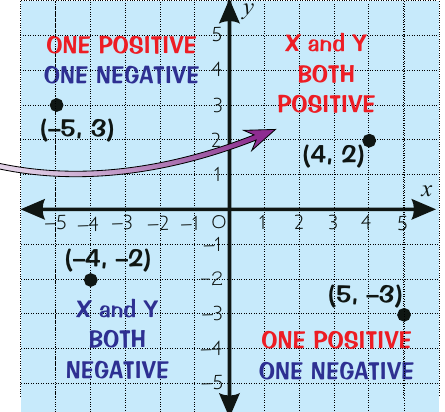
The top-right quadrant is the most straightforward because both x and y coordinates are positive in this region. This makes calculations simpler and is why many examples start here.
In the remaining three quadrants, you'll encounter negative coordinates. The top-left and bottom-right quadrants each have one positive and one negative coordinate, while the bottom-left quadrant has both coordinates as negative values.
Important
Critical Pattern to Remember:
- Top-right quadrant: both x and y are positive (+, +)
- Top-left quadrant: x is negative, y is positive (-, +)
- Bottom-left quadrant: both x and y are negative (-, -)
- Bottom-right quadrant: x is positive, y is negative (+, -)
Note
Coordinates are always written using brackets with the x-value first, followed by the y-value: . Remember that x represents the horizontal position (left or right from the centre), while y represents the vertical position (up or down from the centre).
Finding midpoints of line segments
The midpoint of a line segment is the point that sits exactly halfway between two given points. This concept appears regularly in exams and follows a straightforward process.
To find the midpoint, you need to calculate the average of the x-coordinates from both points, then do the same for the y-coordinates. These averaged values become the coordinates of the midpoint.
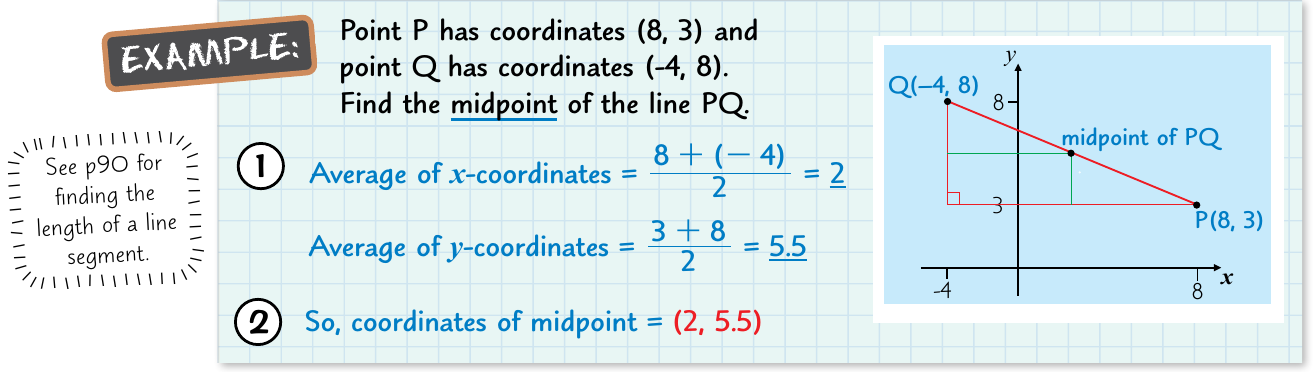
The process involves two simple steps: first, add the x-coordinates together and divide by two. Then, add the y-coordinates together and divide by two. The resulting pair of numbers gives you the midpoint coordinates.
Example
Worked Example: Finding a Midpoint
Given points P(8, 3) and Q(-4, 8), find the midpoint:
Step 1: Calculate the average of x-coordinates Average of x-coordinates =
Step 2: Calculate the average of y-coordinates Average of y-coordinates =
Therefore, the midpoint is (2, 5.5)
This method works because you're essentially finding the centre point by taking the mean position in both the horizontal and vertical directions.
Working with 3D coordinates
Three-dimensional coordinate systems extend our familiar x and y axes by adding a third dimension called the z-axis. This allows us to describe positions in 3D space using three numbers instead of two.
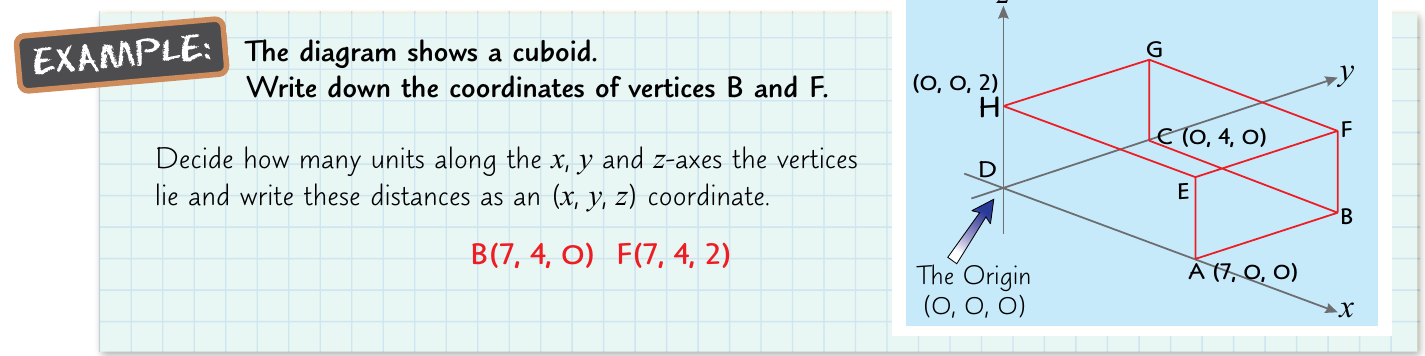
In three-dimensional space, every position requires three coordinates written as . The z-coordinate tells us how far forwards or backwards a point is from the standard xy-plane that we're used to working with.
Note
Understanding the Third Dimension:
- The x-axis typically runs left to right
- The y-axis runs up and down
- The z-axis extends towards you or away from you
When working with 3D shapes like cuboids, you need to carefully count the units along each axis to determine the coordinates of different vertices. The process requires systematic examination of each dimension to ensure accuracy.
Important
Understanding 3D coordinates is crucial for working with solid shapes, calculating volumes, and solving problems involving three-dimensional geometry. This extends your mathematical toolkit from flat, two-dimensional problems into the real world of three-dimensional space.
Summary
Key Points to Remember:
- The coordinate plane has four quadrants, each with its own pattern of positive and negative values
- The top-right quadrant is easiest to work with since both coordinates are positive
- Coordinates are always written as for 2D and for 3D space
- To find a midpoint, calculate the average of the x-coordinates and the average of the y-coordinates
- The z-coordinate in 3D space represents the third dimension, extending the familiar xy-plane into solid geometry