“y = mx + c” (Edexcel GCSE Maths): Revision Notes
📚Revision Notes
Understanding y = mx + c
What is y = mx + c?
The equation y = mx + c represents the standard form for writing straight line equations. This format is incredibly useful because it immediately tells you two key pieces of information about any straight line just by looking at the equation.

Note
In the standard form :
- m represents the gradient (or slope) of the line
- c represents the y-intercept (where the line crosses the y-axis)
Understanding these components is essential for working with linear equations effectively.
Converting equations to y = mx + c form
Many straight line equations don't initially appear in the standard format. The first step in working with these equations is to rearrange them into this standard form.
The process involves isolating y on one side of the equation. Here's how to approach different types of equations:
Example
Worked Example: Rearranging Different Equation Types
Example 1: Rearrange to: This gives you and
Example 2: Rearrange to: This means and
Example 3: Rearrange to: This gives and
Important
A common mistake is mixing up the values of m and c. Remember that m is always the coefficient of x (the number in front of x), whilst c is the constant term that stands alone.
Sketching straight lines using y = mx + c

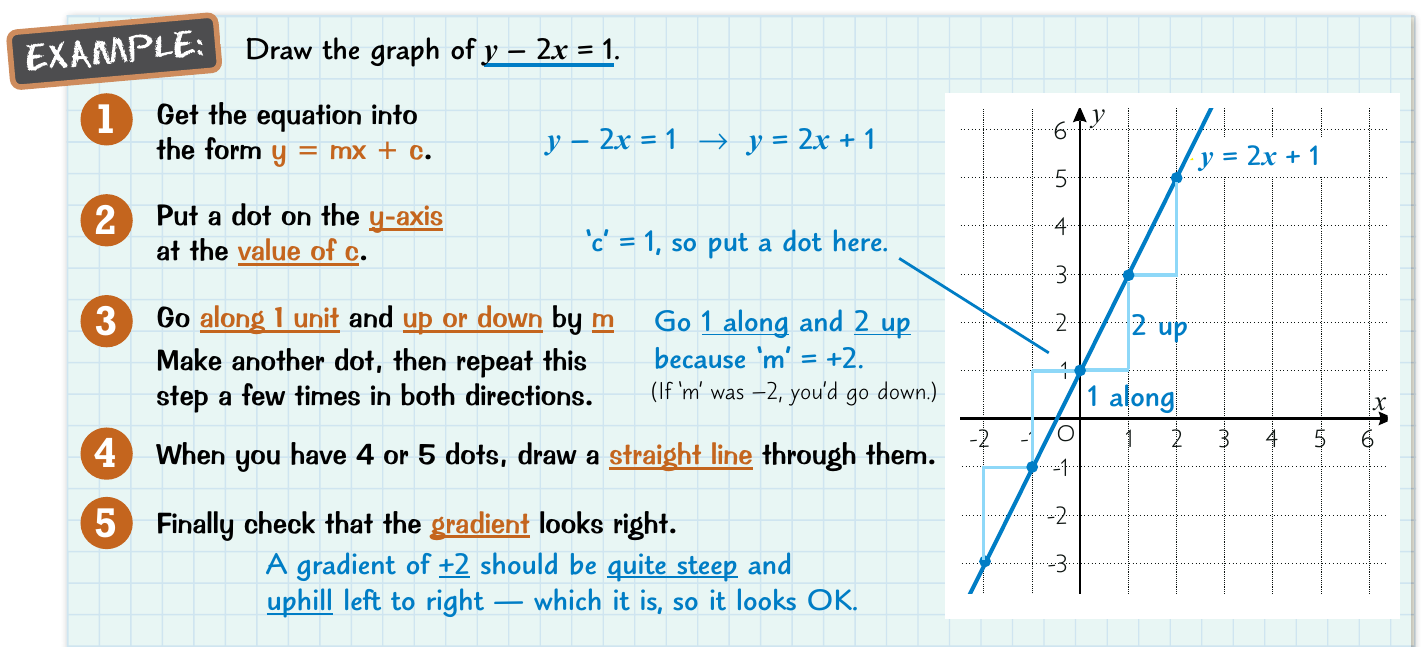
Once you have an equation in form, you can sketch the line using a systematic approach. This method ensures accuracy and helps you understand how the equation relates to the visual representation.
Example
Worked Example: 5-Step Sketching Process
Step 1: Ensure your equation is in form. If it isn't, rearrange it first.
Step 2: Mark the y-intercept on your graph. This is the value of c, and it's where the line crosses the y-axis.
Step 3: Use the gradient to find additional points. Starting from the y-intercept, move 1 unit along the x-axis, then move up or down by m units. If m is positive, move up; if negative, move down.
Step 4: Repeat step 3 to create several points along the line. The more points you plot, the more accurate your line will be.
Step 5: Draw a straight line through all your plotted points. Check that your gradient appears correct - a positive gradient slopes upward from left to right, whilst a negative gradient slopes downward.
This method works because the gradient tells you exactly how steep the line is and in which direction it slopes.
Finding equations from graphs
Sometimes you'll need to work backwards - finding the equation of a line when you're given its graph. This is the reverse of the sketching process.
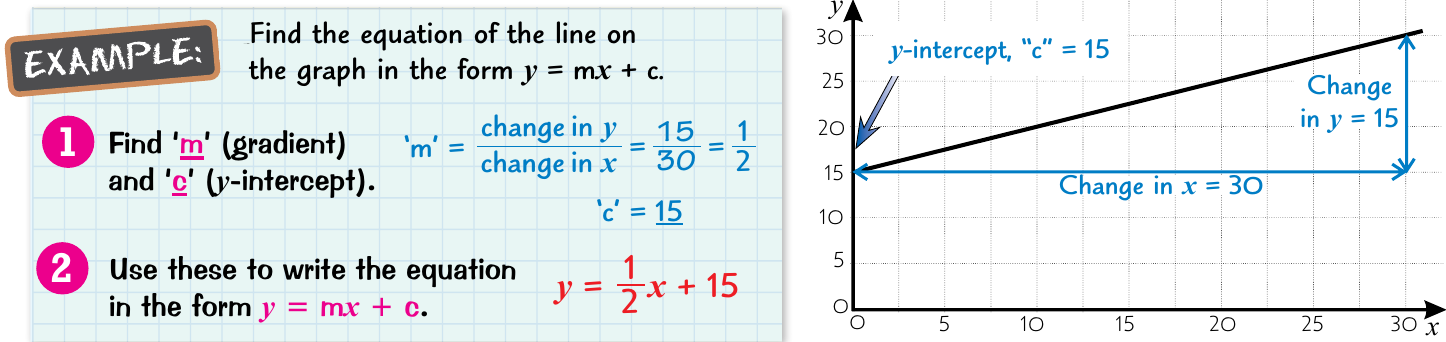
The process involves two main steps:
Example
Worked Example: Finding Equation from Graph
Step 1: Find the gradient (m) and y-intercept (c) from the graph.
To find the gradient, select two clear points on the line and calculate:
The y-intercept is simply where the line crosses the y-axis - read this value directly from the graph.
Step 2: Substitute these values into the format.
For example, if you calculate that and , then your equation becomes:
Note
When calculating gradients, be careful with the signs. If the line slopes upward from left to right, the gradient is positive. If it slopes downward, the gradient is negative.
Key tips and common mistakes
Working with becomes much easier when you understand these important points:
Note
The gradient (m) tells you about the steepness and direction of the line. A larger absolute value means a steeper line, whilst the sign indicates the direction.
The y-intercept (c) is always the point where . This is your starting point when sketching and should be easy to identify on any graph.
When rearranging equations, always aim to get y by itself on one side. This might involve adding, subtracting, multiplying, or dividing both sides of the equation.
Important
A common error is confusing m and c values. Always double-check by identifying which number is with the x (that's m) and which number stands alone (that's c).
Summary
Key Points to Remember:
- The equation is the standard form for straight lines, where m is the gradient and c is the y-intercept
- Always rearrange equations into this form before sketching or analysing
- To sketch a line, start at the y-intercept and use the gradient to find additional points
- To find an equation from a graph, calculate the gradient and identify the y-intercept
- The gradient tells you the steepness and direction of the line - positive gradients slope upward, negative gradients slope downward