Tree Diagrams (Edexcel GCSE Maths): Revision Notes
📚Revision Notes
Tree Diagrams
Tree diagrams are a powerful visual tool for solving probability problems involving multiple events. They help you organise information clearly and calculate probabilities systematically, making even complex problems much more manageable.
Four key tree diagram facts
Understanding these fundamental principles will help you tackle any tree diagram question with confidence.
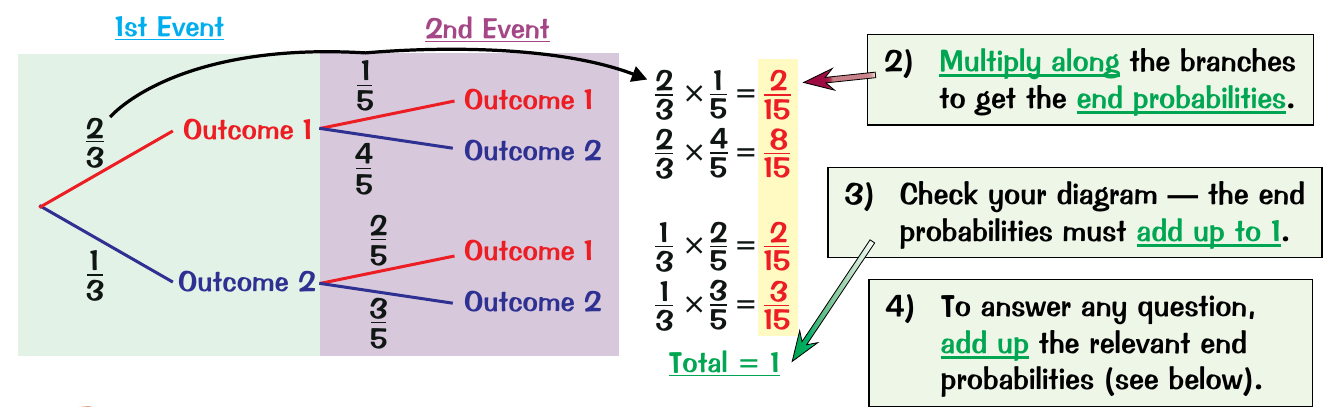
These four rules form the foundation of all tree diagram work and apply to every probability problem involving sequential events:
Important
The Four Essential Rules for Tree Diagrams:
-
Probabilities on branches must sum to 1 - At any branching point, all the probability values must add up to 1. This is because one of the outcomes must definitely happen.
-
Multiply along branches for end probabilities - To find the probability of any specific sequence of outcomes, multiply the probabilities along the path from start to finish.
-
Check your work - All the end probabilities (final outcomes) must add up to 1 when you've completed your diagram. This is a crucial check that your work is correct.
-
Add relevant end probabilities - To answer questions about combined outcomes, add up all the end probabilities that satisfy the condition you're looking for.
Mastering these rules will give you the confidence to approach any tree diagram problem systematically and accurately.
Sampling with replacement
When items are replaced after being selected, the probabilities remain the same for each subsequent selection. This creates a straightforward tree diagram where branch probabilities don't change.
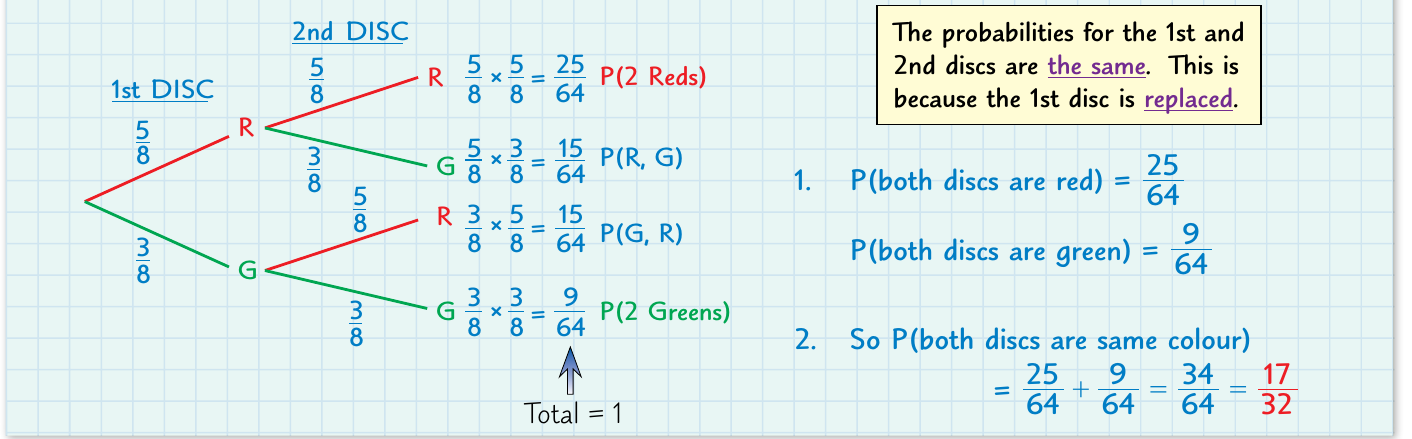
In replacement scenarios, the key characteristic is that each selection is independent of previous selections. The probability of drawing a red disc remains for both the first and second draws because the first disc is returned to the bag. This means the composition of the bag stays the same throughout the process.
Note
Understanding Independence: With replacement, each draw is completely independent. The outcome of the first draw doesn't affect the probabilities for the second draw because the original conditions are restored.
To solve these problems, you multiply along each branch to get the end probabilities, then add the relevant ones together. For example, finding the probability that both discs are the same colour involves adding .
Sampling without replacement
When items are not replaced, the probabilities change after each selection. This creates conditional probabilities where later selections depend on earlier outcomes.
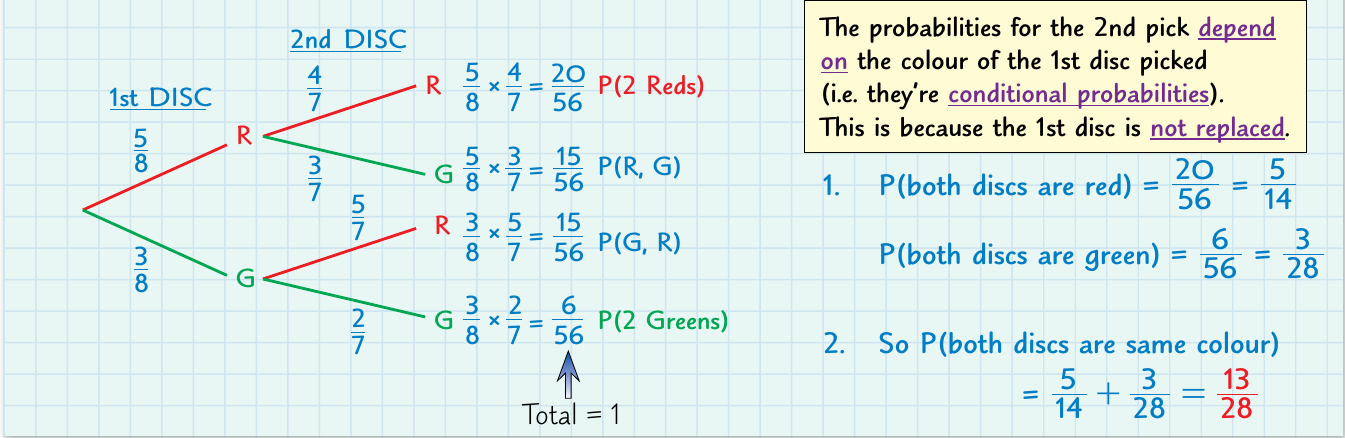
Without replacement, the probabilities for the second selection depend on what happened in the first selection. If a red disc is drawn first, there are now fewer red discs and fewer total discs remaining, which changes the probability ratios for the second draw.
The key insight is that second-stage probabilities are conditional on first-stage outcomes. After drawing a red disc first, the probability of drawing red again becomes (since there are 4 red discs left out of 7 total), while the probability of drawing green becomes .
Important
Critical Concept: Conditional Probability This is one of the most common sources of errors in probability problems. Always remember that when sampling without replacement, the probabilities for later selections must be recalculated based on what has already been removed.
Extra details for the tree diagram method
These additional techniques will help you handle more complex probability problems effectively.
Breaking problems into sequences
Always break complex probability questions into a sequence of separate events. Even if the question seems to involve simultaneous events, you can usually split it into sequential steps that are easier to analyse with a tree diagram.
Using partial diagrams
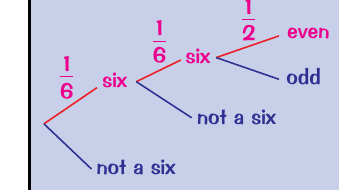
You don't always need to draw a complete tree diagram. Sometimes you can solve problems by drawing just the branches you need for your specific calculation.
Note
Efficiency Tip: For complex problems, consider whether you need the full tree diagram or if a partial diagram focusing on the relevant outcomes would be more efficient.
Understanding conditional probabilities
Watch out for situations where probabilities change based on previous outcomes. This commonly occurs when sampling without replacement, but can also happen in other scenarios where earlier events affect later possibilities.
Handling "at least" questions
Questions asking for "at least" something can often be solved more easily by using the complement. The probability of "at least one" equals 1 minus the probability of "none".
For example:
This approach is particularly useful when calculating the probability of getting "at least one" of something would require adding many different outcomes together.
Worked example with conditional probability
Let's examine a problem involving tiles with letters, which demonstrates conditional probability in action.
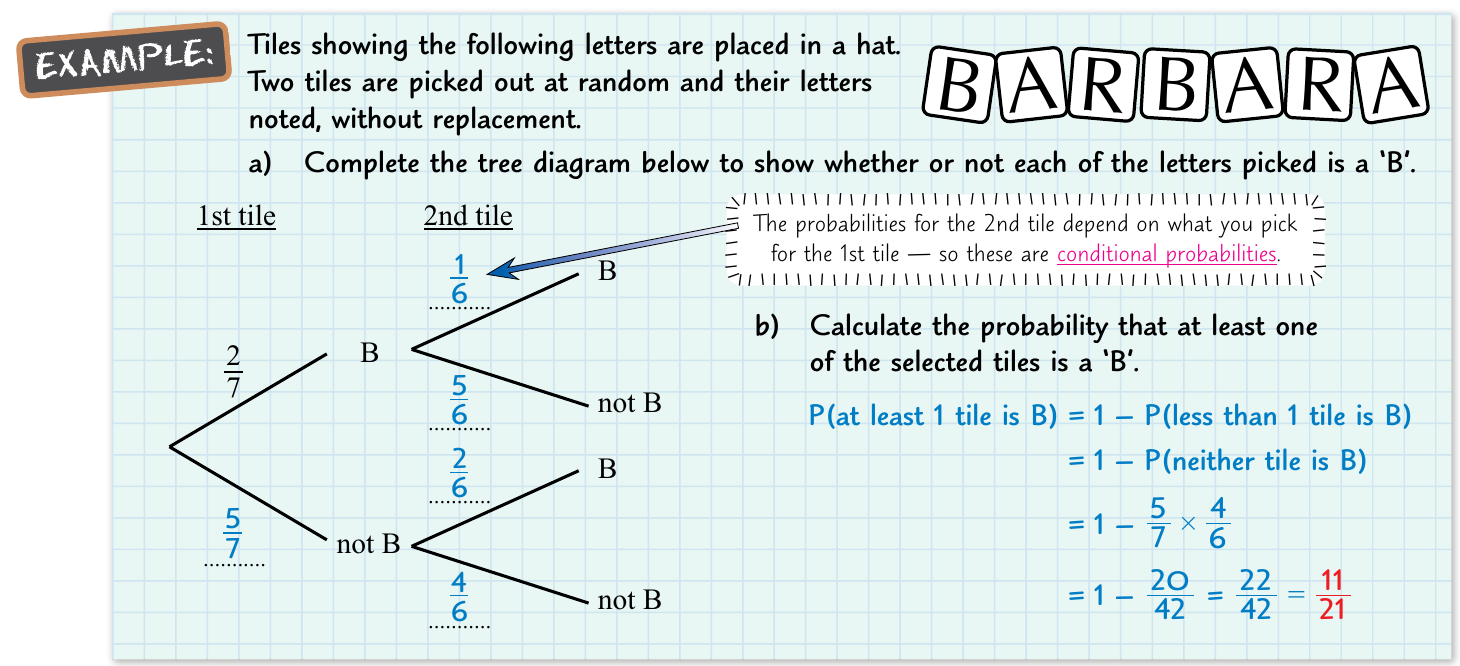
Example
Worked Example: BARBARA Tiles Problem
This example shows how to handle a situation where you're drawing items without replacement from a collection containing duplicate items. The tiles spell "BARBARA", so there are 2 B's, 2 A's, 2 R's, and 1 of each other letter.
Step 1: Calculate the probability of drawing each letter on the first draw
- Total tiles = 7
- P(B on first draw) =
Step 2: For each first draw outcome, calculate the conditional probabilities for the second draw
- If B drawn first: P(B on second) = , P(not B on second) =
- If not B drawn first: P(B on second) =
Step 3: Multiply along branches to find end probabilities
Step 4: Add relevant end probabilities to answer the question
Solution using complement method: P(at least 1 tile is B) = 1 - P(neither tile is B) This often provides a more efficient calculation path.
Remember!
Summary
Key Points to Remember:
- Always check your probabilities sum to 1 - This applies both to branches leaving each point and to all final outcomes
- Multiply along branches, add across outcomes - This is the fundamental rule for calculating probabilities with tree diagrams
- Replacement means probabilities stay the same - Without replacement means probabilities change based on previous selections
- Use the complement for "at least" questions - It's often easier to calculate than to add multiple probabilities
- Break complex problems into sequential events - This makes them much more manageable to solve with tree diagrams