Identifying Bones (Edexcel GCSE Physical Education): Revision Notes
📚Revision Notes
Identifying Bones
Note
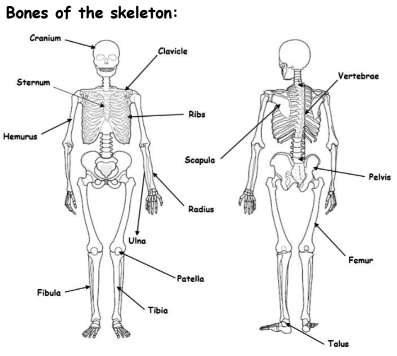
Cranium: The skull bone that protects the brain.
Note
Clavicle: Also known as the collarbone, it connects the arm to the body.
Note
Scapula: The shoulder blade, which provides attachment points for several muscles.
Note
Sternum: The breastbone located in the centre of the chest, to which the ribs are attached.
Note
Ribs: These form the rib cage, protecting the heart and lungs.
Note
Humerus: The upper arm bone between the shoulder and the elbow
Note
Radius and Ulna: The two bones of the forearm. The radius is on the thumb side, and the ulna is on the little finger side.
Note
Carpals: The wrist bones.
Note
Metacarpals: The bones of the hand.
Note
Phalanges: The finger and toe bones.
Note
Pelvis: The hip bones, which support the weight of the upper body.
Note
Femur: The thigh bone, which is the longest and strongest bone in the body.
Note
Patella: The kneecap, which protects the knee joint.
Note
Tibia and Fibula: The bones of the lower leg. The tibia, or shinbone, is larger and bears most of the weight, while the fibula is smaller.
Note
Tarsals: The ancle bones.
Note
Metatarsals: The bones of the foot.
Note
Vertebral Column: The spine, made up of individual vertebrae that protect the spinal cord and provide structural support.