Electromagnetic induction in transformers (Edexcel GCSE Physics): Revision Notes
📚Revision Notes
Electromagnetic induction in transformers
Note
Electromagnetic induction happens when a changing magnetic field creates electricity in a wire. This is how transformers work — they use this idea to change the voltage of electricity, either making it higher (step-up) or lower (step-down).
- Transformers help transmit electricity over long distances and make it safe for use in homes.
How Electromagnetic Induction Works
Electromagnetic induction happens when a magnetic field and an electrical conductor (like a wire) move relative to each other. This means the magnetic field around the wire changes, which creates a potential difference (voltage). If the circuit is complete, this makes an electric current flow.
Note
Ways to Create Electromagnetic Induction:
- Move a magnet near a coil of wire. As the magnet moves, it changes the magnetic field around the wire, inducing a voltage.
- Rotate the magnet or wire. If the magnet or wire spins, the magnetic field changes continuously, creating an alternating current (AC).
- Reverse the direction of movement or flip the magnet's poles. This reverses the current.
Opposition to the Change
When a current is induced in a wire, the current creates its own magnetic field. This new magnetic field opposes the change that caused it, acting as a resistance to the movement that generated the current.
Transformers – How They Work
Transformers consist of:
- Primary coil: The coil where alternating current (AC) flows in.
- Secondary coil: The coil where the transformed voltage comes out.
- Iron core: A soft iron core links the magnetic field between the two coils and ensures efficient transfer of energy.
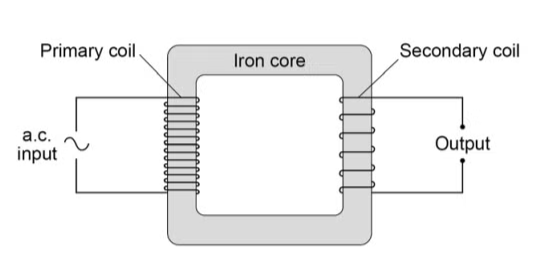
When AC flows into the primary coil, it creates a changing magnetic field. This magnetic field passes through the iron core and induces a voltage in the secondary coil through electromagnetic induction.
Step-Up and Step-Down Transformers
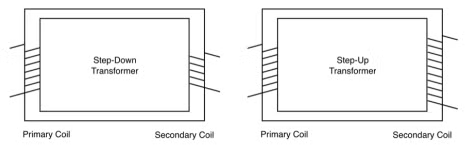
- Step-Up Transformer: Increases the voltage by having more turns of wire in the secondary coil than the primary coil. This type is used to send electricity efficiently over long distances.
- Step-Down Transformer: Decreases the voltage by having fewer turns of wire in the secondary coil. It makes electricity safe for use in homes and devices.
Note
You can increase the induced voltage by:
- Increasing the strength of the magnetic field.
- Moving the magnet or wire faster.
- Adding more turns of wire in the coil.
Efficiency of Transformers
In real-life applications, transformers are highly efficient, but they are not 100% efficient. Some energy is lost as heat in the coils and the core. Despite this, most energy is transferred between the coils, making transformers vital for power transmission.
Note
Real-Life Example: Power Lines
Electricity is generated at low voltage. Step-up transformers increase the voltage so electricity can travel through power lines without losing much energy. When the electricity reaches homes, step-down transformers lower the voltage to make it safe for devices like lights and chargers.