Speakers & Headphones (Edexcel GCSE Physics): Revision Notes
📚Revision Notes
Speakers & Headphones

Note
Loudspeakers work by converting electrical signals into sound. The process is essentially the reverse of how a microphone operates.
Note
How It Works:
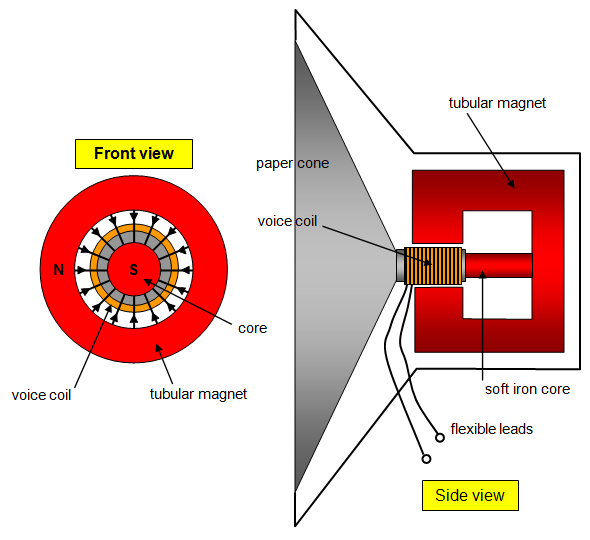
- An electrical current flows into a coil of wire within the loudspeaker.
- This coil is placed within a magnetic field, usually generated by a permanent magnet.
- The interaction between the magnetic field of the coil (due to the current) and the magnetic field of the permanent magnet causes the coil to move.
- As the coil moves, it pushes and pulls on the attached cone (or diaphragm).
- The movement of the cone creates pressure variations in the air, which we perceive as sound.
Note
Headphones function similarly to loudspeakers but on a smaller scale. They convert electrical signals into sound waves that can be heard by the listener.
Note
How It Works:
- Electrical Signal: An audio signal (electrical current) is sent through the headphone wires.
- Magnetic Interaction: Inside the headphones, the current flows through a coil of wire, which is located near a permanent magnet.
- Movement of Coil: The interaction between the magnetic field from the current-carrying coil and the magnetic field of the permanent magnet causes the coil to move.
- Vibrating Diaphragm: The coil is attached to a diaphragm (or cone), which vibrates as the coil moves.
- Sound Waves: These vibrations create pressure waves in the air, which are detected by the ear as sound.
Key Components:
- Coil of wire: Where the electric current flows.
- Magnet: Provides a magnetic field to interact with the coil.
- Diaphragm: Moves to create sound waves.
Types of Headphones:
- Dynamic headphones: These work based on the principle described above, with a moving coil and magnet.
- Electrostatic headphones: Use electrically charged plates and a diaphragm to produce sound, offering a different mechanism.
Electromagnetic Induction in Generators, Speakers, and Microphones
Generators & speakers make use of the electromagnetic induction to produce a current
Generators (Dynamos and Alternators):
-
Generators produce current by rotating a coil in a magnetic field.
-
Dynamos (DC generators) use a split-ring commutator to keep current in one direction.
-
Alternators (AC generators) use slip rings, producing alternating current as the coil's direction changes. Speakers:
- Loudspeakers convert electrical signals into sound waves by using a moving coil in a magnetic field, vibrating a cone to produce sound.
Microphones:
- Microphones reverse this process, using sound waves to move a diaphragm and coil, generating an electrical signal through electromagnetic induction.