DNA Profiling and Sequencing (Leaving Cert Biology): Revision Notes
📚Revision Notes
DNA Profiling and Sequencing
What is DNA profiling?
DNA profiling, also known as DNA fingerprinting, is a powerful technique that creates a unique pattern of DNA bands from an individual. This pattern acts like a genetic fingerprint that can be compared with DNA from other individuals to determine if they match.
Note
Just like no two people have identical fingerprints (except identical twins), each person has their own distinctive DNA profile. This uniqueness is what makes DNA profiling such a reliable identification method.
The technique is incredibly useful in forensic science to solve crimes, identify victims of disasters, establish family relationships, and even track the source of food contamination.
Steps in creating a DNA profile
Creating a DNA profile involves several carefully planned steps that work together to produce a readable pattern:
Sample collection
Scientists collect DNA samples from various sources including:
- Blood samples from individuals
- Cells scraped from the inner lining of the cheek
- Crime scene evidence such as hair, saliva, or semen
- Any biological material containing nucleated cells
DNA extraction
Once samples are collected, the DNA must be carefully extracted from the cells. This process breaks open the cell membranes and nucleus to release the genetic material whilst keeping the DNA strands intact.
Amplifying DNA using PCR
Since DNA samples are often very small, scientists use a technique called Polymerase Chain Reaction (PCR) to make millions of copies of the DNA. This amplification process is essential because there needs to be enough DNA to work with for analysis.
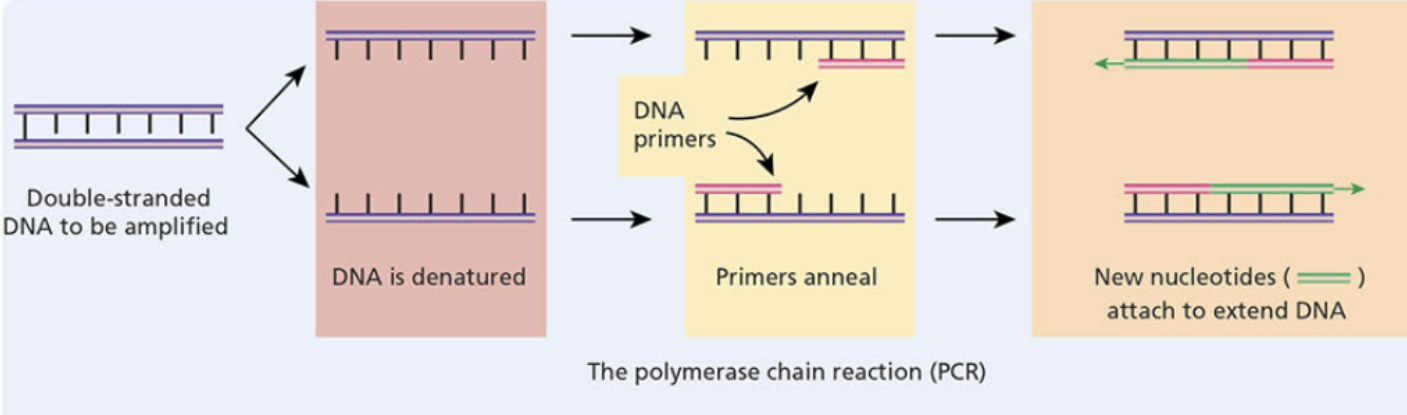
The PCR process works like a molecular photocopying machine and requires several key components:
Important
Essential PCR Components:
- DNA primers: Short single-stranded DNA sequences that mark the beginning and end of the region to be copied
- Nucleotides: The building blocks (A, T, G, C) needed to construct new DNA strands
- Taq polymerase: A special heat-resistant enzyme that builds the new DNA strands
- Buffer solution: Provides the ideal chemical environment for the reaction
Example
The PCR Cycle Process:
The PCR cycle repeats three main steps about 30 times:
Step 1: Denaturation - The mixture is heated to around 94°C to break the hydrogen bonds and separate the double-stranded DNA into single strands
Step 2: Annealing - Temperature is lowered to 50°C to allow the primers to bind to their complementary sequences on the single-stranded DNA
Step 3: Extension - Temperature is raised to 72°C to allow Taq polymerase to add new nucleotides and build complete new DNA strands
After about 30 cycles, there are roughly one billion copies of the original DNA available for analysis.
Cutting DNA into fragments
The amplified DNA is then cut into smaller pieces using restriction enzymes. These molecular scissors cut DNA at specific sequence patterns, creating fragments of different lengths. The exact pattern of cuts depends on the individual's unique DNA sequence.
Separating fragments by gel electrophoresis
The DNA fragments must be separated by size to create the distinctive banding pattern that forms the DNA profile.

Note
How Gel Electrophoresis Works:
Gel electrophoresis works by placing the DNA fragments in wells at one end of a gel matrix. When an electric current is applied:
- DNA fragments (which are negatively charged) move towards the positive electrode
- Smaller fragments move faster and travel further through the gel
- Larger fragments move more slowly and don't travel as far
- This creates a pattern where fragments are separated by size
The result is a series of bands at different positions in each lane, with each band representing DNA fragments of a particular size.
Comparing patterns
When the electrophoresis is complete, each sample produces its own unique pattern of bands. Scientists can then compare these patterns:
- Identical patterns: Indicate the samples came from the same person (or identical twins)
- Different patterns: Show the samples came from different individuals
- Partial matches: Can indicate family relationships where some bands match but others don't
DNA sequencing principles
While DNA profiling shows us patterns, DNA sequencing tells us the exact order of nucleotides (A, T, G, C) in a DNA segment. This is like reading the genetic "letters" that spell out the instructions in our genes.
Sanger sequencing method
The most established method for DNA sequencing is called Sanger sequencing, named after Fred Sanger who won the Nobel Prize twice for his contributions to biochemistry.
Example
The Sanger Sequencing Method:
Step 1: Template preparation - The DNA to be sequenced is used as a template
Step 2: Adding special nucleotides - Four different reactions are set up, each containing normal nucleotides plus specially modified versions of A, T, G, or C that stop DNA synthesis when incorporated
Step 3: DNA synthesis - New DNA strands grow until a chain-terminating nucleotide is added
Step 4: Fragment separation - The resulting fragments of different lengths are separated by gel electrophoresis
Step 5: Reading the sequence - The order of coloured bands reveals the exact nucleotide sequence
Each specially treated nucleotide is labelled with a different fluorescent colour, making it possible to read the sequence directly from the pattern of coloured signals.
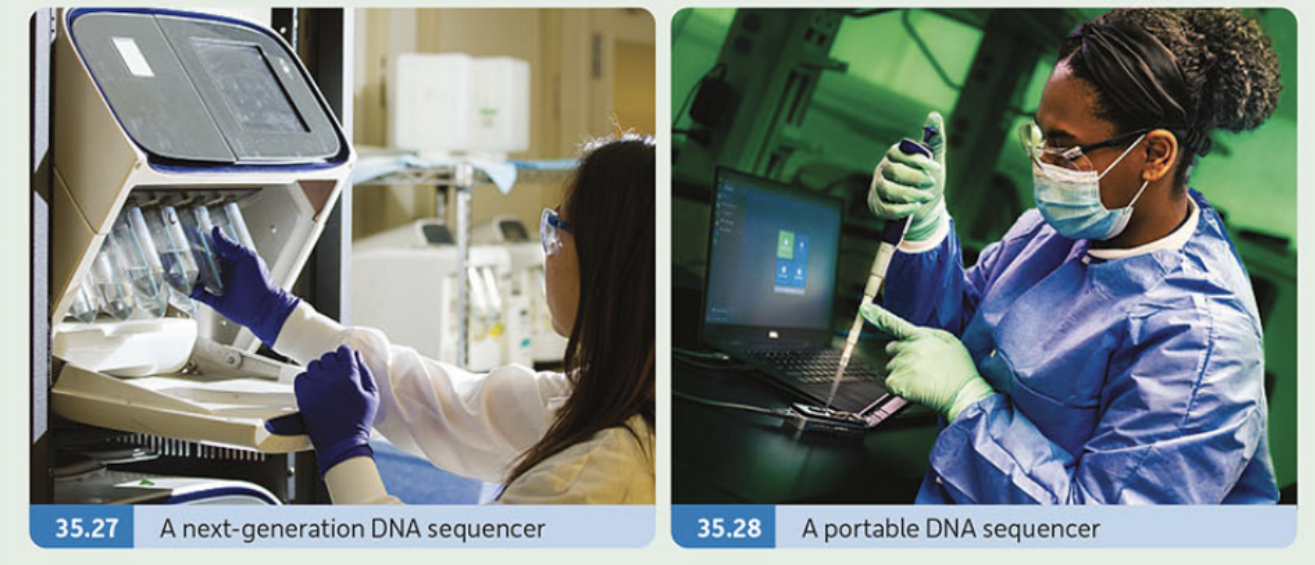
Next-generation sequencing
Modern DNA sequencing has advanced dramatically since the early days of Sanger sequencing. Next-generation sequencing methods can:
- Read multiple DNA sections simultaneously (in parallel)
- Work much faster than traditional methods
- Provide greater accuracy
- Cost significantly less money
Note
Revolutionary Progress in Genome Sequencing:
To put this progress in perspective: the original Human Genome Project took 13 years to complete and cost about £2.5 billion. Today, an entire human genome can be sequenced in just hours for only a few hundred pounds.
Applications of DNA profiling and sequencing
These techniques have revolutionised many fields:
Forensic science applications:
- Solving crimes by matching DNA from suspects to evidence
- Identifying victims of accidents or disasters
- Establishing whether biological samples match suspects or victims
- Cold case investigations using preserved evidence
Medical and research applications:
- Determining family relationships and paternity
- Identifying genetic disorders
- Tracking disease outbreaks
- Food safety testing to identify contamination sources
- Conservation biology to study endangered species
Modern developments:
- Portable DNA sequencers that can be used in the field
- Rapid testing capabilities for immediate results
- Integration with computer databases for automatic matching
- Increased sensitivity allowing analysis of tiny sample amounts
Summary
Key Points to Remember:
- DNA profiling creates unique patterns that can identify individuals, while DNA sequencing determines the exact order of genetic letters
- PCR amplification is essential because it creates millions of copies from tiny DNA samples using repeated cycles of heating and cooling
- Gel electrophoresis separates DNA fragments by size, with smaller pieces moving further through the gel than larger ones
- Sanger sequencing uses chain-terminating nucleotides to create fragments that reveal the exact DNA sequence when separated by size
- Modern sequencing technology has made genome analysis thousands of times faster and cheaper than when first developed