Process and Methods (Leaving Cert Biology): Revision Notes
📚Revision Notes
Process and Methods
Genetic engineering involves deliberately altering an organism's DNA to create new characteristics or produce desired substances. Scientists have developed various methods to achieve this, from traditional "cut-and-paste" techniques to modern precision tools like CRISPR-Cas9.
Understanding genetic engineering
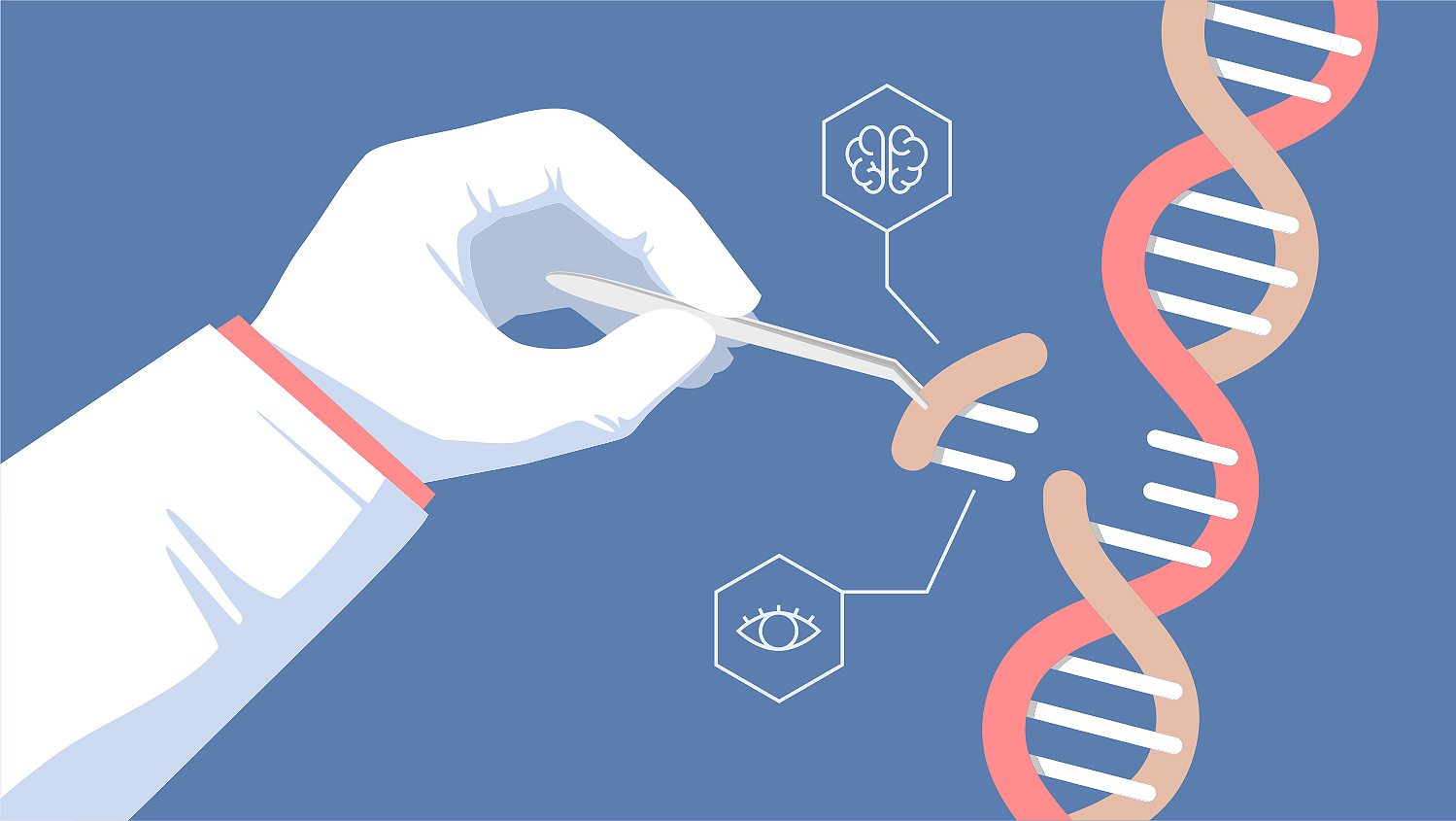
Genetic engineering is the process of manipulating genetic material to modify organisms in ways that don't occur naturally. Also known as genetic modification, recombinant DNA technology, or gene editing, this technology allows scientists to transfer genes between completely different species - something impossible through natural reproduction.
Note
The ability to transfer genes between different species is what makes genetic engineering so powerful - imagine taking a gene from a jellyfish and putting it into a mouse, or taking a human gene and expressing it in bacteria!
The key concept involves creating recombinant DNA - genetic material that combines DNA from different sources. When this modified DNA is introduced into an organism, it produces a genetically modified organism (GMO) with new characteristics determined by the inserted genes.
Traditional genetic engineering methods
The traditional approach follows a systematic "cut-and-paste" process involving bacterial plasmids as vehicles to carry new genes. This method has been the foundation of biotechnology for decades and remains widely used for producing proteins and creating transgenic organisms.
Important
The traditional method always follows the same five essential steps: DNA isolation → Cutting → Ligation → Transformation → Expression. Missing any step will result in failure of the genetic engineering process.
DNA isolation
The process begins by extracting the target gene - the specific piece of DNA that codes for the desired characteristic. Scientists must isolate this gene from its original organism, whether human, plant, animal, or microbe. Simultaneously, they obtain plasmids, which are small, circular pieces of DNA found naturally in bacteria that serve as ideal vehicles for carrying foreign genes.
Note
Think of plasmids as molecular delivery trucks - they're perfect for the job because they're small, circular (so they're stable), and bacteria naturally know how to replicate them. Plus, they can carry "cargo" (your target gene) without affecting their basic function.
Plasmids are particularly useful because they can replicate independently within bacterial cells and are easily manipulated in laboratory conditions. They act like molecular delivery trucks, transporting the target gene into bacterial cells where it can be expressed.
Cutting with restriction enzymes
Both the target gene and plasmid must be cut using restriction enzymes - highly specific molecular scissors that recognise and cut DNA at particular sequences. These enzymes are crucial because they create compatible ends that allow different pieces of DNA to join together properly.
The same restriction enzyme must cut both the gene and plasmid, ensuring they have matching "sticky ends" - single-stranded overhangs that can base-pair with each other. Each restriction enzyme recognises a unique DNA sequence, typically 4-6 base pairs long, making the cutting process highly precise and predictable.
Important
Critical Rule: You MUST use the same restriction enzyme to cut both the target gene and the plasmid. Using different enzymes will create incompatible ends that cannot join together properly, causing the entire process to fail.
Ligation
Ligation joins the cut gene with the opened plasmid to form a continuous DNA molecule. The enzyme DNA ligase acts as molecular glue, sealing the gaps between the joined pieces and creating stable recombinant DNA. This step is critical because it forms a functional, circular plasmid that can survive and replicate within bacterial cells.
The result is a hybrid DNA molecule containing genetic information from two different sources - the original plasmid and the inserted target gene. This recombinant plasmid now carries the instructions for producing the desired protein.
Transformation
The recombinant plasmid must enter bacterial cells through a process called transformation. Since bacteria don't naturally take up large DNA molecules, scientists must make their cell walls temporarily permeable using various techniques such as heat shock, electrical pulses (electroporation), or chemical treatments.
Note
Transformation is often the least efficient step in the process - typically only 1-10% of bacterial cells successfully take up the recombinant plasmids. This is why selection methods are so important for identifying the successful transformants.
During transformation, only a small percentage of bacterial cells successfully take up the recombinant plasmids. Scientists use selection techniques to identify which bacteria have been successfully transformed, often by including antibiotic resistance genes on the plasmids.
Expression
Expression occurs when the inserted gene is transcribed and translated to produce the desired protein within the bacterial cells. The genetically modified bacteria essentially become biological factories, manufacturing the target protein as they grow and reproduce.
Large-scale production involves growing the transformed bacteria in fermentation tanks under controlled conditions. As the bacteria multiply, each new cell contains copies of the recombinant DNA, allowing for mass production of the desired protein, which can then be harvested and purified for commercial use.
Example
Worked Example: Traditional Genetic Engineering Process
Goal: Produce human insulin using bacteria
Step 1: DNA isolation
- Extract human insulin gene from human DNA
- Obtain bacterial plasmids
Step 2: Cutting
- Use EcoRI restriction enzyme to cut both insulin gene and plasmid
- Creates compatible sticky ends on both pieces
Step 3: Ligation
- DNA ligase joins insulin gene to opened plasmid
- Forms recombinant plasmid containing insulin gene
Step 4: Transformation
- Heat shock treatment makes bacterial cell walls permeable
- Recombinant plasmids enter bacterial cells
Step 5: Expression
- Bacteria transcribe and translate insulin gene
- Result: Bacteria produce human insulin protein
CRISPR-Cas9: precision gene editing
CRISPR-Cas9 represents a revolutionary advancement in genetic engineering, offering unprecedented precision and efficiency. Developed from bacterial defence systems, this technology has transformed how scientists approach gene editing across many fields.
How CRISPR-Cas9 works
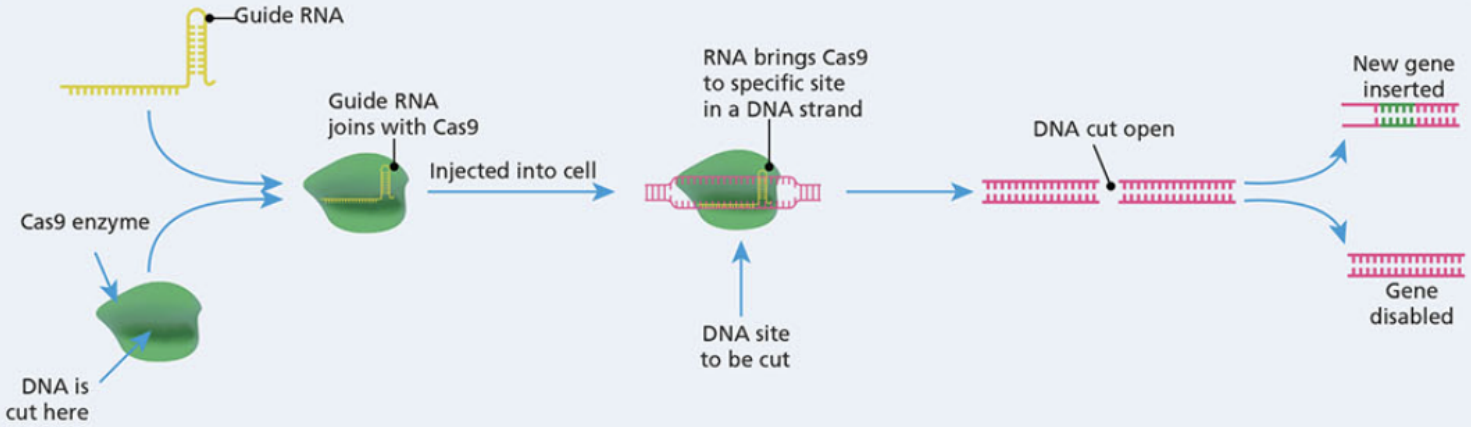
The system consists of two essential components working in partnership:
Guide RNA (gRNA): This small RNA molecule is designed to be complementary to the specific DNA sequence requiring modification. It functions like a molecular GPS, directing the cutting enzyme to exactly the right location in the vast genome.
Cas9 enzyme: This protein acts as programmable molecular scissors, cutting DNA only when guided to the correct location by the guide RNA. The Cas9 enzyme remains inactive until it forms a complex with the guide RNA and finds the matching target sequence.
Note
The beauty of CRISPR is in its simplicity - you just need to design a guide RNA that matches your target sequence, and the Cas9 enzyme does the rest. No need for multiple different restriction enzymes or complex cloning procedures.
The process begins when the guide RNA binds to its complementary sequence in the target DNA. This binding activates the Cas9 enzyme, which then makes a precise double-stranded cut at that exact location. After cutting, scientists have two main options:
- Gene disruption: The cell's natural repair mechanisms may introduce small errors when fixing the break, effectively disabling the gene
- Gene insertion: New genetic material can be inserted at the cut site using the cell's repair machinery
Advantages of CRISPR
CRISPR-Cas9 offers significant improvements over traditional methods:
- Precision: Targets specific DNA sequences with remarkable accuracy
- Speed: Much faster than conventional genetic engineering techniques
- Cost-effectiveness: Relatively inexpensive compared to traditional methods
- Versatility: Works in many different cell types and organisms
- Ease of use: Simpler to design and implement than restriction enzyme-based methods
The technology allows scientists to edit genes directly within living cells, including human cells, opening new possibilities for treating genetic diseases and advancing medical research.
Important
Revolutionary Impact: Unlike traditional methods that require bacteria as intermediate hosts, CRISPR can edit genes directly in the target organism's cells - including human cells, plant cells, and animal cells.
This groundbreaking work earned Emmanuelle Charpentier and Jennifer Doudna the Nobel Prize in Chemistry in 2020, recognising CRISPR's transformative impact on biological research and its potential for treating human diseases.
Applications demonstrating these methods
Real-world examples illustrate how these genetic engineering processes create practical solutions:
Extended shelf-life tomatoes: Scientists inserted genes that slow ripening processes, allowing tomatoes to maintain freshness during transport and storage. This reduces food waste and improves food security.
Research mice: Transgenic mice containing jellyfish genes glow green under UV light, serving as valuable research tools for studying diseases, testing treatments, and tracking biological processes in living animals.
Pharmaceutical production: Bacteria genetically modified with human genes produce essential medicines like insulin, growth hormone, and clotting factors. This creates reliable, large-scale sources of life-saving medications.
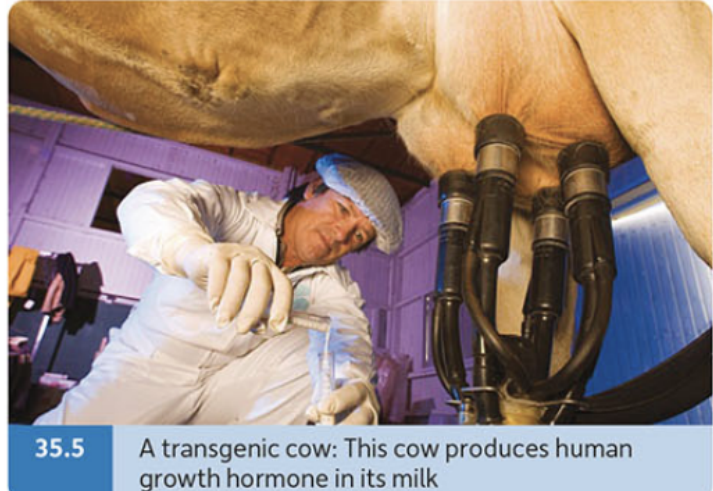
Therapeutic proteins from livestock: Transgenic animals produce human proteins in their milk, effectively turning dairy animals into biological pharmaceutical factories for producing complex medicines.
Note
These applications demonstrate the versatility of genetic engineering - from improving food production to manufacturing life-saving medicines. Each application uses the same basic principles but applies them to solve different real-world problems.
Choosing the right method
Different genetic engineering approaches suit different applications:
Traditional methods excel for:
- Large-scale protein production in bacteria
- Creating stable transgenic organisms
- Applications requiring well-established, reliable protocols
CRISPR-Cas9 is ideal for:
- Making precise edits to existing genes
- Research applications requiring accuracy
- Potential therapeutic interventions
- Situations requiring speed and cost-effectiveness
Understanding these methods helps explain why genetic engineering continues expanding into medicine, agriculture, and biotechnology, addressing increasingly complex global challenges through precisely controlled genetic modifications.
Summary
Key Points to Remember:
-
Traditional genetic engineering follows five key steps: DNA isolation, cutting with restriction enzymes, ligation, transformation into bacteria, and expression of the desired protein
-
CRISPR-Cas9 uses guide RNA to direct Cas9 enzyme to specific DNA locations for precise cutting and editing
-
Restriction enzymes are molecular scissors that must be the same for both gene and plasmid to create compatible sticky ends
-
Transformation requires special treatments to make bacterial cell walls permeable to foreign DNA
-
Both methods create practical applications from life-saving medicines to improved food crops, demonstrating the real-world impact of genetic engineering technology
-
Choose your method wisely: Traditional methods for large-scale production, CRISPR for precision editing and research applications