14 – Investigating the Rate of Decomposition of Hydrogen Peroxide (LC 2027) (Leaving Cert Chemistry): Revision Notes
📚Revision Notes
14 – Investigating the Rate of Decomposition of Hydrogen Peroxide
Introduction
This experiment explores how quickly hydrogen peroxide breaks down when a catalyst is present. Hydrogen peroxide naturally decomposes very slowly, but when we add manganese dioxide (MnO₂) as a catalyst, the reaction speeds up dramatically. This allows us to study reaction rates by measuring how much oxygen gas is produced over time.
Note
A catalyst is a substance that speeds up a chemical reaction without being consumed in the process. This makes it possible to study reactions that would otherwise be too slow to observe effectively in the laboratory.
The decomposition reaction follows this equation:
This means each molecule of hydrogen peroxide breaks down to form water and releases half a molecule of oxygen gas.
Apparatus and method
The experiment uses a gas collection method to measure the oxygen produced. The key components include:
- Conical flask containing the hydrogen peroxide solution
- Delivery tube to transport the gas
- Graduated cylinder filled with water (inverted in a water bath)
- Manganese dioxide powder as the catalyst
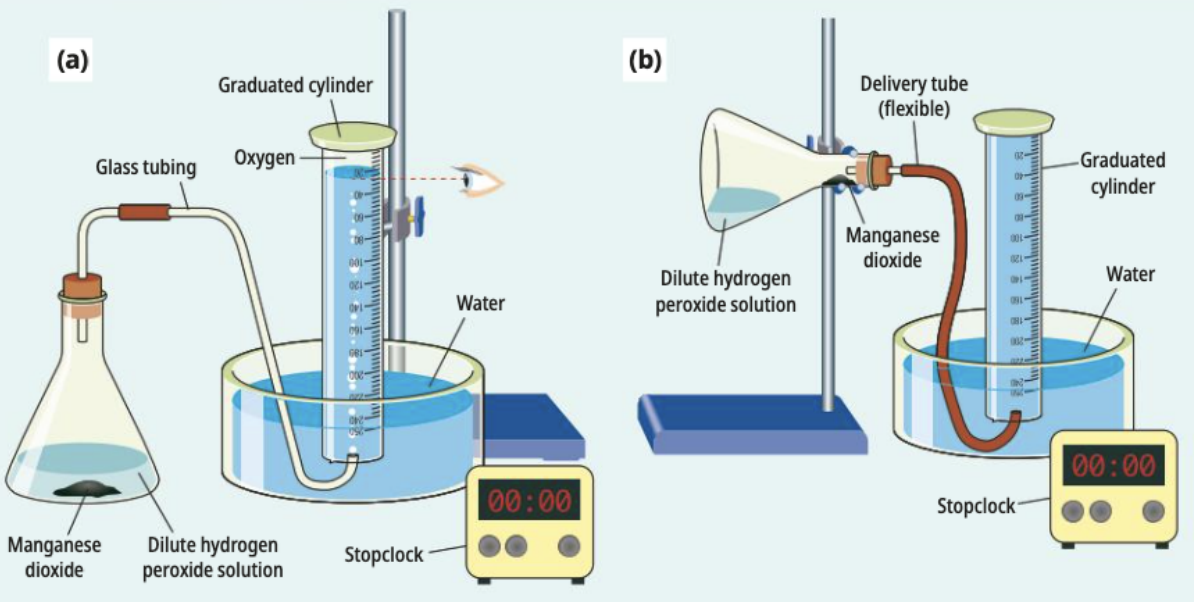
The apparatus can be set up in two ways - either with the graduated cylinder standing in a water basin, or with a more compact arrangement where the cylinder is supported vertically. Both methods work by water displacement - as oxygen gas enters the cylinder, it pushes the water out, allowing us to measure the volume of gas produced.
Important
Ensure all connections in your apparatus are secure before starting. Any gas leaks will lead to inaccurate volume measurements and affect your rate calculations.
Procedure steps
The experiment follows these key stages:
Preparation phase:
- Set up the gas collection apparatus ensuring all connections are secure
- Fill the graduated cylinder completely with water and invert it carefully to avoid air bubbles
- Prepare the hydrogen peroxide solution in the conical flask
Starting the reaction:
- Quickly add a small amount of manganese dioxide powder to the hydrogen peroxide
- Immediately connect the delivery tube and start timing
- The catalyst causes immediate gas production, so speed is important
Data collection:
- Record the volume of oxygen gas collected at regular time intervals
- Continue measurements until gas production stops
- Note that the reaction rate will slow down as the hydrogen peroxide is consumed
Important
Timing is Critical!
The reaction begins immediately when the catalyst is added. Have your stopwatch ready and work quickly to connect the apparatus. Any delay in timing will affect the accuracy of your initial rate measurements.
Data collection
Use a systematic approach to record your measurements.
Take readings every 30 seconds for the first few minutes, then extend to longer intervals as the reaction slows. The volume of oxygen should be read from the bottom of the meniscus in the graduated cylinder.
Note
Reading the Meniscus Correctly
Always read the volume from the bottom of the curved meniscus at eye level with the liquid surface. This ensures consistent and accurate volume measurements throughout your experiment.
Results analysis and graph interpretation
When you plot your results, you'll see a characteristic curve that tells the story of the reaction:
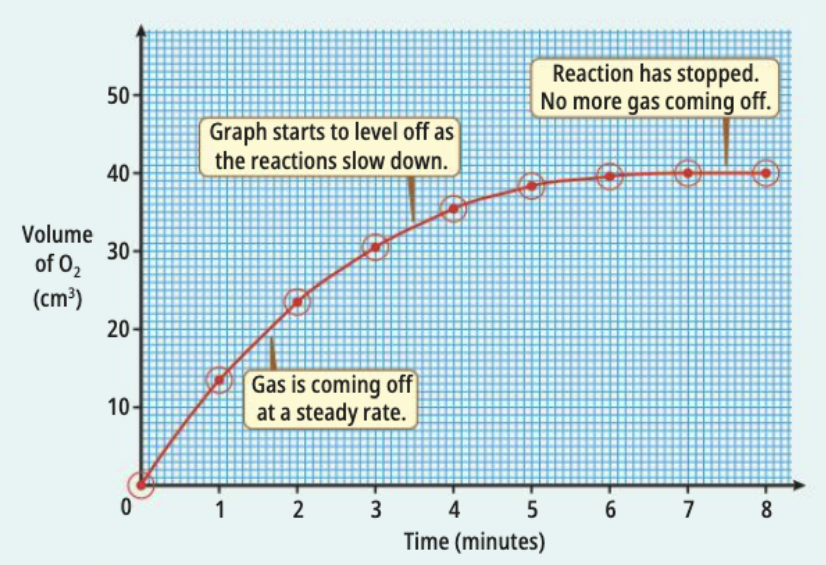
The graph shows three distinct phases:
Initial rapid phase: The curve rises steeply because there's plenty of hydrogen peroxide available and the catalyst is working efficiently.
Slowing phase: The curve begins to level off as hydrogen peroxide becomes less concentrated, meaning fewer molecules are available to react.
Completion phase: The curve flattens completely when all hydrogen peroxide has decomposed, and no more gas can be produced.
Note
Understanding the Curve Shape
This characteristic S-shaped curve is typical of many chemical reactions. The changing slope at different points tells you how the reaction rate varies over time, providing insights into the reaction mechanism and kinetics.
Rate calculations
Understanding reaction rates helps predict how fast chemical processes occur. The average rate of reaction can be calculated using:
Example
Worked Example: Calculating Average Reaction Rate
If 40 cm³ of oxygen is produced in 7 minutes:
Step 1: Apply the formula Average rate = Total volume ÷ Total time
Step 2: Substitute the values Average rate = 40 cm³ ÷ 7 min = 5.71 cm³/min
Therefore, the average rate of oxygen production is 5.71 cm³ per minute.
This calculation gives you the overall speed of the reaction, but remember that the instantaneous rate (speed at any specific moment) varies throughout the experiment, starting fast and gradually slowing down.
Key factors affecting the results
Several variables can influence your experimental outcomes:
Temperature effects: Higher temperatures increase molecular movement, leading to faster reaction rates and more gas production.
Catalyst amount: More manganese dioxide provides more surface area for the reaction, potentially increasing the rate.
Hydrogen peroxide concentration: Higher concentrations provide more reactant molecules, sustaining faster rates for longer periods.
Equipment precision: Accurate timing and volume measurements are essential for reliable rate calculations.
Note
Optimizing Your Experiment
Consider these factors when designing your investigation. Controlling variables like temperature and catalyst amount allows you to study the effect of concentration more accurately, while maintaining consistent measurement techniques ensures reliable data.
Remember!
Summary
Key Points to Remember:
- Hydrogen peroxide decomposes into water and oxygen gas: H₂O₂ → H₂O + ½O₂
- Manganese dioxide acts as a catalyst, speeding up the reaction without being consumed
- Gas collection by water displacement allows accurate measurement of oxygen volume produced
- Reaction rate decreases over time as reactant concentration falls, creating a characteristic curved graph
- Average rate = total volume ÷ total time gives a simple measure of overall reaction speed