19 – Investigating the Heat of Combustion of Alcohols (LC 2027) (Leaving Cert Chemistry): Revision Notes
📚Revision Notes
19 – Investigating the Heat of Combustion of Alcohols
What is heat of combustion?
The heat of combustion is the amount of energy released when one mole of a substance burns completely in oxygen. When we burn alcohols, they react with oxygen to produce carbon dioxide and water, releasing heat energy in the process.
Note
The combustion reaction follows the general pattern: Alcohol + Oxygen → Carbon dioxide + Water + Heat energy
This is an exothermic reaction, meaning energy is released to the surroundings.
In this experiment, you'll measure this energy release by using a technique called calorimetry. This involves burning the alcohol and measuring how much the temperature of a known mass of water increases as a result.
Experimental setup
The apparatus for this experiment uses a simple but effective calorimetry system to measure heat transfer.
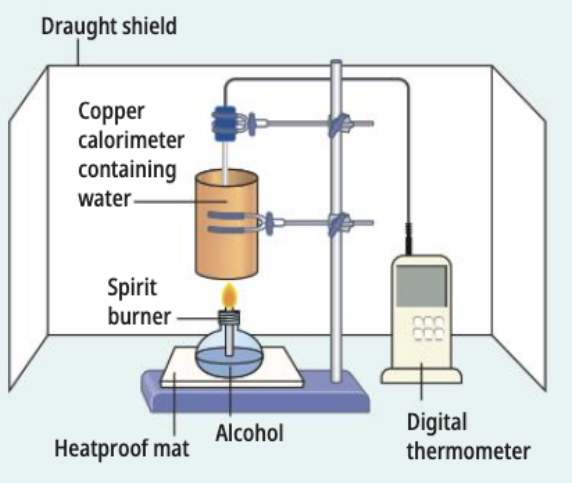
Key components of the apparatus
- Copper calorimeter: Contains a known mass of water. Copper is used because it's an excellent heat conductor, ensuring efficient heat transfer from the flame to the water
- Spirit burner: Contains the alcohol being investigated. The burner allows controlled burning of the alcohol
- Draught shield: Surrounds the apparatus to prevent air currents from interfering with the flame, improving the accuracy of your measurements
- Digital thermometer: Measures temperature changes in the water accurately
- Heatproof mat: Protects the bench surface from heat damage
- Clamp stand: Supports the calorimeter at the correct height above the burner
Important
The copper calorimeter is essential for accurate results. Copper's high thermal conductivity means heat from the flame is quickly and evenly distributed to the water, minimising heat loss to the surroundings.
Procedure
Setting up the experiment
-
Prepare the calorimeter: Use a graduated cylinder to measure a known volume of water (depending on your calorimeter's capacity) and pour it into the copper calorimeter
-
Prepare the spirit burner: Fill the spirit burner to about half capacity with the alcohol you're investigating
-
Weigh the spirit burner: Place the cap on the spirit burner and record the total initial mass of the spirit burner and alcohol
-
Position the apparatus: Set up the equipment as shown in the diagram, ensuring the calorimeter is positioned correctly above the spirit burner
Carrying out the experiment
-
Record initial temperature: Measure and record the initial temperature of the water
-
Light the burner: Remove the cap from the spirit burner and light the wick carefully
-
Heat the water: Allow the alcohol to burn and heat the water. Stir the water gently with a glass rod from time to time to ensure even heat distribution
-
Monitor temperature: Watch the temperature rise. When it has increased by a certain amount (e.g., 40°C), extinguish the flame and replace the cap on the spirit burner
-
Record final measurements: Note the final temperature of the water and weigh the spirit burner and cap again to find the mass of alcohol burned
Important
Critical Steps for Accuracy:
- Always stir the water regularly to ensure even heat distribution
- Extinguish the flame at the target temperature rise to maintain consistency
- Weigh the spirit burner immediately after extinguishing to minimise evaporation losses
Understanding the data
Different alcohols release different amounts of energy when they burn. Here's what you'd expect to find:
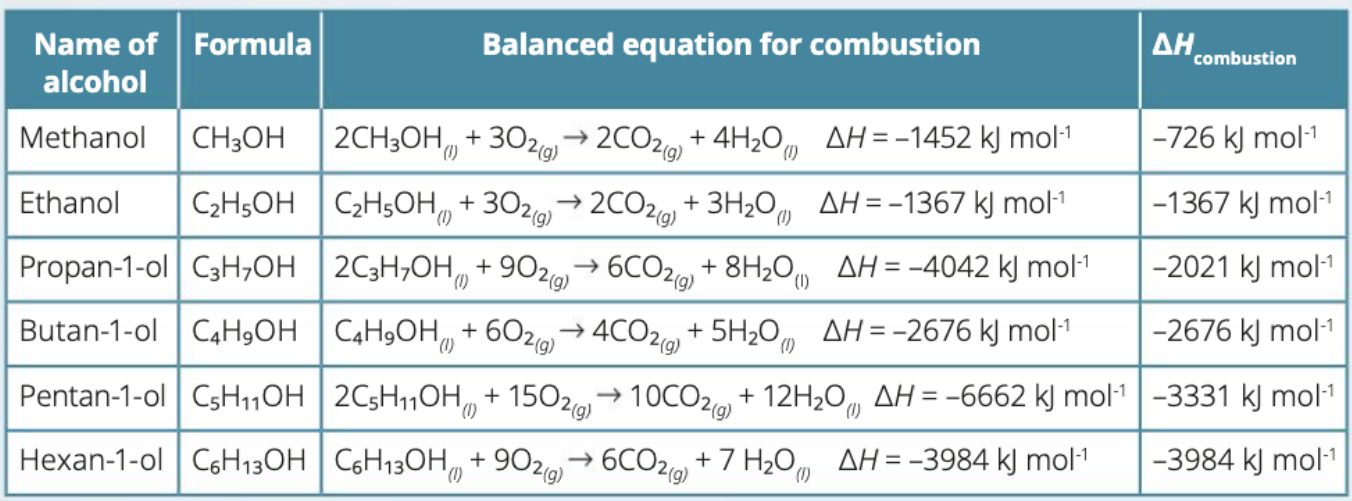
This table shows the enthalpy of combustion (ΔH) values for primary alcohols. Notice how the energy released increases as the alcohol molecules get larger. This is because longer carbon chains contain more bonds that can be broken and reformed during combustion, releasing more energy.
Note
Pattern Recognition: As you move from methanol to butanol, each additional -CH₂- group in the carbon chain contributes approximately 650 kJ/mol more energy release. This regular pattern helps predict the heat of combustion for longer alcohols.
Calculations
The heat transfer equation
The heat energy transferred from the burning alcohol to the water can be calculated using:
Heat gained = mass of water × specific heat capacity of water × rise in temperature of water
Where:
- = mass of water in kg
- = specific heat capacity of water in J kg⁻¹ K⁻¹
- = temperature rise
Understanding specific heat capacity
Specific heat capacity () is the amount of heat required to raise the temperature of 1 kg of a substance by 1 K. For water, this value is 4200 J kg⁻¹ K⁻¹ (or 4.2 kJ kg⁻¹ K⁻¹).
Important
This means it takes 4200 joules of heat to raise the temperature of 1 kg of water by just 1°C. Water has a relatively high specific heat capacity, which makes it excellent for calorimetry experiments because it can absorb a lot of heat energy with measurable temperature changes.
Making your calculations
Once you know how much heat the water absorbed, you can work backwards to find how much energy was released per gramme of alcohol burned. You can then scale this up to find the energy released per mole of alcohol.
Example
Worked Example: Calculating Heat of Combustion
Given data:
- Mass of water = 0.2 kg
- Initial temperature = 20°C
- Final temperature = 60°C
- Mass of ethanol burned = 0.8 g
Step 1: Calculate temperature rise Temperature rise = 60°C - 20°C = 40°C
Step 2: Calculate heat absorbed by water Heat = Heat = 0.2 kg × 4200 J kg⁻¹ K⁻¹ × 40 K = 33,600 J
Step 3: Calculate energy per gramme of ethanol Energy per gramme = 33,600 J ÷ 0.8 g = 42,000 J/g = 42 kJ/g
Important considerations for accuracy
Why we use a draught shield
Air currents can blow the flame away from the calorimeter, meaning some heat energy is lost to the surroundings instead of heating the water. The draught shield keeps the flame steady and directs more heat towards the calorimeter.
Assumptions we make
We assume that all the heat produced by the burning alcohol goes into heating the water. In reality, some heat is lost to the surroundings, some heats up the calorimeter itself, and some is lost through incomplete combustion.
Improving accuracy
- Stir the water regularly to ensure even heat distribution
- Use a draught shield to minimise heat loss
- Keep the calorimeter as close as possible to the flame
- Ensure complete combustion by providing adequate oxygen
Note
Additional Tips for Better Results:
- Use a lid on the calorimeter with a small hole for the thermometer to reduce heat loss
- Pre-heat the spirit burner wick to ensure consistent flame size
- Take multiple readings and calculate an average
- Consider the mass of the calorimeter in your calculations for even greater accuracy
Sources of error
Your experimental results will likely be lower than the theoretical values shown in the table. This happens because:
Important
Common Sources of Error:
- Heat loss to surroundings: Not all heat from the flame reaches the water
- Incomplete combustion: Some alcohol may not burn completely, producing less energy
- Heat absorption by apparatus: The calorimeter and thermometer also absorb some heat
- Evaporation losses: Some alcohol may evaporate rather than burn
These factors typically result in experimental values being 30-50% lower than theoretical values.
Summary
Summary
Key Points to Remember:
- Heat of combustion is the energy released when one mole of substance burns completely in oxygen
- Calorimetry measures heat transfer by monitoring temperature changes in a known mass of water
- The heat transfer equation is:
- Draught shields prevent air currents from reducing measurement accuracy
- Longer alcohol molecules release more energy when burned because they contain more chemical bonds
- Experimental values are typically lower than theoretical values due to unavoidable heat losses