20 – Determining the Enthalpy of Reaction of a Neutralisation Reaction (LC 2027) (Leaving Cert Chemistry): Revision Notes
📚Revision Notes
20 – Determining the Enthalpy of Reaction of a Neutralisation Reaction
What is this experiment about?
This experiment measures the enthalpy of reaction (heat change) when an acid neutralises a base. We do this by mixing equal volumes of hydrochloric acid (HCl) and sodium hydroxide (NaOH) in an insulated container and measuring the temperature change that occurs.
When acids and bases react together, they release energy in the form of heat, making this an exothermic reaction. By measuring how much the temperature rises, we can calculate exactly how much energy is released per mole of acid or base.
Why do we use concentrated solutions?
Unlike in titrations where we might use 0.1M solutions, this experiment requires 1M concentrated solutions of both the acid and base. This is essential because:
- Dilute solutions would only produce a small temperature rise
- Small temperature changes are difficult to measure accurately
- We need a significant temperature change to get reliable results
- More concentrated solutions release more heat energy when they react
Important
Safety note: These concentrated solutions are corrosive and can cause burns. Always wear safety glasses and avoid contact with skin or eyes.
Equipment and setup
Note
Essential Equipment Setup:
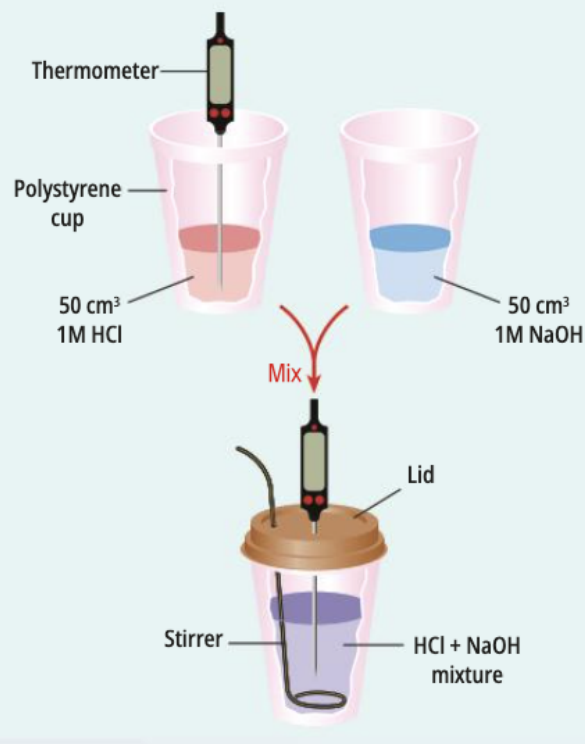
The experimental setup uses simple but effective equipment:
- Polystyrene cups - these act as an insulated calorimeter to prevent heat loss
- Thermometer - to measure temperature changes accurately
- Graduated cylinders - to measure exact volumes of solutions
- Stirrer - to ensure thorough mixing
- Lid - to minimise heat loss to the surroundings
The polystyrene cups are crucial because they have excellent insulating properties, ensuring that the heat produced by the reaction stays within the solution rather than escaping to the environment.
Method
Follow these steps carefully to get accurate results:
-
Preparation: Measure 50 cm³ of 1M hydrochloric acid using a graduated cylinder and place it in a polystyrene cup
-
Second solution: Measure 50 cm³ of 1M sodium hydroxide in a separate polystyrene cup
-
Temperature equilibration: Allow both solutions to stand until they reach the same temperature as the room
-
Initial readings: Record the initial temperature of each solution using the thermometer
-
Mixing: Quickly add the sodium hydroxide solution to the hydrochloric acid solution, being careful to avoid splashing
-
Sealing: Immediately place the lid on the cup containing the mixed solutions
-
Monitoring: Stir the mixture continuously and record the maximum temperature reached
The key is to work quickly but safely when mixing the solutions and to monitor the temperature carefully to catch the maximum reading.
Observations
Note
What You Will Observe:
During the experiment, you will observe:
- A rapid rise in temperature when the solutions are mixed
- The temperature reaches a maximum and then begins to decrease as heat is lost to the surroundings
- The solution may feel warm to the touch (but don't touch it directly!)
Calculations and formula
To calculate the enthalpy of reaction, we use the fundamental heat equation:
Where:
- = mass of solution in kg
- = specific heat capacity of solution in J kg⁻¹ K⁻¹
- = temperature rise in K or °C
Important values to remember:
- Mass of 100 cm³ of solution = 100 g = 0.1 kg (assuming density same as water)
- Specific heat capacity of the solution = 4060 J kg⁻¹ K⁻¹
- Temperature rise = maximum temperature - initial temperature
Example
Worked Example: Calculating Heat Released
If the temperature rises by 10°C:
Step 1: Identify the values
Step 2: Substitute into the formula
Step 3: Calculate the result
This heat is released when equal moles of acid and base react, so we can calculate the enthalpy per mole.
Important assumptions
Note
Key Assumptions Made:
When performing calculations, we make several key assumptions:
- All the heat generated goes towards raising the temperature of the solution
- No heat is absorbed by the polystyrene container (negligible heat capacity)
- No heat is lost to the surroundings (good insulation)
- The density of the solution is the same as pure water
- The specific heat capacity remains constant throughout the reaction
If the initial temperatures of the acid and base are different, use the average of the two temperatures as your starting point.
Common exam errors and tips
Important
Most Common Mistake: Forgetting to convert mass from grammes to kilogrammes when substituting into the formula. The specific heat capacity units include kg, so your mass must be in kg too!
Other Important Points:
- Always use the maximum temperature reached, not the final temperature
- Show all steps in your calculation clearly
- Include proper units throughout your working
- Remember that this is an exothermic reaction (heat is given out)
Sources of error
Note
Potential Sources of Error:
Your experimental result may differ from textbook values due to:
- Heat loss to the surroundings despite insulation
- Incomplete mixing of the solutions
- Reaction not going to completion
- Measurement errors in temperature or volume readings
- Heat absorption by the calorimeter itself
To Improve Accuracy:
- Work quickly to minimise heat loss
- Ensure thorough stirring for complete reaction
- Use more precise measuring equipment
- Repeat the experiment multiple times and take an average
Summary
Key Points to Remember:
- Purpose: Measure the enthalpy change when acid neutralises base by monitoring temperature rise
- Key equipment: Polystyrene cups provide insulation; thermometer measures temperature change precisely
- Formula: Heat given out = , where mass must be in kg
- Safety: Use 1M concentrated solutions with proper safety equipment due to corrosive nature
- Common error: Always convert grammes to kilogrammes before substituting into the heat equation