23 – Preparing & Investigating Ethene (LC 2027) (Leaving Cert Chemistry): Revision Notes
📚Revision Notes
23 – Preparing & Investigating Ethene
Introduction
Ethene is one of the most important organic chemicals in industry. It serves as a starting material for manufacturing many other substances, particularly plastics. In this experiment, you'll learn how to prepare ethene gas by removing water from ethanol (a process called dehydration) and then investigate its key properties.
Note
The reaction involves heating ethanol with aluminium oxide, which acts as a catalyst to speed up the dehydration process. This is classified as an elimination reaction because water is removed from the ethanol molecule.
Preparing ethene
Equipment and materials needed
- Boiling tube
- Glass wool
- Ethanol
- Aluminium oxide (Al₂O₃)
- Bunsen burner
- Delivery tube
- Water trough
- Test tubes for gas collection
- Retort stand and clamps
Safety precautions
Important
Before starting this experiment, remember these crucial safety points:
- Ensure the stopper on the boiling tube is air-tight to prevent gas leaks
- Never allow the Bunsen burner flame near the end of the delivery tube where gas escapes
- Wear gloves when handling glass wool to avoid cuts
- Be careful to avoid 'suck-back' - water being drawn back into the hot apparatus
Procedure steps
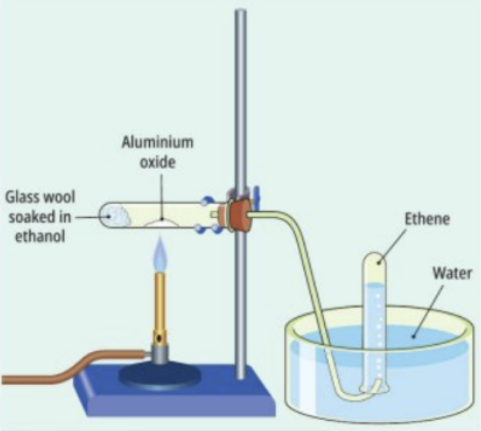
- Set up the apparatus, ensuring all connections are secure
- Prepare the reaction mixture by soaking glass wool in ethanol and placing it in the boiling tube along with aluminium oxide
- Heat the mixture gently using a Bunsen burner - the glass wool helps distribute the heat evenly
- Collect the gas by water displacement - bubbles of ethene gas will be visible as they collect in the inverted test tube
What happens during the reaction
Note
As the aluminium oxide becomes hot, it catalyses the breakdown of ethanol. The ethanol loses a water molecule to form ethene gas, which travels through the delivery tube and can be collected over water. If the temperature became too high, the ethanol would simply turn to vapour rather than being converted to ethene.
The chemical equation for this reaction is:
(with Al₂O₃ as catalyst)
Investigating ethene properties
Physical properties
Once you've collected ethene gas, you can observe its physical characteristics:
Note
Key Physical Properties:
- Colourless gas with no visible appearance
- Sweet smell that's quite distinctive
- Insoluble in water - this is why gas collection over water works effectively
Chemical properties - tests for unsaturation
Ethene contains a C=C double bond, making it an unsaturated hydrocarbon. You can test for this unsaturation using two main chemical tests:
Example
Test 1: Bromine Water Test
Procedure: Add a few drops of bromine water to a test tube containing ethene
Observation: The orange/brown colour of bromine water disappears rapidly
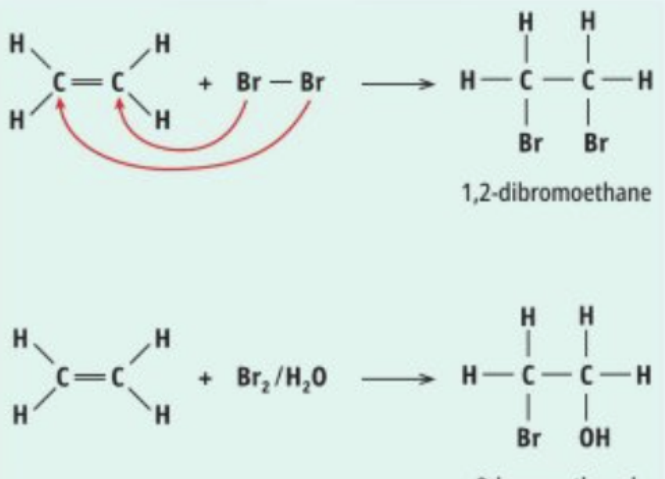
Explanation: This colour change shows that ethene has reacted with the bromine in an addition reaction. The bromine adds across the double bond to form 1,2-dibromoethane, which is colourless. This reaction is evidence of unsaturation in the molecule.
Example
Test 2: Acidified Potassium Permanganate Test
Procedure: Add dilute acidified potassium permanganate (KMnO₄) solution to ethene gas, stopper the test tube and shake gently
Observation: The purple colour changes to colourless
Explanation: This colour change from purple to colourless indicates the presence of unsaturation
Understanding the test results
Both tests work because alkenes (like ethene) are much more reactive than alkanes due to their C=C double bond. When bromine or permanganate is added, these reagents add across the double bond, causing the characteristic colour changes you observe.
Combustion of ethene
When ethene burns in air, you'll notice:
- A bright yellow flame that may appear slightly smoky
- The flame becomes clearer if you use a gas jar rather than a small test tube
- Limewater turns milky - this shows carbon dioxide is produced during combustion
The reaction produces carbon dioxide and water:
Exam tips
Summary
Key Points for Exams:
- Remember that ethene preparation is a dehydration reaction - water is removed from ethanol
- The aluminium oxide acts as a catalyst - it speeds up the reaction but isn't consumed
- Unsaturation tests are key - both bromine water and acidified permanganate turn from coloured to colourless
- Gas collection over water works because ethene is insoluble in water
- Always mention safety precautions in exam answers - particularly about preventing gas leaks and avoiding flames near the delivery tube
Summary
Summary
Essential Points to Remember:
- Ethene is prepared by dehydrating ethanol using aluminium oxide as a catalyst
- Physical properties: colourless gas with a sweet smell, insoluble in water
- Chemical tests for unsaturation: bromine water (orange to colourless) and acidified permanganate (purple to colourless) both show positive results
- Safety is crucial: prevent gas leaks, avoid flames near gas outlets, and be careful with hot glassware
- The double bond makes ethene reactive - this explains why it gives positive results in unsaturation tests