4 – Verifying the Law of Conservation of Mass (LC 2027) (Leaving Cert Chemistry): Revision Notes
📚Revision Notes
4 – Verifying the Law of Conservation of Mass
What is the law of conservation of mass?
The law of conservation of mass states that matter cannot be created or destroyed during a chemical reaction. This means the total mass of all reactants (starting materials) must equal the total mass of all products (substances formed). This fundamental principle helps us understand that atoms are simply rearranged during chemical reactions, not lost or gained.
Note
Verifying this law through practical experiments is essential because it demonstrates one of the most important principles in chemistry. When we can prove that mass stays constant during reactions, we confirm that chemical equations must be balanced and that atoms are conserved.
Experiment 1: Silver chloride precipitation
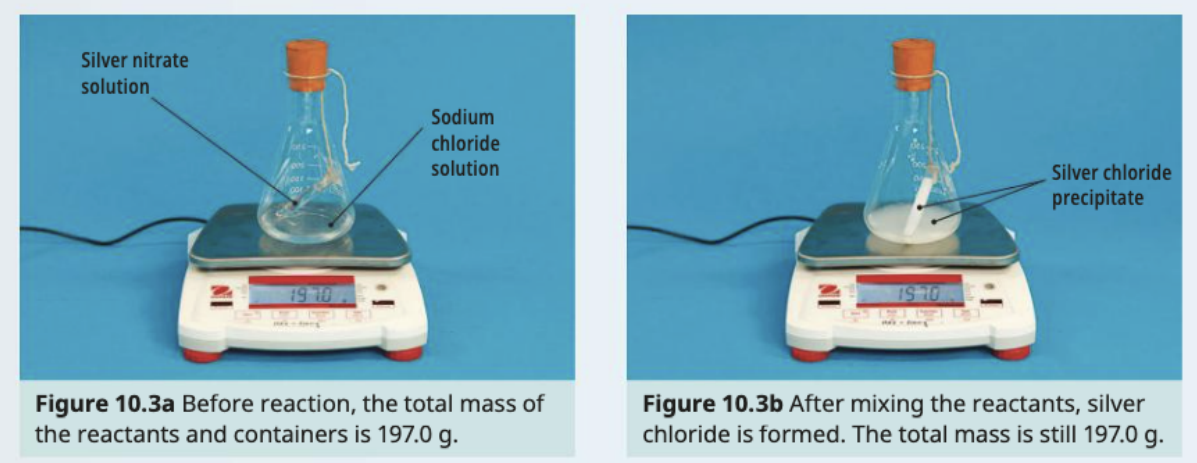
This classic experiment involves mixing silver nitrate solution with a solution containing chloride ions to form a white precipitate of silver chloride.
The chemical reaction
When silver ions (Ag⁺) meet chloride ions (Cl⁻), they form solid silver chloride:
This reaction produces a white precipitate that you can clearly see forming in the solution.
Experimental procedure and results
Example
Worked Example: Measuring Mass Conservation
The experiment uses a digital balance to measure the total mass before and after the reaction occurs. The flask containing both reactants is placed on the balance, and measurements are taken at two key points:
Step 1: Initial measurement
- Before reaction: Total mass = 197.0 g
Step 2: Final measurement
- After reaction: Total mass = 197.0 g (exactly the same!)
Conclusion: The results clearly show that despite the dramatic visual change (formation of white precipitate), the total mass remains completely unchanged.
This proves that no atoms were lost or gained during the chemical reaction.
Why the closed system matters
Important
This experiment works because it uses a closed system - a setup where nothing can enter or escape. The flask is sealed with a rubber stopper to prevent any materials from escaping as gases or vapours. Without this sealed system, we might lose some mass through evaporation, which would give us incorrect results.
Experiment 2: Alka-Seltzer reaction
The second experiment demonstrates conservation of mass using Alka-Seltzer tablets, which produce gas when dissolved in water.
The chemical reaction
When Alka-Seltzer dissolves in water, bicarbonate ions react with hydrogen ions to produce carbon dioxide gas:
This reaction is familiar to many students because you can see the fizzing and bubbling as carbon dioxide gas forms.
Experimental setup and observations
This experiment demonstrates a more challenging scenario because gas is produced. The key points include:
- Before reaction: The sealed container with Alka-Seltzer tablet and water has a specific mass
- During reaction: Vigorous bubbling occurs as CO₂ forms
- After reaction: The total mass remains the same when measured in the sealed system
The experiment shows that even when gas is produced, the law of conservation of mass still applies. The carbon dioxide gas remains trapped within the sealed container, so the total mass stays constant.
Accounting for buoyancy effects
Note
In some cases, you might notice tiny differences in mass readings due to the buoyancy effect. When gas bubbles form, they can slightly affect how the container sits on the balance. However, the overall mass of all materials (solid, liquid, and gas) remains exactly the same.
Key experimental considerations
Importance of closed systems
Important
Both experiments emphasise the crucial role of closed systems in verifying conservation of mass. A closed system prevents:
- Gas molecules from escaping into the atmosphere
- Water vapour from evaporating away
- Any external materials from entering the reaction vessel
Without proper sealing, apparent mass loss would occur, but this would be due to materials escaping rather than mass being destroyed.
Accurate mass measurements
Using precise digital balances is essential for detecting the conservation of mass. These sensitive instruments can measure mass to several decimal places, allowing us to confirm that mass truly remains constant during chemical reactions.
Choosing appropriate reactions
The experiments selected demonstrate conservation of mass in different types of reactions:
- Precipitation reactions (silver chloride formation) where a solid forms from dissolved ions
- Gas-producing reactions (Alka-Seltzer) where bubbles are created
This variety shows that conservation of mass applies to all types of chemical changes, regardless of the physical states involved.
Practical applications
Understanding conservation of mass helps chemists:
- Balance chemical equations correctly by ensuring equal numbers of each type of atom on both sides
- Calculate quantities needed for industrial chemical processes
- Predict yields from chemical reactions
- Identify errors in experimental procedures when mass appears to change
Summary
Key Points to Remember:
- Mass is conserved: The total mass of reactants always equals the total mass of products in any chemical reaction
- Closed systems are essential: Experiments must prevent any materials from entering or escaping to demonstrate conservation accurately
- Atoms rearrange: Chemical reactions involve rearranging atoms into new combinations, not creating or destroying them
- All reaction types follow the law: Whether forming precipitates, producing gases, or other changes, mass conservation applies universally
- Precise measurements matter: Sensitive balances are needed to detect that mass truly remains constant during reactions