5 – Investigating Decreases in Concentration (LC 2027) (Leaving Cert Chemistry): Revision Notes
📚Revision Notes
5 – Investigating Decreases in Concentration
Introduction to serial dilutions
Serial dilution is a fundamental technique in chemistry that allows us to create solutions of progressively lower concentrations from a single stock solution. This process is essential for understanding how concentration changes affect chemical properties and for preparing solutions of known concentrations for analysis.
In a serial dilution, we take a specific volume from one solution and dilute it to create the next solution in the series. Each step reduces the concentration by a fixed ratio, creating a predictable pattern of concentration decreases.
Note
The predictable nature of serial dilutions makes them invaluable in analytical chemistry, where precise control over concentration is crucial for accurate measurements and reproducible results.
Understanding dilution calculations
When performing dilutions, we follow a systematic approach to calculate the final concentrations. The key principle is that we're reducing the concentration by a known factor at each step.
Important
The fundamental principle of dilution: each dilution step divides the original concentration by the dilution factor. For a 1:10 ratio (taking 1 part solution and adding it to 9 parts water), the concentration becomes one-tenth of the original.
For example, if we start with a solution and dilute it using a 1:10 ratio, the concentration becomes one-tenth of the original. This process can be repeated multiple times to create a series of solutions with known concentration relationships.
The potassium permanganate experiment
Student Experiment No. 5 demonstrates serial dilution using potassium permanganate (KMnO₄) solution. This compound is ideal for this experiment because its distinctive purple colour allows us to visually observe the concentration changes.
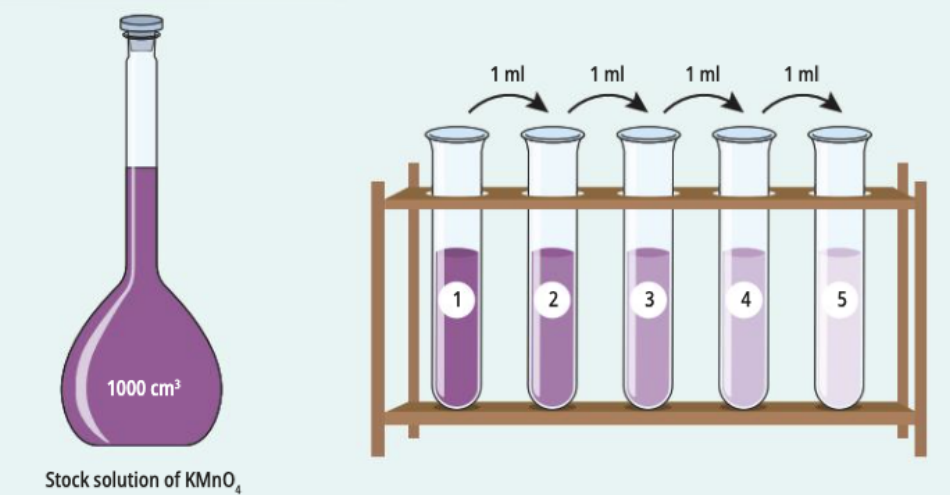
The experiment involves preparing a series of 1:10 serial dilutions of a stock potassium permanganate solution. Each dilution step creates a solution that is ten times more dilute than the previous one.
Key procedure steps
The experiment follows these essential steps:
Preparation phase:
- Start with a stock solution of potassium permanganate
- Prepare five clean test tubes in a rack
- Use graduated pipettes for accurate volume measurements
Dilution process:
- Take 1 cm³ of the stock solution and add it to 9 cm³ of distilled water in the first test tube
- Mix thoroughly to ensure homogeneous distribution
- From this first dilution, take 1 cm³ and add it to 9 cm³ of water in the second test tube
- Continue this process for all five test tubes
Documentation:
- Record observations about colour changes
- Calculate the concentration of each solution
- Note the visual progression from dark purple to light pink
Key observations
The most striking aspect of this experiment is the visual demonstration of concentration changes. As you progress through the serial dilutions, you can observe:
Note
Visual Progression Through Serial Dilutions:
The colour changes provide immediate visual feedback about the decreasing concentrations, making this abstract concept tangible and memorable for students.
- Test tube 1: Noticeably lighter purple than the stock solution
- Test tube 2: Further reduction in colour intensity
- Test tube 3: Continued lightening of the purple colour
- Test tube 4: Very pale purple or light pink
- Test tube 5: Almost colourless or very faint pink
This visual progression clearly demonstrates how serial dilution systematically reduces concentration, making the abstract concept of concentration decrease tangible and observable.
Concentration calculations
Each step in the serial dilution reduces the concentration by a factor of 10. If we start with a concentration of 0.05 M:
Example
Worked Example: Serial Dilution Concentration Calculations
Starting concentration:
Step-by-step calculations:
- Test tube 1: (original ÷ 10¹)
- Test tube 2: (original ÷ 10²)
- Test tube 3: (original ÷ 10³)
- Test tube 4: (original ÷ 10⁴)
- Test tube 5: (original ÷ 10⁵)
General formula: where is the concentration after dilution steps and is the original concentration.
This mathematical progression helps us understand the quantitative relationship between dilution steps and final concentrations.
Practical applications
Serial dilutions are widely used in:
- Analytical chemistry: Preparing standard solutions for analysis
- Quality control: Testing products at different concentration levels
- Research: Creating solutions with precise concentrations for experiments
- Medical laboratories: Preparing samples for testing and analysis
Note
Serial dilutions are particularly valuable when working with expensive reagents or when you need to create a wide range of concentrations from a single stock solution, saving both time and materials.
Exam tips
Important
Essential Exam Success Strategies:
When answering questions about serial dilutions:
- Always identify the dilution factor (usually 1:10)
- Show your calculation steps clearly
- Remember that each dilution step divides the concentration by the dilution factor
- Use the visual observations to support your understanding of concentration changes
- Practice calculating concentrations for multiple dilution steps
Remember!
Summary
Key Points to Remember:
- Serial dilution creates solutions of progressively lower concentrations by repeatedly diluting a stock solution using the same ratio
- Visual observation is powerful - the colour change in potassium permanganate clearly demonstrates concentration decreases
- Each 1:10 dilution step reduces concentration by a factor of 10 - making calculations predictable and systematic
- Accurate measurement is crucial - use graduated pipettes to ensure precise volumes for reproducible results
- This technique is widely applicable in analytical chemistry, research, and quality control processes