8 – Standardising a Sodium Hydroxide Solution (LC 2027) (Leaving Cert Chemistry): Revision Notes
📚Revision Notes
8 – Standardising a Sodium Hydroxide Solution
What is standardisation?
Standardisation is the process of determining the exact concentration of a solution by titrating it against a solution of known concentration. This technique is essential when working with solutions that cannot be prepared to an exact concentration.
Important
Why do we need to standardise sodium hydroxide?
Sodium hydroxide (NaOH) is deliquescent, which means it absorbs water vapour from the air so readily that it actually dissolves in the absorbed moisture. Because of this property, you cannot weigh out an exact amount of solid NaOH and expect to make a solution of precise concentration. The solid will have absorbed an unknown amount of water, making your calculations inaccurate.
To solve this problem, we prepare an approximate 0.1 M solution of sodium hydroxide, then determine its exact concentration by titrating it against hydrochloric acid of known concentration.
The chemical reaction
During the titration, the following neutralisation reaction occurs:
Note
The Neutralisation Equation:
This is a 1:1 molar ratio reaction, meaning one mole of hydrochloric acid neutralises exactly one mole of sodium hydroxide.
Equipment and setup
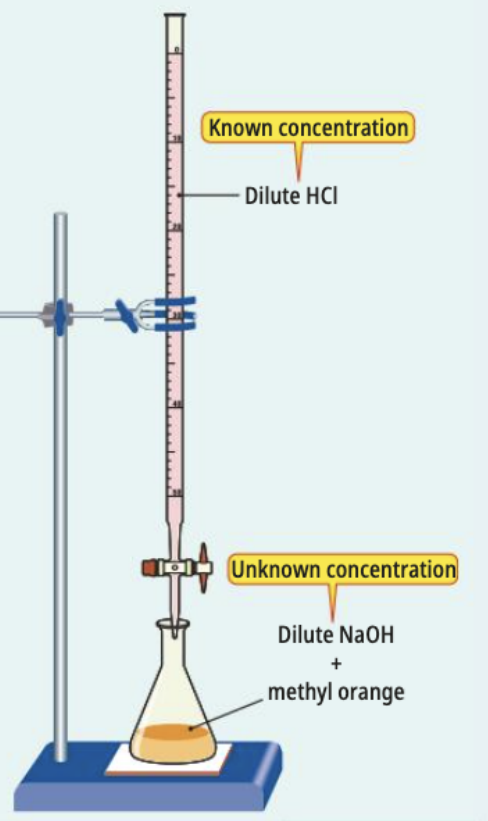
The titration setup includes:
- Burette - contains the standard HCl solution
- Conical flask - contains the NaOH solution being standardised
- Pipette - for measuring exact volumes of NaOH solution
- Volumetric flask - for preparing the approximate NaOH solution
- White tile - placed under the conical flask to help see colour changes
- Methyl orange indicator - shows the end point of the titration
Step-by-step procedure
Example
Worked Example: Complete Standardisation Procedure
Step 1: Preparation of sodium hydroxide solution
- Dissolve approximately 1 g of sodium hydroxide in deionised water
- Transfer to a 250 cm³ volumetric flask and make up to the mark with deionised water
- Invert the flask 20 times to ensure thorough mixing
Step 2: Setting up the titration 4. Rinse the pipette first with deionised water, then with some of the NaOH solution 5. Rinse the burette first with deionised water, then with some of the HCl solution 6. Pipette 25 cm³ of NaOH solution into a clean conical flask (previously rinsed with deionised water) 7. Add a few drops of methyl orange indicator to the NaOH solution 8. Fill the burette with standard HCl solution and adjust the meniscus to the zero graduation mark
Step 3: Carrying out the titration 9. Place a white tile under the conical flask to help observe colour changes 10. Titrate the NaOH solution against the standard HCl solution 11. Perform one rough titration followed by two accurate titrations that agree within 0.1 cm³
Observations
During the titration, you will observe that the methyl orange indicator changes colour from yellow to red (pink) when the end point is reached.
Explanation of colour change
The methyl orange changes from yellow to red because the solution in the conical flask becomes acidic at the end point. Initially, the solution is basic (due to excess NaOH), so the indicator appears yellow. When all the NaOH has been neutralised and a slight excess of HCl is added, the solution becomes acidic, causing the indicator to turn red.
Calculations
After completing your titrations, you need to:
- Calculate the average volume of HCl used (from your concordant results)
- Determine the exact molarity of the NaOH solution using the titration equation
- Express the concentration in both moles per litre and grammes per litre
The calculation uses the relationship: Moles of HCl = Moles of NaOH (due to the 1:1 ratio)
Important
Safety Considerations
⚠️ CAUTION: Sodium hydroxide is highly caustic. Do not allow it to come into contact with skin or eyes as it causes severe burns. Always wear safety goggles and handle with care.
Summary
Key Points to Remember:
- Standardisation determines exact concentration of solutions that cannot be prepared precisely
- Sodium hydroxide is deliquescent - it absorbs water from air, preventing exact preparation
- The reaction follows a 1:1 molar ratio - one mole of HCl neutralises one mole of NaOH
- Methyl orange changes from yellow to red at the end point when solution becomes acidic
- Always perform concordant titrations (results agreeing within 0.1 cm³) for accuracy