Answering Questions about Solutions (Leaving Cert Chemistry): Revision Notes
📚Revision Notes
Answering Questions about Solutions
When working with solutions in chemistry, you'll often need to perform calculations involving concentration, volume, and mass. Understanding how to convert between different units and apply fundamental principles will help you solve volumetric analysis problems confidently.
Converting between grammes per litre and moles per litre
Understanding molarity
Molarity (M) expresses concentration in moles of solute per litre of solution. This is the most common way to describe solution concentration in chemistry.
Key formula:
Converting grammes per litre to moles per litre
When you know the mass concentration (g/L), you can find the molar concentration using a systematic approach:
- Find the molecular mass of the compound
- Convert grammes to moles by dividing by molecular mass
- The result gives you molarity (mol/L)
Formula:
Example
Worked Example: Converting NaOH concentration
If you have sodium hydroxide (NaOH) at 3.68 g/L:
Step 1: Find the molecular mass of NaOH
- Na = 23, O = 16, H = 1
- Molecular mass = 23 + 16 + 1 = 40 g/mol
Step 2: Apply the conversion formula
- Molarity = 3.68 ÷ 40 = 0.092 M
Therefore, 3.68 g/L NaOH = 0.092 M NaOH
Converting moles per litre to grammes per litre
When you need to find mass concentration from molar concentration, the process is reversed:
- Multiply molarity by molecular mass
- This gives you the mass concentration in g/L
Formula:
Note
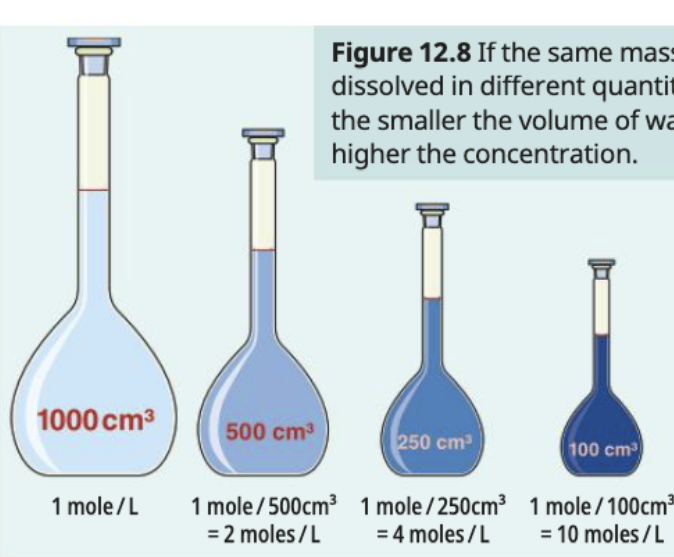
The relationship between solution volume and concentration is inverse - when the same amount of solute is dissolved in different volumes, smaller volumes create higher concentrations.
Using first principles for solution calculations
The fundamental approach
First principles calculations involve breaking down problems using basic definitions rather than memorising complex formulas. This approach helps you understand the underlying chemistry and adapt to different question types.
Key relationship:
Note
This formula works because:
- Molarity tells us moles per 1000 cm³ (1 litre)
- We scale this down for smaller volumes
Step-by-step method
The systematic approach ensures accuracy and understanding:
- Identify what you know: volume, concentration, molecular mass
- Identify what you need: usually moles, mass, or concentration
- Apply basic definitions: use the relationship between moles, mass, and concentration
- Work systematically: show each calculation step clearly
Practical applications
This method works for calculating:
- Number of moles in a given volume of solution
- Mass of solute needed to make a specific concentration
- Volume required to obtain a certain number of moles
Calculating solution volumes
Using molarity to find volume
When you know the number of moles needed and the concentration available, you can calculate the required volume using the rearranged molarity equation.
Rearranged formula:
Important
Unit Conversion Alert
Always check your units carefully:
- Volume can be given in cm³, mL, or litres
- 1 litre = 1000 cm³ = 1000 mL
- When using molarity, volume must be in litres or you must adjust the calculation using the factor 1000
Working with small volumes
In practical chemistry, you often work with small volumes (like 25 cm³ portions). Remember:
- Small volume = (Total volume × fraction taken)
- Concentration remains the same regardless of volume taken
- Number of moles decreases proportionally with volume
Reactions between solutions and solids
Understanding stoicheiometry in solution reactions
When solids react with solutions, you need to consider multiple factors to solve the problem correctly:
- The balanced chemical equation
- The molarity of the solution
- The volume of solution used
- The molar ratios from the equation
Calculation strategy
Follow this systematic approach for solution-solid reactions:
- Write the balanced equation
- Calculate moles of solution reactant: use volume and molarity
- Use molar ratios: determine moles of solid that will react
- Convert to mass: multiply moles by molecular mass
Key considerations
Understanding these principles is essential for accurate calculations:
- The limiting reagent determines how much product forms
- Solution volume affects the number of moles available for reaction
- Stoichiometric ratios from balanced equations are essential
Essential formulas summary
Basic relationships:
Conversion formulas:
For reactions:
- Use balanced equations for molar ratios
- Calculate moles in solution first, then apply stoicheiometry
Summary
Key Points to Remember:
- Always check units - convert cm³ to litres when necessary, or use the factor of 1000 in your calculations
- Molecular mass is crucial - you need accurate molecular masses for all conversions between mass and moles
- First principles work best - break complex problems into simple steps using basic definitions
- Stoichiometry applies to solutions - use balanced equations and molar ratios for reaction calculations
- Practice with worked examples - familiarise yourself with the calculation patterns for exam success