Material Properties (Leaving Cert Engineering): Revision Notes
📚Revision Notes
Material Properties
Understanding what makes materials strong or weak
Materials behave differently under various conditions due to their unique properties. These characteristics determine how materials respond to forces and environmental factors. Understanding these properties helps engineers select the right materials for specific applications.
Note
Why Material Properties Matter
The success or failure of any engineering project often depends on choosing materials with the right combination of properties. A material that works perfectly in one application might be completely unsuitable for another.
Physical and mechanical properties
Hardness
Hardness refers to a material's ability to resist scratching, indentation, or surface damage.
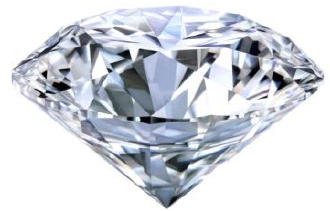
This property becomes crucial when considering wear and tear in mechanical systems. Car gearboxes contain meshing gears that must resist wearing away during operation. Materials lacking sufficient hardness will deteriorate quickly under these conditions. However, extremely hard materials can become brittle, potentially splintering or shattering like glass under impact.
Important
The Hardness-Brittleness Trade-off
Remember that extremely hard materials often become brittle. This means they can shatter or splinter under impact, like glass. Engineers must balance hardness requirements with toughness needs.
Toughness
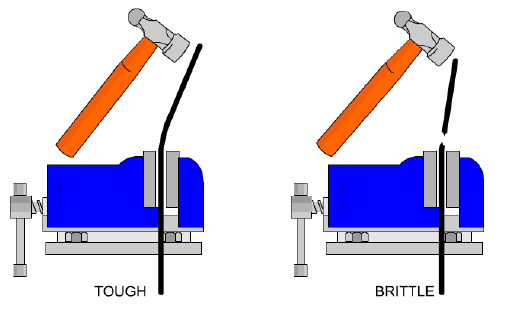
Toughness describes how well a material can absorb impact energy without fracturing.
Engineering components frequently experience impacts of varying intensity. Vehicle suspension systems and bicycle frames encounter repeated impacts when travelling over rough surfaces. Materials lacking adequate toughness may fail catastrophically under these conditions. Generally, tougher materials tend to be softer than very hard materials, creating a design trade-off between hardness and toughness.
Note
Impact vs Static Loading
Toughness specifically relates to impact resistance - how materials handle sudden, high-energy forces. This is different from static strength, which deals with gradual, steady forces.
Ductility
Ductility measures a material's capacity to be stretched or drawn into wire-like shapes without breaking.
Metals demonstrate varying degrees of ductility. Copper and aluminium can stretch considerably before fracturing, whilst cast iron exhibits brittle behaviour with minimal stretching capability. Materials fail through two main mechanisms: sudden brittle fracture (snapping) or gradual ductile fracture (stretching then breaking). Ductility relates closely to malleability - the ability to hammer or shape materials without fracturing.
Note
Ductile vs Brittle Failure
- Ductile failure: Material stretches and deforms before breaking, giving warning signs
- Brittle failure: Material snaps suddenly without warning, often catastrophically
Elasticity
Elasticity represents a material's ability to return to its original dimensions after deformation forces are removed.

Elastic bands exemplify this property clearly, but all materials exhibit some degree of elasticity. Steel beams can flex under loading but spring back when forces are removed. Each material has an elastic limit beyond which permanent deformation occurs. Exceeding this limit results in either permanent deformation or complete failure.
Important
Understanding the Elastic Limit
The elastic limit is a critical threshold. Below this limit, materials return to their original shape. Above it, permanent damage occurs. Always ensure design loads stay well below this limit.
Thermal and electrical properties
Conductivity
Conductivity describes how readily materials allow heat or electricity to flow through them.

Electrical conductivity becomes extremely important in electrical applications. Gold provides excellent conductivity but cost prohibits widespread use, making copper the preferred alternative for most applications. Materials that don't conduct electricity are termed insulators. Polymers typically function as good insulators, which explains why electrical tool casings use insulating polymers to prevent electrical shock during operation.
Note
Material Selection for Conductivity
While gold is the best conductor, copper offers the best cost-performance balance for most electrical applications. Silver is also excellent but expensive, while aluminium is cheaper but has higher resistance.
Glass transition temperature
Glass transition temperature indicates the temperature at which materials change from brittle, glass-like behaviour to soft, flexible behaviour.
All materials exhibit some flexibility and ductility at room temperature. Raising temperature generally increases flexibility and softness. Conversely, lowering temperature makes materials more brittle. This transition temperature varies between different materials and becomes critical when designing components for extreme temperature environments such as Arctic exploration or aerospace applications.
Note
Temperature Effects on Material Behaviour
Understanding how temperature affects your chosen materials is crucial for applications in extreme environments. What works at room temperature might fail completely at -40°C or +200°C.
Strength and resistance properties
Tensile strength
Tensile strength measures the maximum pulling force a material can withstand before fracturing.
This property is measured in (kilonewtons per square millimetre), representing the force applied per unit cross-sectional area. Steel demonstrates relatively high tensile strength, making it suitable for load-bearing cables in cranes. Softer materials like copper and aluminium exhibit lower tensile strength values.

Example
Tensile Strength Calculation
If a steel cable has a cross-sectional area of 10 mm² and a tensile strength of 400 kN/mm²:
Maximum load = Tensile strength × Cross-sectional area Maximum load = 400 kN/mm² × 10 mm² = 4000 kN
This cable could theoretically support 4000 kN (approximately 400 tonnes) before breaking.
Fatigue resistance
Fatigue resistance indicates how well materials withstand repeated loading cycles over extended periods.
A material might resist fracture under a small force applied once. However, repeatedly applying and removing this same force over time can initiate small cracks that gradually grow until complete fracture occurs. This process resembles materials becoming 'tired' from constant stress application.
Important
The Danger of Fatigue Failure
Fatigue failure is particularly dangerous because it can occur at loads well below the material's normal strength limit. Small, repeated stresses cause microscopic cracks that grow over time until sudden catastrophic failure occurs.
Creep resistance
Creep resistance measures a material's ability to maintain its shape under constant loading over long periods.
Unlike fatigue (repeated on/off loading), creep occurs under steady, continuous loads. Steel cables supporting heavy loads over extended periods may gradually stretch, becoming thinner and weaker. This gradual deformation eventually leads to failure if the load exceeds the material's creep resistance.
Note
Creep vs Fatigue
- Creep: Gradual deformation under constant, steady loads over time
- Fatigue: Failure due to repeated loading and unloading cycles
Nature of forces acting on materials
Materials fail when specific forces exceed their resistance capabilities. Forces vary in both magnitude (strength) and nature (how they act). Understanding different force types helps engineers select appropriate materials and design effective compromises.
Tension (tensile force)
Tension occurs when opposing forces create a pulling effect on materials.
Metals generally demonstrate good tensile resistance, making steel suitable for load-bearing cables that lift heavy loads. However, materials like concrete perform poorly under tension and fracture easily even under minor tensile loads.
Important
Material-Force Matching
Different materials excel under different force types. Steel is excellent in tension, concrete excels in compression. Never assume a material that's strong in one direction will be strong in all directions.
Compression (compressive force)
Compression results when opposing forces create a squeezing effect on materials.
Although concrete performs poorly in tension, it excels under compressive loading. Building load-bearing walls demonstrate concrete's excellent compressive capabilities.
Bending force
Bending forces are more complex, incorporating both tension and compression simultaneously.
During bending, one side of the material experiences compression whilst the opposite side experiences stretching (tension). Bridge construction exemplifies this complexity, often requiring reinforced concrete - a combination of traditional concrete with embedded steel rods or mesh. This arrangement allows concrete to handle compressive loads whilst steel manages tensile loads.
Note
Why Reinforced Concrete Works
Reinforced concrete is brilliant because it combines the compressive strength of concrete with the tensile strength of steel. Each material does what it does best, creating a superior composite material.
Torsion (twisting force)
Torsion involves two twisting forces acting in different directions on the same component.
Automotive engineering frequently encounters torsional forces. Engine drive shafts transfer rotary power to wheels, but resistance (such as climbing hills) creates opposing twisting forces that could cause shaft failure without adequate torsional strength.
Shear force
Shear forces occur when opposing forces act on different planes within a material.
Scissors demonstrate shear action clearly - one blade presses paper down whilst the other presses up, causing the paper to shear apart. Engineering bolts and shafts may experience shear failure when excessive forces act upon them.
Summary
Key Points to Remember:
- Material properties determine how materials behave under different conditions and help engineers select appropriate materials for specific applications
- Physical properties like hardness, toughness, ductility, and elasticity describe how materials respond to mechanical forces and deformation
- Conductivity and glass transition temperature are crucial for electrical and temperature-sensitive applications
- Strength properties like tensile strength, fatigue resistance, and creep resistance determine how materials perform under various loading conditions over time
- Different force types (tension, compression, bending, torsion, shear) affect materials in unique ways, requiring careful consideration in engineering design
- No single material is perfect - engineering design involves selecting the best compromise between different properties
- Temperature and time effects can dramatically change how materials behave under stress